












































































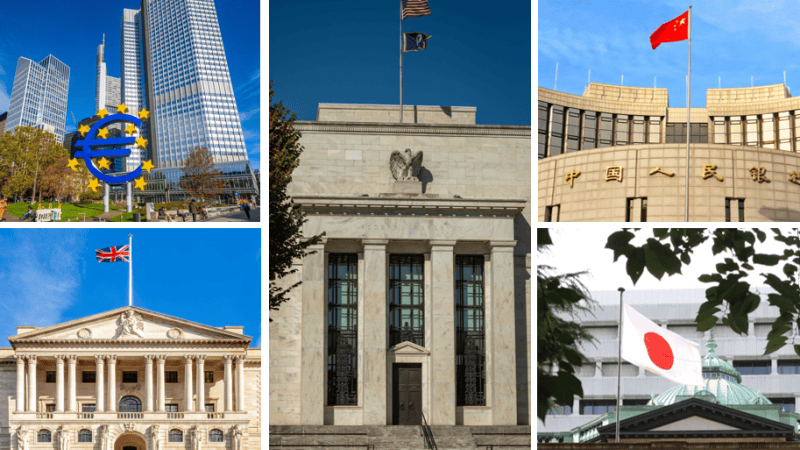
Major central banks across the world’s advanced economies are moving toward tighter monetary policy as a surge in energy prices threatens to prolong inflation and complicate the outlook for interest rates.
The Federal Reserve shifted toward a more restrictive policy stance on Wednesday, raising interest rates and signalling further increases may be needed to bring inflation down more quickly. The move came as financial markets continued to price in a more aggressive tightening cycle than projected by the Fed’s own forecasts.
Economists, however, warn that investors may be overestimating the scale of future rate increases, particularly as higher energy costs could weaken economic growth and eventually reduce inflationary pressure.
Concerns have intensified following developments in the Middle East, including the seizure of a strategic section of the Red Sea coastline by Houthi forces, which has raised fears of a broader escalation and further disruption to energy supplies.
Here is where the major central banks in the Group of 10 developed economies stand, based on their current policy rates.
1. Australia
The Reserve Bank of Australia has raised interest rates three times this year, taking its benchmark rate to 4.35% and reversing all of last year’s rate cuts.
The prospect of another increase remains strong after inflation accelerated more than expected in July. The central bank’s deputy governor has indicated that policymakers will consider the case for another hike at their meeting later this month.
Financial markets are broadly positioned for another rate increase.
2. Norway
Norges Bank’s policy rate stands at 4.25%, among the highest in the G10, although the central bank appears to be approaching the end of its tightening cycle.
The bank left rates unchanged in August and noted that inflation had moderated. Economic growth also slowed more than expected in the second quarter, expanding by just 0.3%.
Markets are nevertheless pricing in one additional quarter-point increase before the end of the year.
3. Britain
The Bank of England held its interest rate at 3.75% on Thursday, in line with expectations.
Three members of the Monetary Policy Committee voted for a rate increase, matching the number of dissenters at the previous meeting.
Policymakers remain concerned about inflation. Governor Andrew Bailey warned that a prolonged conflict in the Middle East could push the bank toward tighter monetary policy.
Markets were pricing in at least one more BoE rate increase this year, with the possibility of another.
4. United States
The Federal Reserve raised interest rates and indicated that additional tightening could follow.
The decision also eased concerns about the central bank’s commitment to fighting inflation amid pressure from President Donald Trump for lower borrowing costs.
Fed policymakers currently project one more rate increase in 2026, followed by no further hike in 2027. Traders are taking a more aggressive view, pricing in more than one increase this year and roughly three additional moves by the end of 2027.
The divergence highlights the uncertainty surrounding the path of U.S. monetary policy.
5. New Zealand
The Reserve Bank of New Zealand raised its policy rate to 2.75% earlier this month, marking its second consecutive increase.
The move was widely anticipated, although policymakers indicated that any further tightening would likely be gradual as risks to economic growth increase.
Recent economic data showed stronger-than-expected growth, suggesting that the economy remains resilient. Markets are pricing in at least one additional rate increase before the end of the year.
6. Euro Zone
The European Central Bank raised interest rates for the second time this year and adopted a hawkish tone as higher energy prices add to inflation concerns.
Markets are pricing in at least one further increase before the end of the year and expect the ECB’s deposit rate to move above 3% in 2027.
Some economists, however, believe the energy shock could weaken economic growth and ultimately help ease inflationary pressures heading into next year.
7. Canada
The Bank of Canada kept interest rates unchanged earlier this month, but Governor Tiff Macklem said the central bank could raise rates several times if inflation remains elevated.
His comments represented a shift from earlier guidance that inflation risks and risks to economic growth were broadly balanced.
Since then, signs of a cooling labour market have emerged, while trade tensions with the United States continue to cloud Canada’s economic outlook.
Markets nevertheless expect another rate increase by the end of the year.
8. Sweden
Sweden’s Riksbank remains among the more cautious central banks in the G10.
The bank is expected to leave its policy rate at 1.75% when it meets later this month, after August inflation came in below expectations.
Despite the softer inflation data, financial markets still expect rates to rise later this year.
9. Japan
The Bank of Japan is expected to raise its policy rate to 1.25% at a closely watched meeting later this week.
Investors will be focused not only on the decision but also on how strongly policymakers signal further tightening.
Economists surveyed by Reuters expect the rate to reach 1.75% in the second quarter of 2027, sooner than previously anticipated.
Markets are also watching for potential repatriation flows from Japan’s Government Pension Investment Fund as higher domestic yields make Japanese assets more attractive.
10. Switzerland
The Swiss National Bank is widely expected to keep its key interest rate at 0% when it meets on September 24, with markets anticipating that the rate could remain there well into next year.
A recent rise in consumer prices and stronger economic growth have increased speculation about an earlier policy shift.
However, the strength of the Swiss franc has helped contain inflation, reducing pressure on the central bank to tighten monetary policy.
Source: Reuters