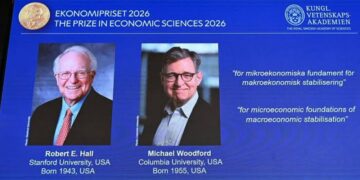












































































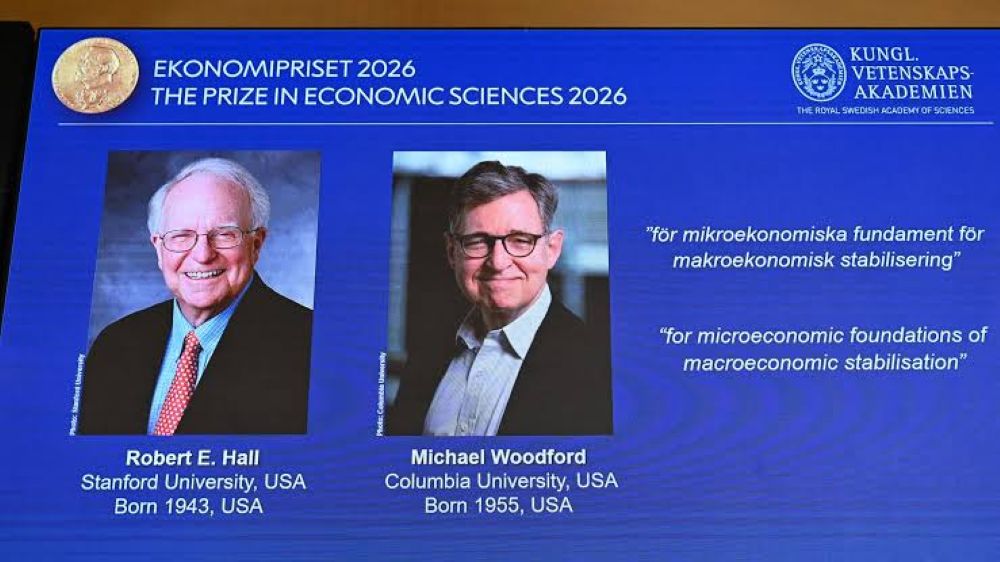
American economists Robert Hall and Michael Woodford have won the 2026 Nobel Prize in Economic Sciences for their work on the theoretical foundations of macroeconomic stabilization, the Royal Swedish Academy of Sciences announced on Monday.
The laureates were recognized for developing economic models that have improved the understanding of how governments and central banks can use monetary and fiscal policies to limit damaging fluctuations in economic activity.
The prize, formally known as the Sveriges Riksbank Prize in Economic Sciences in Memory of Alfred Nobel, carries an award of 12 million Swedish kronor, equivalent to approximately $1.2m. It is the final Nobel award to be announced this year.
The academy said Hall and Woodford’s research had strengthened the theoretical basis for designing policies that help economies respond to sudden disruptions, including energy crises and unexpected changes in household spending.
John Hassler, chair of the Committee for the Prize in Economic Sciences, said the economists’ work had established a reliable foundation for models now used by central banks and governments around the world.
“With them, we are better equipped to deal with shocks in the economy, such as energy crises or sudden changes in how much households consume,” Hassler said.
Their work focuses on the relationship between individual economic decisions and the wider performance of the economy, helping policymakers better assess when and how to intervene during periods of instability.
Economics prize has a distinct history
The economics award was first presented in 1969 and differs from the original five Nobel Prizes established under the will of Swedish industrialist Alfred Nobel, who invented dynamite.
Instead, it was created by Sweden’s central bank, Sveriges Riksbank, in memory of Nobel.
American researchers have dominated the list of previous winners. However, women remain significantly underrepresented, with only three having received the economics prize. The most recent was Claudia Goldin, who won in 2023 for research examining the effects of gender on wages and employment in the United States over time.
Ahead of this year’s announcement, analysis by the Institute for Scientific Information, part of Clarivate, identified researchers working on monetary policy, the economics of information technology and evolutionary economic theory as possible candidates for the award.
Last year’s prize went to Joel Mokyr, Philippe Aghion and Peter Howitt for their work on “creative destruction”, which examines how technological advances and new production methods drive economic growth and improve living standards.
The 2026 economics award concludes this year’s Nobel announcements. The prizes for medicine, physics, chemistry, literature and peace were announced last week.