













































































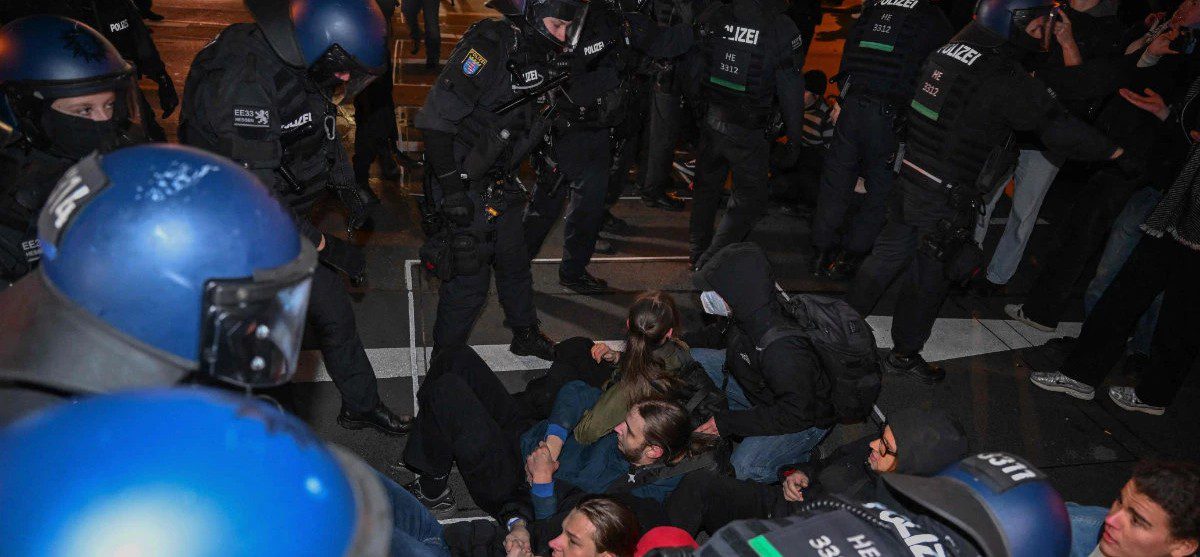
Violence broke out in Frankfurt on Saturday night as hooded demonstrators looted shops and damaged businesses during nationwide protests by young people demanding improved education, lower living costs and greater investment in public services.
The demonstrations, organized by the campaign group Gen Z regelt, meaning “Gen Z takes charge”, were held in 34 German cities, including Berlin, Munich and Frankfurt. They formed part of a wider wave of youth-led protests across Europe, where young people have been calling for political and economic reforms.
In Frankfurt, at least two stores were looted, while several other shops were damaged as police struggled to restore order, a Reuters witness reported.
The city’s police department said violent incidents were still ongoing, with shop windows smashed and Molotov cocktails thrown at emergency workers. Officers urged residents and visitors to stay away from the city centre or leave the area.
Although organizers had projected a turnout of 182,000, figures released by Saturday afternoon indicated that participation was lower. Police in Frankfurt, Munich and Berlin estimated that up to 18,000 people had taken part, compared with about 36,000 listed on the organizers’ website.
German authorities said most demonstrations had remained peaceful but warned that extremist groups could attempt to exploit the rallies. In Hamburg, some barricades were set on fire.
The campaign opposes compulsory military service and is demanding increased funding for schools, universities, healthcare and other public services. It also wants a fairer distribution of economic and social responsibilities.
Speaking at a rally in Berlin, the group’s spokesperson, Lina Friedrich, said young people were demonstrating for peace and freedom rather than war and coercion. She called for better support for education and healthcare and rejected compulsory military service.
Businesses take precautions amid fears of unrest
The possibility of violence prompted businesses in several German cities to take precautionary measures, including boarding up windows and closing early. Some luxury retailers along Berlin’s Kurfürstendamm shopping boulevard secured their premises ahead of the demonstrations.
Roman Poseck, interior minister for the state of Hesse, which includes Frankfurt, warned against a repeat of the violence witnessed during recent protests in France.
He cited incidents involving looting, arson and attacks on police officers, saying France should not be treated as an example for Germany.
The federal interior ministry also said far-left extremist groups and some organizations linked to foreign extremist movements had joined efforts to mobilize support for the demonstrations.
The protests come as Germany struggles to restore economic growth while facing mounting pressure on pensions and public services. The retirement of the baby-boomer generation and a shrinking working-age population have added to concerns about the country’s ability to meet future demands.
Young demonstrators say they are increasingly burdened by rising living costs and cuts to services, while schools and universities continue to struggle with inadequate facilities and funding.
An 18-year-old protester identified as Steve, who was due to address a rally in Munich, accused Chancellor Friedrich Merz’s government of ignoring young people’s concerns and placing further burdens on them.
He said the demonstrations would continue until the government addressed their demands.
However, questions have emerged over the campaign’s leadership and how representative it is of young people, given the involvement of different political and civil society groups.
Germany’s national umbrella organization for school students, BSK, has distanced itself from Gen Z regelt and announced plans to organize a separate protest on November 20.
Sean Baker, a student at the Technical University of Berlin, said he joined Saturday’s demonstrations to draw attention to the poor condition of university buildings.
He described parts of the campus as looking abandoned, despite students being expected to use the facilities regularly.
The protests follow youth-led movements in other European countries, including Serbia, where student activism contributed to an electoral setback for the country’s longtime ruling leadership, and France, where demonstrations over economic and social grievances have been accompanied by episodes of rioting and looting.