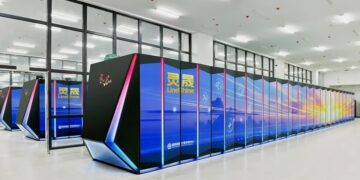












































































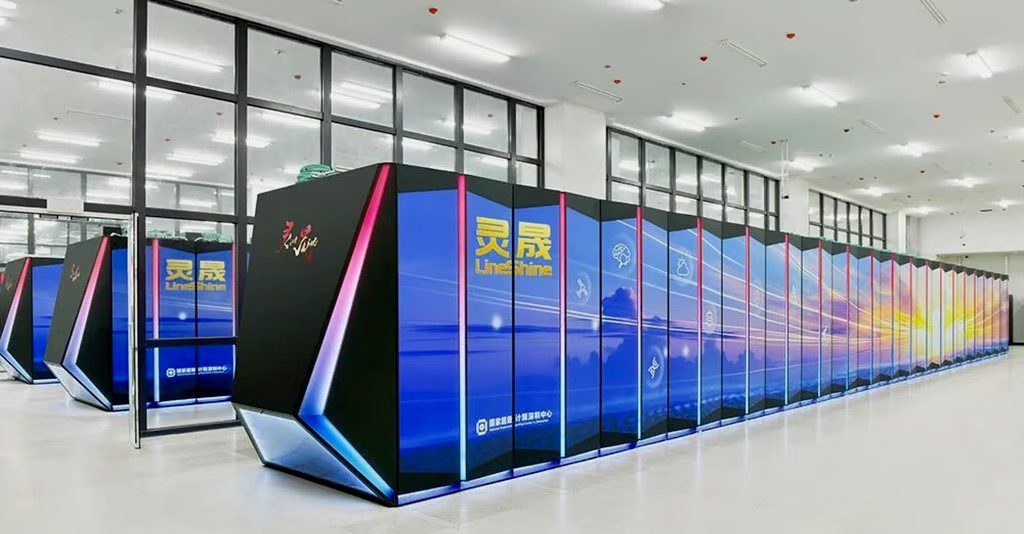
China has regained the crown in the global supercomputing race after unveiling the world’s fastest publicly ranked supercomputer, ending nearly a decade of United States dominance in one of the most closely watched indicators of technological advancement.
The newly introduced LineShine supercomputer, housed at China’s National Supercomputing Center in Shenzhen, claimed the top position in the latest Top500 global rankings released on Tuesday, replacing the United States’ El Capitan, which now slips to second place.
The achievement marks the first time since 2017 that a Chinese system has occupied the summit of the influential rankings, widely regarded as a benchmark for national leadership in advanced computing and scientific research.
According to the Top500 project, LineShine delivers an unprecedented 2.198 exaflops of computing performance, enabling it to execute more than 2.2 quintillion calculations every second.
Unlike most of today’s cutting-edge artificial intelligence systems, LineShine relies entirely on conventional central processing units (CPUs) rather than graphics processing units (GPUs), which have become the preferred architecture for AI computing.
The machine consumes approximately 42.2 megawatts of electricity, reflecting the enormous energy demands required to power next-generation supercomputers.
Strategic technology race
The latest rankings underscore the growing technological rivalry between China and the United States, with both countries investing billions of dollars in advanced computing capabilities viewed as critical to economic competitiveness, national security and scientific innovation.
Supercomputers perform calculations more than a thousand times faster than conventional computers and are used for highly complex tasks ranging from medical research and climate modelling to artificial intelligence development, nuclear simulations, aerospace engineering and advanced weapons testing.
The United States continues to dominate the upper tier of the rankings despite losing the top spot.
El Capitan, located at the Lawrence Livermore National Laboratory in California, now ranks second, followed by two other American systems based at national laboratories in Tennessee and Illinois.
Germany’s Jupiter supercomputer occupies fifth place, making it Europe’s highest-ranked system. Together, the top five represent the only publicly verified exascale supercomputers currently operating worldwide.
Italy, Switzerland and Japan also feature among the world’s ten most powerful computing systems.
Europe accelerates AI ambitions
The latest rankings come as governments around the world intensify investments in high-performance computing to strengthen their artificial intelligence capabilities.
The European Union recently announced a €20 billion initiative to establish a network of AI “gigafactories” equipped with next-generation supercomputers capable of supporting the development of increasingly sophisticated AI models.
The proposed facilities are expected to support breakthroughs in healthcare, biotechnology, robotics, advanced manufacturing and scientific discovery.
While today’s leading AI computing centres typically operate with about 25,000 advanced AI processors, the planned gigafactories are expected to deploy more than 100,000 processors each, significantly expanding Europe’s computational capacity.
Environmental concerns remain
Despite their growing importance, supercomputers and AI data centres continue to attract criticism over their enormous energy and water requirements.
Many facilities consume tens of megawatts of electricity and require extensive cooling systems that place significant pressure on water resources.
European officials have said future AI infrastructure will be designed to operate primarily on renewable energy while incorporating water recycling systems to reduce environmental impact.
Environmental campaigners, however, continue to warn that the rapid expansion of energy-intensive computing infrastructure could undermine global efforts to reduce carbon emissions unless accompanied by major investments in clean energy generation.
UK and Australia maintain presence
The United Kingdom has 11 supercomputers on the latest Top500 list, with the Isambard-AI system at the University of Bristol remaining the country’s highest-ranked machine in 11th place, despite dropping two positions since the previous rankings.
Australia has four systems on the list, led by Western Australia’s Setonix, which ranks 86th globally.
China’s return to the top of the rankings is expected to further intensify competition among the world’s major economies as advanced computing increasingly becomes central to artificial intelligence development, scientific research and strategic technological leadership.