













































































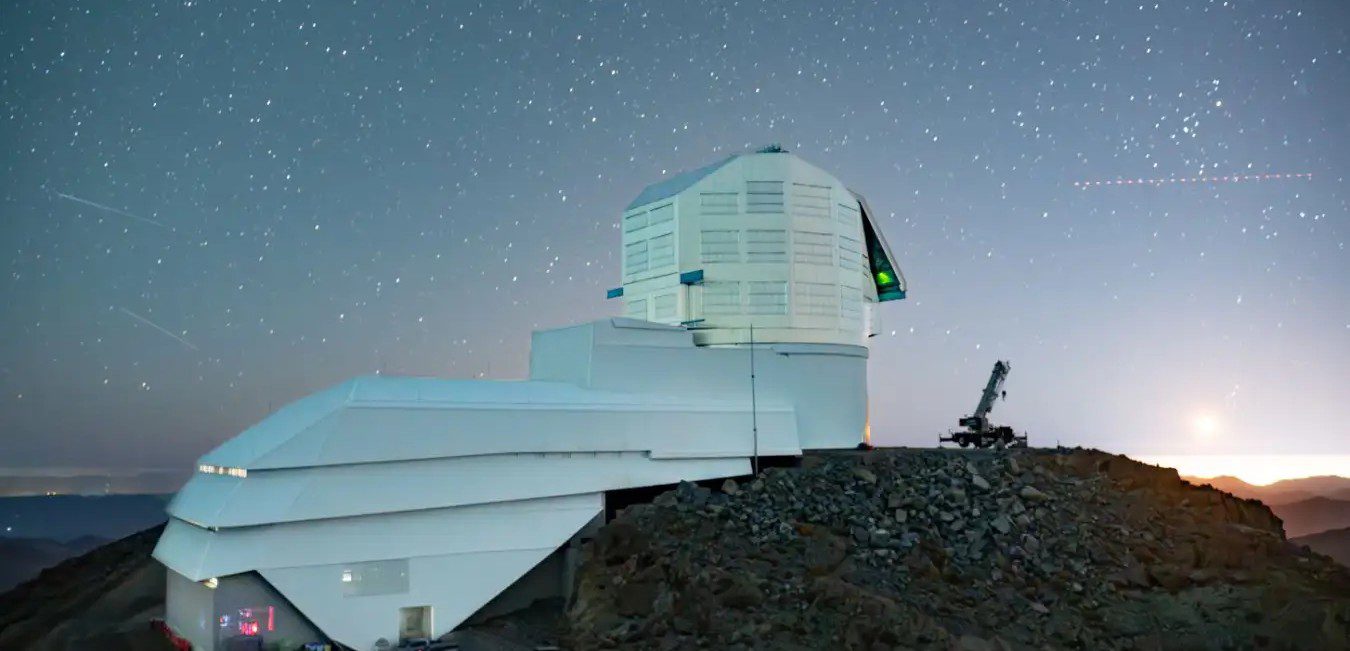
The Vera C. Rubin Observatory has officially launched one of the most ambitious astronomical projects ever undertaken, marking the beginning of a 10-year mission to create an unprecedented record of the southern night sky.
The initiative, known as the Legacy Survey of Space and Time (LSST), commenced this week from the observatory’s mountaintop facility on Cerro Pachón in northern Chile. Scientists expect the project to reshape humanity’s understanding of the universe by capturing vast amounts of data on galaxies, stars, asteroids and other celestial objects.
At the heart of the observatory is the world’s largest digital astronomical camera, weighing about 6,600 pounds and capable of producing ultra-high-resolution images. Every 40 seconds throughout each night of observation, the camera will photograph a different section of the sky, eventually compiling an extensive visual record of cosmic activity over the next decade.
Researchers say the continuous observations will enable astronomers to monitor changes across the universe in unprecedented detail, from the movement of near-Earth asteroids to the explosion of distant stars and the evolution of galaxies.
Unlike traditional telescopes that observe selected targets, the Rubin Observatory will repeatedly scan the entire southern sky every few nights. By revisiting the same regions hundreds of times over the survey period, scientists hope to create a dynamic timeline showing how astronomical objects change over time.
The project is expected to generate one of the largest scientific datasets ever assembled in astronomy. Millions of alerts identifying significant celestial events, including supernova explosions, variable stars, asteroid movements and other transient phenomena, will be issued every night, allowing observatories around the world to conduct follow-up observations.
Artificial intelligence and advanced machine-learning systems will play a central role in analyzing the enormous volume of information generated during the survey, helping researchers identify unusual events and previously unknown objects.
Scientists also expect the survey to advance efforts to understand some of the universe’s greatest mysteries, including the nature of dark matter and dark energy. By mapping billions of galaxies and studying how their light is affected by gravity, researchers hope to gain new insights into the invisible forces believed to shape the cosmos.
Beyond deep-space research, the observatory is also expected to significantly improve the catalogue of objects within the Solar System, including potentially hazardous asteroids and other small celestial bodies.
The Rubin Observatory is jointly funded by the United States National Science Foundation and the Department of Energy. Built at an altitude of more than 2,600 metres in Chile’s Atacama region, the site was selected for its exceptionally dark skies and favourable atmospheric conditions, making it one of the world’s premier locations for astronomical observations.
Although the survey was initially expected to begin earlier, project teams completed additional technical testing and system optimization before formally commencing scientific operations.
Over the next 10 years, the observatory is expected to collect trillions of astronomical measurements involving billions of celestial objects, creating one of the most comprehensive digital maps of the universe ever produced.
Astronomers believe the unprecedented dataset will not only support decades of scientific research but also make a vast archive of astronomical information available to researchers worldwide, potentially leading to discoveries that are impossible with current observing methods.