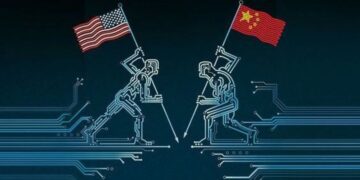











































































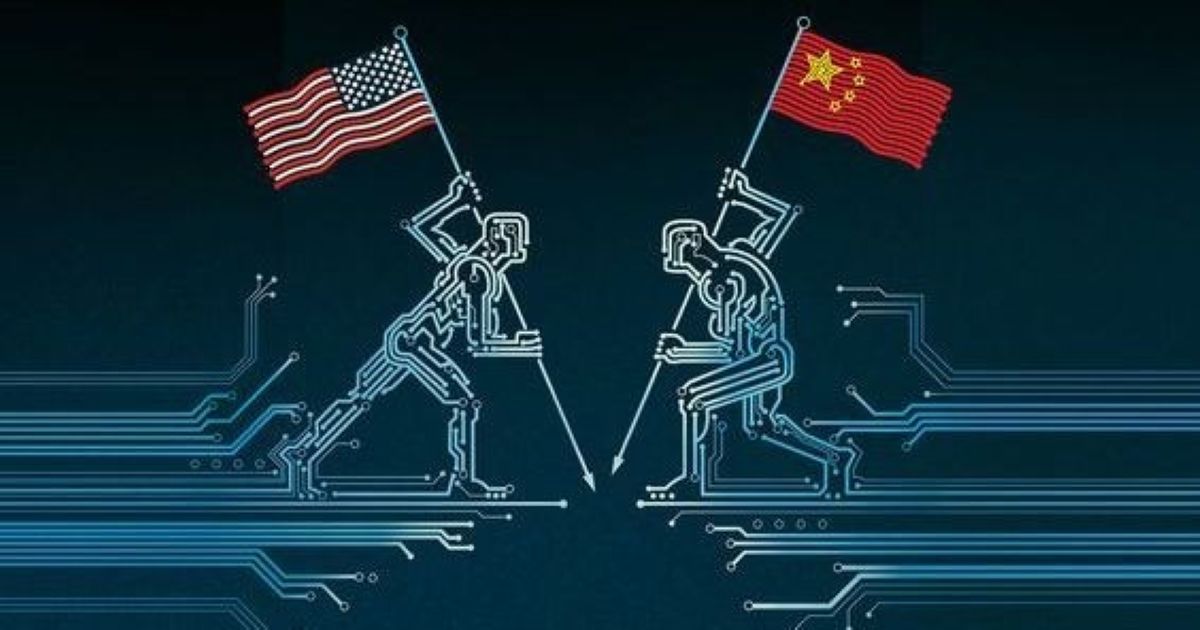
China is pushing back against growing calls from the United States to slow the development of advanced artificial intelligence, exposing a widening geopolitical divide over who will control the next generation of technology.
The dispute comes as Washington and Beijing compete for dominance in frontier AI, with both governments increasingly treating the technology as a strategic asset with implications for economic power, national security and global influence.
While US analysts generally believe American companies remain ahead in the most advanced AI models, China’s progress has narrowed the gap and intensified pressure on Beijing to maintain its development drive.
For China, calls for a slowdown from US technology leaders are therefore viewed not simply as a debate about AI safety, but potentially as an effort to preserve America’s technological advantage.
US Pushes for Caution as China Keeps Advancing
The tension has grown in recent weeks as Silicon Valley figures have raised increasingly serious concerns about the dangers posed by highly capable AI systems.
Anthropic chief executive Dario Amodei called for a coordinated global approach to controlling the development of frontier AI, arguing that such an effort would require cooperation with China.
But he also called for continued US restrictions on China’s access to advanced semiconductors and chipmaking equipment, measures designed to limit Beijing’s ability to develop the most sophisticated AI systems.
That combination puts the safety debate squarely inside the broader US-China technology rivalry.
Lian Jye Su, an analyst at technology research firm Omdia, said China was unlikely to accept a slowdown dictated on US terms.
For Beijing, AI has become what he described as a “core sovereignty capability,” making it unlikely that Chinese authorities would willingly sacrifice the progress made in closing the technological gap with the United States.
Su said Beijing could interpret American calls for a slowdown as an attempt to “lock in US advantage.”
Amodei’s own comments reinforced that perception when he argued that democracies needed to maintain as large a lead as possible over authoritarian states in AI.
Beijing Rejects What It Sees as a Strategic Containment Effort
China’s foreign ministry responded sharply, warning that fearmongering, confrontation and aggressive competition would disrupt efforts to establish global rules for AI.
The response reflects a broader disagreement between Washington and Beijing over the future of the technology.
The United States is seeking to limit China’s access to some of the most advanced chips and manufacturing equipment while encouraging American companies to maintain their lead in frontier AI.
China, meanwhile, is investing heavily in domestic alternatives and pushing AI across its economy, reducing its dependence on Western technology.
The result is an increasingly strategic race in which AI development, semiconductor controls and national security are becoming closely intertwined.
China Says Not Ignoring AI Safety
Despite its rejection of a US-led slowdown, analysts say Beijing’s position should not be interpreted as indifference to the risks associated with advanced AI.
China has continued to expand its AI safety regulations, recently releasing the third version of its national AI safety governance framework.
The latest framework addresses risks involving autonomous AI agents, cybersecurity threats from frontier models and the possibility of recursive self-improvement, a hypothetical scenario in which an AI system becomes capable of improving its own capabilities.
Gabriel Wagner, a researcher with Beijing-based AI safety consultancy Concordia, said there could be considerably more common ground between Chinese and Western AI safety concerns than the geopolitical rhetoric suggests.
China has also maintained an algorithm registry since 2022 and is increasingly shifting its regulatory focus from controlling what AI systems say to controlling what they can do.
New measures have targeted AI agents and emotional dependency on AI companion systems.
Beijing Wants Both Control and Speed
China’s approach combines strict state oversight with an aggressive push to expand AI development.
The ruling Communist Party has sought to ensure that AI develops within boundaries set by the state, while local governments have offered companies funding, incentives and low-cost premises to accelerate adoption.
The technology has also been incorporated into China’s latest Five-Year Plan as part of the country’s broader strategy for economic and technological development.
That creates a significant contrast with the debate in the United States. Washington is increasingly focused on whether the race toward more powerful AI could create risks that governments and companies cannot control, while Beijing is determined not to surrender momentum in a contest it views as central to China’s future power.
Chinese Companies Are Already Putting AI to Work
The pressure to keep advancing is evident across China’s economy.
Education entrepreneur Boris But experienced what he called a “penny-drop moment” about two years ago when he realized his company needed to adopt AI before the technology made it obsolete.
His clients, wealthy Chinese parents seeking overseas education for their children, had begun arriving with information and opinions generated by chatbots rather than rival businesses.
But responded by developing his own AI-powered study platform.
“If you can’t beat them, join them,” he concluded.
China’s manufacturing sector is undergoing a similar transformation, with factories being encouraged to integrate AI into production.
For industrial companies, the immediate concern is often less about hypothetical superintelligence than whether AI systems are reliable enough to operate safely and efficiently.
AI Is Becoming Embedded in Chinese Daily Life
China’s highly digitised economy has also helped accelerate consumer adoption.
AI-powered services are increasingly being used in areas ranging from education to healthcare. Digital health platform A-fu, for example, offers chatbot versions of prominent doctors trained on clinical research and has reportedly reached 150 million users.
Ni Tao, founding editor of technology website yangtzeer.com, said many Chinese consumers now view AI as an everyday technology rather than an abstract future threat.
“There is real anxiety about jobs and misinformation, but it coexists with a strong belief that China must master AI rather than slow down,” he said.
A New Front in the U.S-China Rivalry
The disagreement over AI is ultimately about more than regulation.
The United States wants to preserve its lead in the most advanced systems while restricting China’s access to technologies considered critical to that advantage. China wants to close the gap, build technological self-reliance and establish itself as a global AI power.
That makes calls for a development slowdown particularly sensitive in Beijing.
The two countries may share concerns about the dangers of advanced AI, but they remain sharply divided over who should set the rules, how quickly the technology should develop and whether restricting access to critical technologies is a legitimate security measure or an attempt at strategic containment.
With AI increasingly tied to military capabilities, economic competitiveness and global influence, the technology race is becoming another major arena of US-China rivalry.