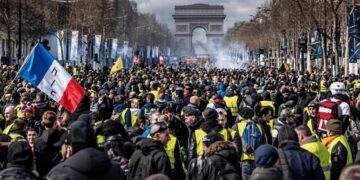














































































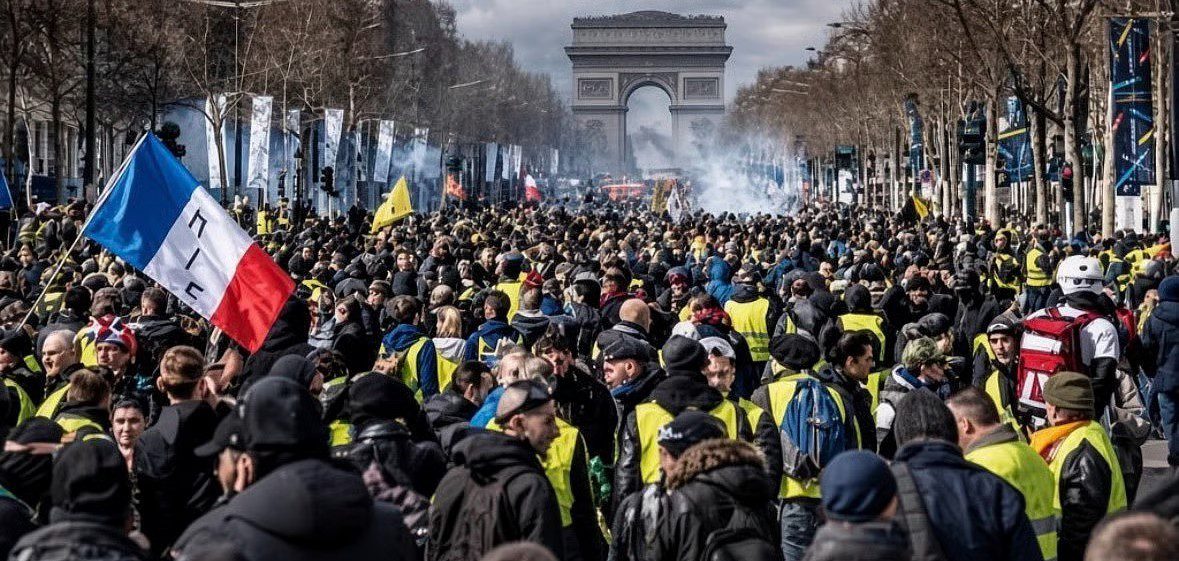
France is facing one of its largest waves of demonstrations in recent years as worsening economic conditions, rising living costs and growing dissatisfaction with government policies trigger a nationwide general strike.
Between 500,000 and 700,000 people are expected to participate in protests across the country, in what could become a major test of public confidence in the government.
The industrial action, coordinated by L’intersyndicale, an alliance representing France’s major trade unions, is expected to disrupt several critical sectors, including education, healthcare, public transportation and government services. Workers in private companies are also expected to join the demonstrations, extending the impact beyond the public sector.
The scale of the planned action has prompted authorities and businesses to prepare for widespread disruption. In Paris, several commercial establishments have boarded up their premises ahead of the demonstrations, while police have been deployed at major railway stations to conduct security checks and prevent potentially dangerous items from reaching protest sites.
Interior Minister Laurent Nuñez has warned that violence and public disorder would not be tolerated, adding that arrests would be made where necessary. Although authorities and trade unions have agreed on demonstration routes in most cities, disagreements persist in some locations.
The US Embassy in France has also issued a security advisory warning American citizens of possible disruptions to rail, metro, road and air transport, alongside potential closures or reduced operations at hospitals, banks, schools and government offices. It urged travellers to avoid demonstration areas and make alternative transport arrangements.
The disruption has already affected one of the country’s most recognizable landmarks. The Eiffel Tower, which receives approximately seven million visitors annually, was closed for the day because of the national strike. Visitors holding electronic tickets were advised to check their emails for further information.
Diverse groups unite against economic hardship
While the trade unions are leading the industrial action, the demonstrations are expected to attract a broader coalition of protesters, including students, climate activists and members of the Yellow Vest movement, which emerged in 2018 as a grassroots campaign against economic inequality and rising living costs. Some groups identified as extremist are also expected to participate.
The protests reflect mounting frustration over declining purchasing power, the cost of living and concerns about the quality and accessibility of public services.
Economic outlook deepens government pressure
France’s economic difficulties have intensified public discontent, with sluggish growth, rising public debt and weak consumer demand placing additional pressure on the country’s finances.
The economy contracted by 0.1 per cent in the third quarter, bringing France closer to a potential recession. Manufacturing investment has weakened, consumer spending remains subdued and the agricultural sector has been affected by a hot, dry summer.
The Bank of France’s existing growth projection of 0.4 per cent for 2026 is also facing downward pressure. Governor Emmanuel Moulin acknowledged this week that the forecast could prove overly optimistic.
Meanwhile, France’s sovereign debt has climbed to approximately $4 trillion, increasing the government’s borrowing costs as investors demand higher returns on French bonds.
Credit rating agency Fitch Ratings downgraded France’s credit rating at the end of October, citing weaker economic growth, higher borrowing costs and an expanding budget deficit. The agency warned that these developments were worsening the country’s debt outlook.
Public anger has also been fuelled by longstanding disagreements over government spending and pension policy. Successive administrations have struggled to contain welfare expenditure, while the controversial 2023 pension reform, which sought to increase the retirement age from 62 to 64 for most workers, remains politically divisive. The National Assembly has since suspended the reform until after the 2027 presidential election.
France’s unrest reflects wider European discontent
The demonstrations come amid a broader wave of anti-government protests across Europe, with Belgium, Germany, Spain, Italy, Portugal and Albania also experiencing public unrest in recent weeks.
Although the immediate triggers differ, economic insecurity, rising living costs and dissatisfaction with government responses have emerged as common grievances.
In Germany, a youth-led movement known as Gen Z has got this! recently mobilized against the cost of living, inadequate funding for schools and universities, environmental concerns and the possible reintroduction of compulsory military service. Some demonstrations escalated, prompting police to deploy water cannons and riot units in Cologne and Hamburg.
In Albania, protests have been driven partly by opposition to a proposed luxury resort development associated with Ivanka Trump and her husband, Jared Kushner, alongside wider corruption concerns.
Italy has witnessed demonstrations linked to rising fuel prices, while Portugal’s protests have centred largely on the growing difficulty of accessing affordable housing. In Spain, migration-related tensions surrounding Ceuta and the nationwide housing affordability crisis have contributed to public dissatisfaction.
The growing unrest across the continent underscores a common challenge for European governments: addressing economic pressures and restoring public confidence amid increasing frustration over living standards, public spending and policy decisions.
For France, the scale of the latest demonstrations will be a significant indication of how deeply economic anxiety has translated into opposition to the government.