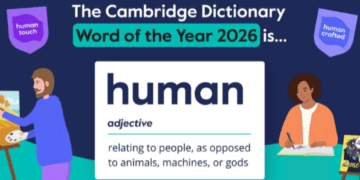














































































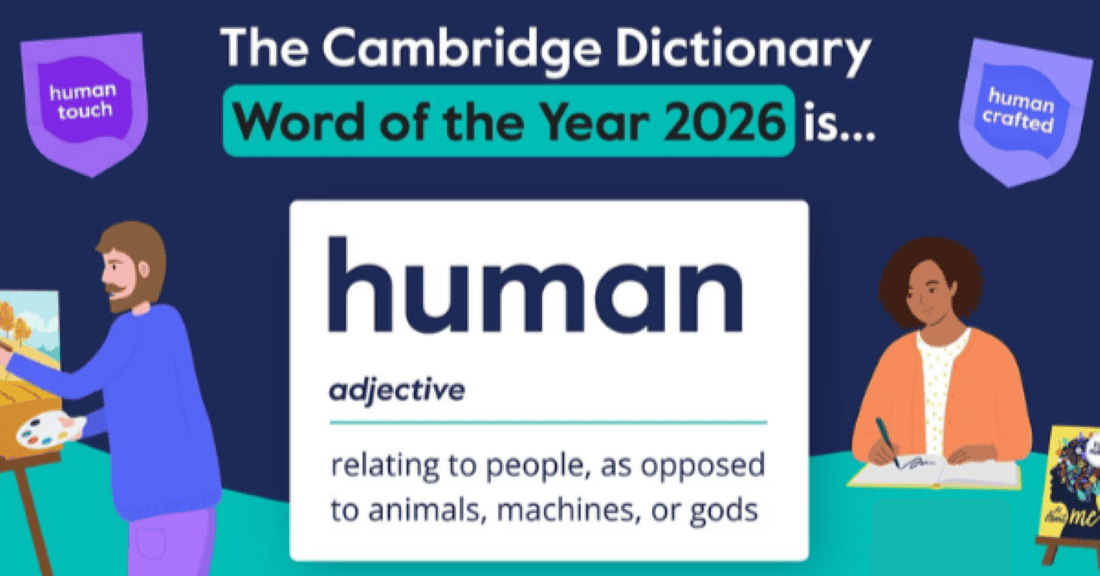
The Cambridge Dictionary has selected “human” as its 2026 Word of the Year, highlighting growing public interest in human identity and the qualities that set people apart from artificial intelligence.
The dictionary announced the choice on Wednesday, explaining that the selection reflected renewed attention to human creativity, emotional connection and authenticity as AI becomes more deeply embedded in everyday life.
Cambridge defines “human” as possessing the qualities, weaknesses and feelings associated with people, rather than gods, animals or machines.
Its lexicographers also noted increased use of expressions such as “human-made”, as people seek clearer ways to distinguish work created by humans from material produced by artificial intelligence.
Cambridge Dictionary lexicographer Colin McIntosh said the rapid development of AI was changing how people discussed what it means to be human.
He said concerns about the possible loss of human abilities as people increasingly depend on AI had prompted fresh questions about the technology’s role in different areas of life, from advanced mathematics to early childhood education.
McIntosh said this renewed examination of human identity informed the dictionary’s decision.
Other expressions considered for the 2026 title included “agent”, which describes an AI system capable of carrying out complex tasks with limited human supervision, and “analogue”, referring to activities or objects that operate outside digital technology.
“Wholesome”, used to describe something that benefits a person’s physical, moral or emotional well-being, was also among the contenders.
The dictionary also highlighted “FOBO”, an abbreviation for the fear of becoming obsolete, as an expression to watch in 2027. The term reflects concerns that advances in artificial intelligence could make certain jobs and human skills less relevant.
Another expression identified was “weather whiplash”, which describes a sudden shift between extreme weather conditions.
The selection comes as debate intensifies over AI’s potential effects on jobs, education, creative work and human relationships.
AI-related language has featured in recent dictionary word-of-the-year announcements. Cambridge chose “hallucinate” in 2023 to describe the production of false or misleading information by artificial intelligence systems.
In 2025, Merriam-Webster selected “slop”, a term used to describe large amounts of low-quality digital content, much of it generated by AI.