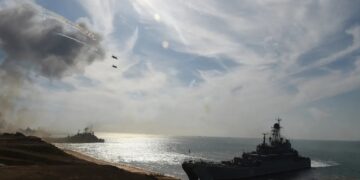













































































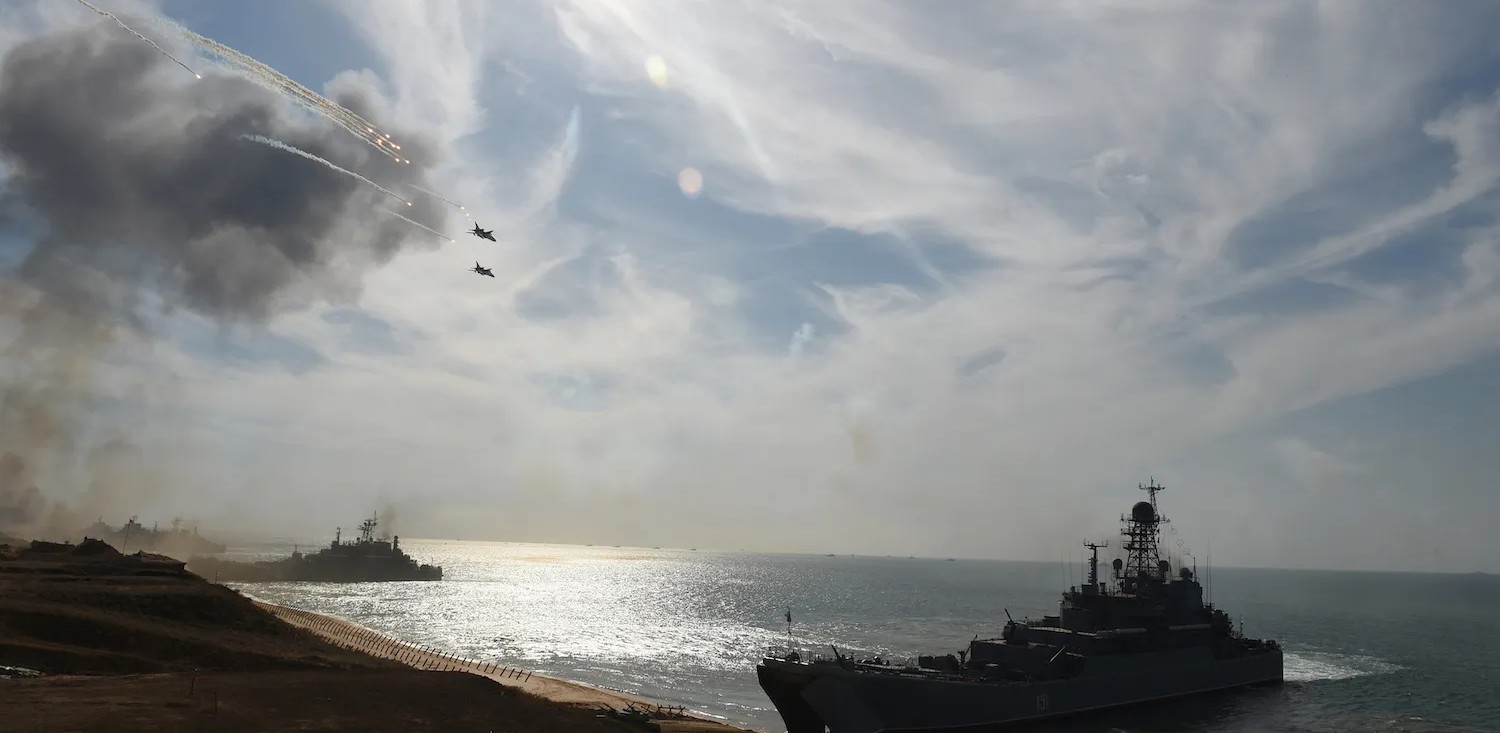
The war between Russia and Ukraine is increasingly spilling into the Black Sea, with repeated attacks on commercial vessels raising security concerns for NATO members Romania and Bulgaria and threatening vital supplies of grain and oil.
At least nine cargo ships were reportedly hit in waters close to the two countries in October. Despite warnings from the US-led NATO alliance, further attacks followed, including a strike on a vessel just outside Romanian waters on October 23 and the sinking of a Greek container ship by naval drones in Bulgaria’s exclusive economic zone last week.
The attacks have heightened fears that the maritime conflict could draw NATO countries into a wider confrontation with Russia. In response, the alliance has announced plans to strengthen surveillance along its eastern flank with maritime patrol aircraft, radar systems and drones.
Military analysts believe Russia was responsible for the attacks, although Moscow has denied targeting neighbouring countries with drones. Shipping security firm Ambrey said a naval drone seen in footage of the latest strike resembled a Russian model.
Sidharth Kaushal, a senior fellow at the London-based Royal United Services Institute, described the developments as a clear escalation.
Russia has accused European governments of worsening the war by supplying weapons to Ukraine. Its Defence Ministry did not respond to a request for comment on the latest attacks.
Russia accused of testing NATO’s limits
Analysts say the attacks could be part of a wider effort to test how far Russia can push NATO without triggering a direct military response.
Several of the vessels hit in October were anchored near, or travelling to and from, a Romanian canal that Ukraine relies on to move exports. One attack occurred in Romanian territorial waters, while eight others took place within the exclusive economic zones of Romania and Bulgaria.
Iulia Joja, director of the Black Sea programme at the Washington-based Middle East Institute, said Russia appeared to be exploiting Western reluctance to allow the conflict to escalate.
She compared the attacks with previous Russian drone incursions into NATO airspace, arguing that Moscow was testing the alliance’s response while expecting it to take limited measures.
A NATO official described Russian actions aimed at discouraging member states from supporting Ukraine as a serious security threat. The official stressed that the alliance’s commitment to defending every member, including those along the Black Sea, remained firm.
NATO also acknowledged the need for more affordable systems to intercept drones. It said members had committed more than $40 billion to developing and acquiring counter-drone capabilities over the next five years.
Romania and Bulgaria face growing security risks
The Black Sea is strategically important to Romania, serving as a major trade route and providing access to offshore energy projects.
The country is developing the Neptun Deep gas project, which is expected to make it the European Union’s largest gas producer next year. A naval drone also approached the project in August, raising concerns about the security of critical energy infrastructure.
Bucharest has accused Russia of carrying out systematic attacks on civilian vessels but has avoided directly attributing individual incidents without forensic evidence. Bulgaria has also stopped short of blaming Moscow, although officials have suggested that some of the attacks appear to benefit Russia.
The latest escalation comes as the United States reviews its military presence in Europe amid a growing strategic focus on China. Washington withdrew 1,000 troops from Romania last year.
A senior Romanian official said the changing relationship between the United States and Europe could create an opportunity for Russian President Vladimir Putin to increase pressure on the region. The official also expressed concern that NATO and European Union attention was concentrated on the Baltic region and other parts of northern Europe.
Joja said Romania had not received the same level of enhanced NATO military presence as the Baltic states and Poland, despite requests from Bucharest.
Romania has called for more surface-to-air interceptors and radar equipment to protect its territory and critical infrastructure. Analysts say the availability of relatively cheap interception systems remains a major challenge for Western countries, partly because of competing demands created by the war in Iran.
Hundreds of vessels caught up in the conflict
The intensifying attacks have disrupted commercial shipping across the Black Sea and the Sea of Azov, both important routes for Russian and Ukrainian exports.
Data from Ambrey Analytics showed that 317 merchant and other vessels were attacked by the two sides between May and October. That was more than four times the 74 vessels hit during the preceding six months.
The pattern of attacks has also shifted. Ukraine carried out 137 attacks on vessels in the third quarter, compared with 92 attributed to Russia. In October, however, Russia carried out 38 attacks, while Ukraine was responsible for five, according to Ambrey.
The attacks have damaged ports and forced both countries to look for alternative routes to move their goods.
Russia exported only 300,000 metric tonnes of grain through the Black Sea and Sea of Azov in September, a sharp fall from 4.74 million tonnes recorded in the same month last year, according to Russian export data reviewed by Reuters.
Ukraine has also suffered a significant decline in shipments. Following repeated Russian attacks, it suspended operations at its Black Sea ports in late July and redirected cargo through Danube river ports, Romania’s Sulina Canal and other routes along the Romanian Black Sea coast.
Despite these alternatives, Ukraine’s grain exports through its ports fell to 810,000 metric tonnes in September, compared with 2.1 million tonnes in September last year, government figures showed.
Andriy Ryzhenko, a naval analyst and former senior Ukrainian naval officer, said Russia’s main objective was to further restrict Ukraine’s export capacity, with pressure on NATO serving as a secondary goal.
Grain and fuel supplies face further pressure
The disruption to Black Sea shipping has raised concerns about global food and energy supplies, particularly as Russia and Ukraine remain major exporters of agricultural commodities.
Countries including Egypt, Turkey and India have supported efforts to secure a maritime ceasefire to prevent further disruption at a time when international fuel and grain prices are already under pressure.
Turkey has emerged as an important player in the discussions because it controls access for warships through the Bosphorus and Dardanelles under the Montreux Convention.
Last week, defence ministers and military chiefs from Turkey, Romania and Bulgaria met in Sofia to discuss the growing threats in the Black Sea.
Turkey’s Defence Minister used the meeting to warn both Russia and Ukraine against further attacks on commercial shipping. Ankara is also awaiting responses from Moscow and Kyiv to a proposal for a limited ceasefire at sea.
US Secretary of State Marco Rubio said on Saturday that international support for a restricted maritime ceasefire was growing.
Russia has rejected the proposal, arguing that such an arrangement would give Ukraine an opportunity to recover and strengthen its position.
Ukrainian President Volodymyr Zelenskyy has warned that the consequences of the shipping disruption could extend beyond immediate fuel shortages, with a wider agricultural crisis potentially emerging in the coming months.
The threat is particularly significant for countries that depend on imported grain and fuel. Prolonged disruption to Black Sea exports could push up commodity prices, increase shipping costs and add pressure to food markets already facing uncertainty.
For countries such as Nigeria, which rely heavily on imported food and refined petroleum products, further increases in global grain and energy prices could translate into higher import bills and additional pressure on household budgets.
As attacks continue, the Black Sea is becoming not only a major battlefield in the Russia-Ukraine war but also a growing test of NATO’s willingness and ability to protect its members without being drawn into direct conflict with Moscow.