











































































The United States carried out a ninth consecutive day of military strikes against Iran on Monday, while fears over global energy supplies intensified after Tehran claimed two oil tankers had exploded and become immobilized in the Strait of Hormuz.
The latest escalation comes amid the collapse of a month-old ceasefire agreement, with both Washington and Tehran stepping up military operations across the Middle East and targeting strategic infrastructure, military installations and shipping routes.
Iran’s Islamic Revolutionary Guard Corps (IRGC) said it launched ballistic missile attacks against U.S. aircraft at Jordan’s Aqaba Airport as well as American military facilities at Kuwait’s Al-Adiri Camp, Ali Al Salem Air Base and positions in Syria.
Air raid sirens were activated across Bahrain on Monday morning, according to the country’s Interior Ministry, while Kuwait’s military said its air defence systems intercepted hostile drones during an Iranian attack.
The renewed violence has intensified the struggle for control of the Strait of Hormuz, through which roughly one-fifth of global oil supplies normally pass, fuelling concerns about energy markets and inflation worldwide.
In a statement, U.S. Central Command confirmed it had begun what it described as a new wave of strikes targeting Iranian military capabilities.
The military said the operation was aimed at degrading Iran’s ability to launch attacks against commercial shipping operating through the Strait of Hormuz but did not disclose specific targets.
Iran’s semi-official Tasnim News Agency reported that U.S. missiles struck multiple locations across the country early Monday.
According to the agency, explosions were recorded in Tabriz, Chabahar, Konarak, Bandar Mahshahr and Bandar Imam Khomeini.
U.S. Secretary of State Marco Rubio defended the ongoing military campaign, accusing Iran of threatening international maritime navigation.
“The Strait of Hormuz is an international waterway, and Iran continues launching attacks against ships operating there,” Rubio said.
“As long as Iran insists on trying to control an international waterway, we will respond. The United States remains open to a diplomatic solution.”
Iran said its military operations also targeted several U.S. military facilities across the Gulf region.
Meanwhile, Kuwaiti authorities reported that one of the country’s desalination plants had been attacked for the second consecutive day, triggering a fire at what officials described as vital civilian infrastructure.
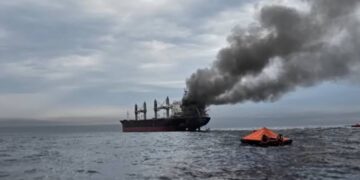
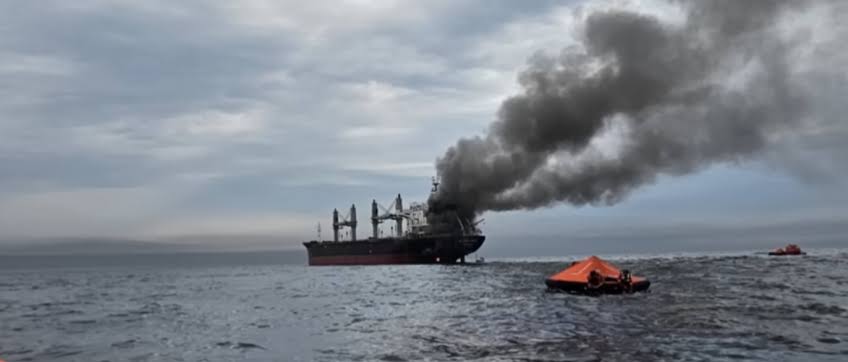
Tehran also claimed that two oil tankers attempting to transit what it called an unsafe southern shipping route through the Strait of Hormuz had exploded and become disabled.
The Revolutionary Guards alleged the vessels had been encouraged by the U.S. military to use the route but did not identify the ships or provide details regarding casualties or damage.
Reuters could not independently verify the claims.
The Guards warned that the Strait of Hormuz would remain unsafe while U.S. military operations continued in the region.
“This passage will not be safe for the transit of petrochemical products or even a single drop of oil and gas,” the statement said.
Separately, the United Kingdom Maritime Trade Operations (UKMTO) said late Sunday that it had received reports of a vessel on fire near Oman’s coastline, although the cause of the incident had not been confirmed.
Commercial traffic through the Strait of Hormuz continues to slow as security risks mount.
Data from the London Stock Exchange Group (LSEG) showed that only four vessels transited the strategic waterway on Sunday, down from eight the previous day.
However, at least three oil product tankers and one Very Large Crude Carrier (VLCC) have entered the strait since Friday to load cargoes.
The growing uncertainty pushed crude oil prices higher, with benchmark prices rising about two per cent on Monday to trade above $90 per barrel.
The Pentagon also announced another American military casualty linked to the conflict.
According to U.S. Central Command, a U.S. service member was killed on Saturday in northern Iraq during the controlled detonation of unexploded ordnance recovered from a downed Iranian attack drone.
The military had previously confirmed the deaths of two U.S. service members in Jordan, while another remains missing following Iranian attacks last week.
Officials also disclosed that unidentified human remains had been recovered from the site of Friday’s attack in Jordan and were undergoing forensic examination.
The latest announcement raises the number of U.S. military personnel killed since the conflict began to 17, with more than 420 others reported wounded.
The conflict began after the United States and Israel launched coordinated strikes against Iran on February 28, targeting Tehran’s nuclear facilities, missile infrastructure and regional proxy networks. Since then, the fighting has spread across the Middle East, causing thousands of deaths, particularly in Iran and Lebanon, while threatening global energy security through repeated disruptions in the Strait of Hormuz.