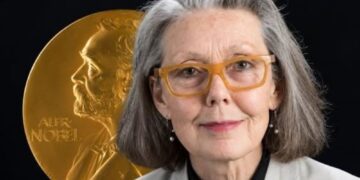




































































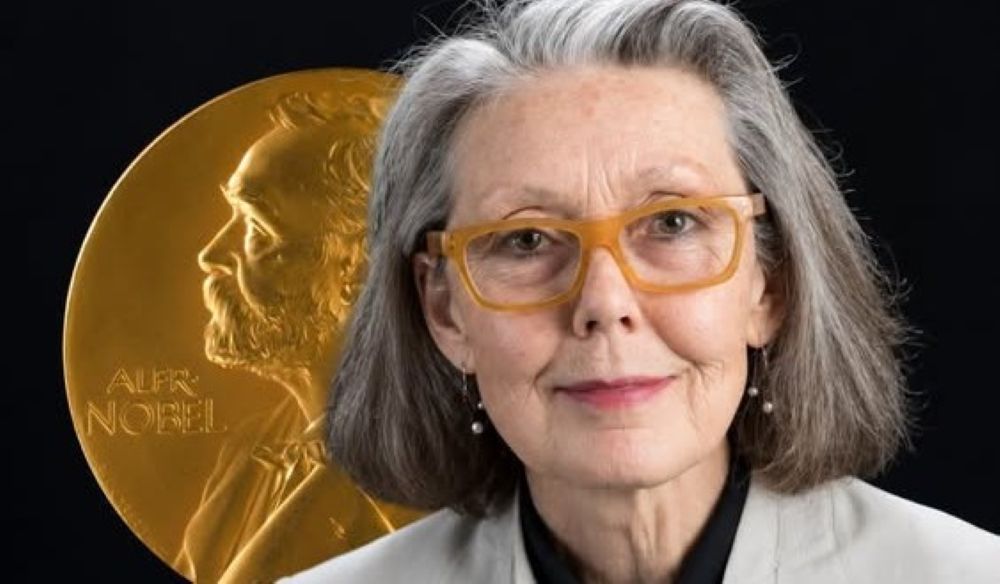
Anne Carson has won the 2026 Nobel Prize in Literature for a body of work that blends poetry, prose, dialogue and translation while challenging conventional literary forms.
The Swedish Academy announced the award on Thursday, praising the 76-year-old author for her “bold and inventive oeuvre” and her role in creating new forms of contemporary literature through an ongoing engagement with classical traditions.
The prize comes with 12 million Swedish kronor, worth about $1.2 million.
Carson was in Iceland when she received the news. She told Icelandic broadcaster RUV that her reaction was simple.
“Crazy, I think they’re all crazy,” she said when asked how she felt about winning the Nobel.
She added that she expected the award to result in a sticker being placed on the cover of her books.
A literary career without clear boundaries
Born in Toronto, Carson has built a reputation for work that refuses to fit neatly into a single genre. Her writing has moved between poetry, prose, literary criticism, translations, opera libretti and verse novels.
She is particularly recognized for her translations of classical Greek works, which have also shaped her own writing.
Steve Sem-Sandberg, a Swedish novelist and member of the Nobel committee, said Carson’s books effectively occupy a category of their own because of their resistance to conventional genres.
The Swedish Academy said her work sits at the meeting point between the precision of a philologist and the search for new meaning associated with poetry.
“Almost all her literary production has centred upon the intersection between the philologist’s obsession with words and the poet’s desire for new meaning,” the Academy said.
It also highlighted Carson’s interest in the origins of words, noting that her translations from Classical Greek can stand as literary works in their own right.
Reworking ancient stories
One of Carson’s best-known works is Autobiography of Red, published in 1998. The book reimagines the ancient Greek myth of Geryon and explores questions surrounding love, destruction and identity.
The Academy described the work as an example of Carson’s ability to bring classical literature into a new form while retaining its underlying questions.
Her interest in combining ancient and modern cultural references is also evident in Norma Jeane Baker of Troy, a 2019 performance work that brings together the story of Helen of Troy from Euripides’ Helen with the life and image of Marilyn Monroe.
Carson’s engagement with modern literature is equally evident in The Albertine Workout, which draws on Marcel Proust’s In Search of Lost Time and its character Albertine.
Carson has said she spent seven years reading Proust’s work and found it difficult to adjust after finishing the novel. She described life after Proust as seeming “so grey” and used The Albertine Workout to extend her engagement with the book.
Finding inspiration in poetry and art
Carson has taught classics at universities in both Canada and the United States and has described herself as a visual artist as well as a writer.
She has said she thinks of poems as objects, comparing them to drawings that readers can enter through language.
She also believes poetry can suit the pace of contemporary life because of its brevity.
Speaking to RUV after the Nobel announcement, Carson said she considered poetry particularly useful in a world where people are increasingly in a hurry.
Yet when asked about her own literary influences by the Nobel Committee, she pointed to Homer, the ancient Greek poet traditionally credited with The Odyssey.
Asked whether the classical stories she has adapted remain relevant to modern readers, Carson responded that she was not particularly interested in relevance.
Life in Iceland
Although Carson was born in Canada, Iceland has become an important part of her life.
She and her husband, artist Robert Currie, first began spending time in the country after Iceland’s 2008 banking collapse. Over time, they spent longer periods there and developed close ties with local communities.
Carson became an Icelandic citizen in 2022 and maintains a home there. She was in Iceland when she received the Nobel Committee’s call.
Ingrid Carlberg, permanent secretary of the Swedish Academy, said Carson had been caught off guard by the announcement and had little time to speak during the call.
“She is for the moment in Iceland, where she’s listening to the wind,” Carlberg told reporters in Stockholm.
Boxing after Parkinson’s diagnosis
Carson began boxing in her 70s after being diagnosed with Parkinson’s disease. The exercise has been used as part of therapy for the condition, particularly because it requires concentration, coordination and the sequencing of movements.
She has also spoken publicly about how the disease affected her handwriting.
At a literary festival in Denmark in 2024, Carson described the frustration of having to erase paragraphs because of changes in her handwriting.
Despite the physical challenges, she has continued to write and produce new work across several forms.
Fourth Nobel prize announced this week
The literature award is the fourth Nobel Prize announced this week, following the prizes for medicine, physics and chemistry.
The Nobel Peace Prize is due to be announced in Oslo on Friday.
The Nobel Prizes were established through the will of Swedish industrialist and dynamite inventor Alfred Nobel and have been awarded since 1901.
Carson, who had been among the writers considered contenders for this year’s literature prize, now joins a list of internationally recognized laureates that includes Ernest Hemingway, Alexander Solzhenitsyn and fellow Canadian writer Alice Munro.
Hungarian author László Krasznahorkai won the 2025 Nobel Prize in Literature.