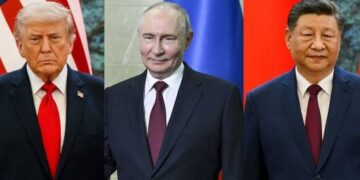

























































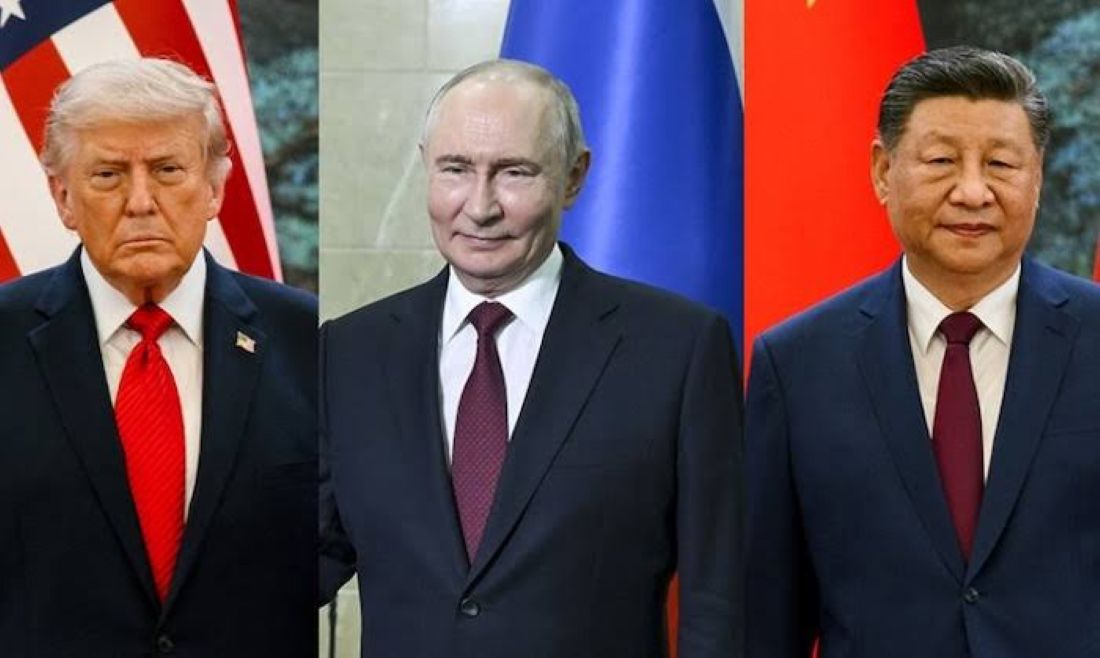
US President Donald Trump, Chinese President Xi Jinping and Russian President Vladimir Putin have concluded an unprecedented three-way meeting, with discussions covering the war in Ukraine, nuclear arms control and other major international issues.
The leaders met on Thursday at Kylin Villa in Shenzhen, southern China, on the sidelines of the Asia-Pacific Economic Cooperation (APEC) summit. They described the gathering as historic at the start of the discussions but made no immediate public statements after it ended.
Trump said the meeting offered an important opportunity for engagement, arguing that peace could not be achieved by avoiding discussions between major powers.
Putin, meanwhile, said the three countries shared several interests in resolving regional conflicts, including the war in Ukraine.
Xi did not directly mention Ukraine in his opening remarks. He instead stressed the importance of cooperation among powerful countries, warning that rivalry between major powers could lead to global instability.
The meeting brought together leaders whose countries have significant differences over Ukraine, Iran, nuclear weapons and international trade. Analysts have questioned whether the discussions would produce major agreements, while smaller countries at the summit have expressed concern that their interests could be sidelined by decisions made by the world’s leading powers.
Before the trilateral meeting, Trump held separate discussions with Xi and Putin, referring to both leaders as friends.
Trump also said he and Xi agreed that oil shipments through the Strait of Hormuz must continue, as the Iran conflict has disrupted shipping through the strategic waterway. Xi did not directly address Iran in his public comments.
China’s state news agency, Xinhua, reported that Xi told the two leaders nuclear weapons should be prohibited and eliminated, with the eventual aim of creating a world without them. China has made similar calls in the past, even as it continues to expand its nuclear capabilities.
Xi also urged the United States, China and Russia to encourage countries involved in conflicts to pursue negotiations and settle disputes through political and diplomatic channels.
Kylin Villa, the venue for the meeting, has previously hosted sensitive diplomatic engagements. Its past visitors include former North Korean leader Kim Jong-il, Xi’s father, Xi Zhongxun, and representatives of the Dalai Lama.
Diplomatic ceremony and tensions at APEC
The summit featured considerable ceremony around Trump’s arrival, which he later highlighted in an interview with Fox News.
Xi personally welcomed the US president at the airport, marking the first time he had received a visiting leader in that manner since becoming China’s president. The gesture reciprocated Trump’s reception of Xi at Joint Base Andrews in September, when the two last met. The leaders also briefly embraced.
Trump described the welcome as a positive gesture for both countries, drawing attention to the large crowds, military personnel, children and ceremonial display arranged for his arrival.
Other visiting leaders received less elaborate receptions. Russian President Putin’s welcome was more restrained, while Japanese Prime Minister Sanae Takaichi arrived without a formal welcoming ceremony.
Relations between Tokyo and Beijing have deteriorated following Takaichi’s remarks in 2025 that Japan could deploy its military if a Chinese move against Taiwan also threatened Japanese territory.
During the summit, Takaichi maintained that Japan’s position on Taiwan remained unchanged from the policy established in 1972.
Japan and Taiwan also reported sightings of Russian military aircraft near their territories during the week, with the incidents highlighting Moscow’s continued military presence in Asia despite its ongoing war in Ukraine.
Xi, meanwhile, told Trump that Washington needed to handle the Taiwan issue carefully to avoid serious damage to relations between the two countries.
Before Trump’s arrival, Xi and Putin had delivered speeches criticising Western trade protectionism and sanctions.
Xi called for international trade to remain open and unrestricted, while Putin described Russia as an important contributor to food and energy security in the Asia-Pacific region.
Western governments have criticised China’s economic model, arguing that its emphasis on industrial production over domestic consumption creates trade imbalances and puts pressure on other economies.
Trump used his address to underline the United States’ longstanding role as a Pacific power.
Nuclear arms control remains a difficult issue
Nuclear weapons were among Trump’s main priorities for the trilateral discussions, despite China’s longstanding reluctance to join formal arms-control negotiations with Washington and Moscow.
The United States and Russia maintain significantly larger nuclear arsenals than China, which has been expanding its own capabilities.
Trump acknowledged the difficulty of reaching an agreement on nuclear disarmament, telling Xi and Putin that persuading countries to give up such weapons would not be straightforward.
Craig Singleton of the Foundation for Defense of Democracies said the three leaders had several reasons to meet but fewer incentives to reach substantive agreements.
The discussions also took place against the background of fragile US-China trade relations. Washington and Beijing extended their trade truce earlier in November, but disagreements remain over technology exports and access to advanced computer chips.
Reports that Nvidia chips were being diverted to China through Southeast Asian countries have raised fresh questions about the effectiveness of US export restrictions and Beijing’s access to advanced technology.
Singleton warned that the controversy could complicate Trump’s efforts to negotiate technology concessions with Xi, particularly if concerns over chip exports lead to stronger restrictions backed by both Democrats and Republicans in the US Congress.