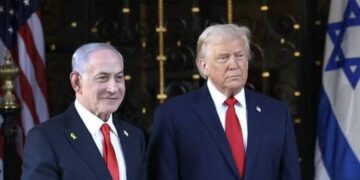









































































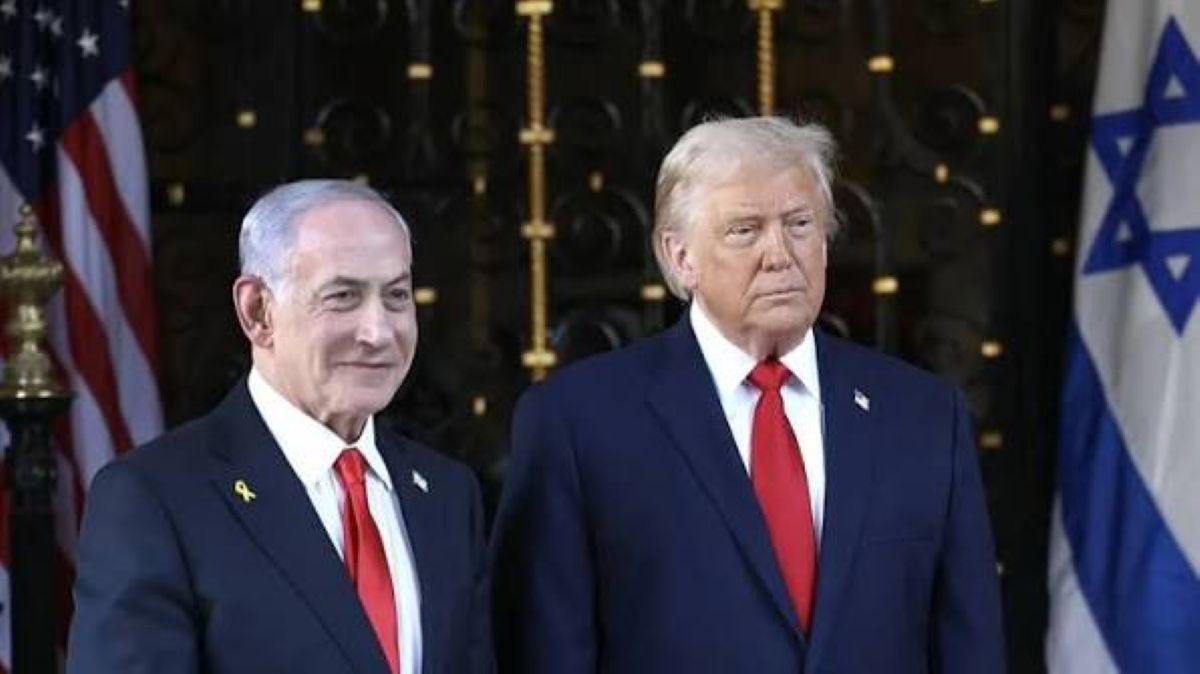
US President Donald Trump has announced that Washington will stop providing about $4bn in annual financial assistance to Israel after the end of this year, saying the Middle Eastern ally no longer needs the support.
Trump disclosed on Tuesday as Americans voted in the midterm elections, which will determine whether Republicans retain control of Congress or Democrats take over either chamber.
Speaking on Fox News’ Fox & Friends, Trump said he had reached an agreement with Israeli Prime Minister Benjamin Netanyahu months ago to end the payments, although the United States would continue selling weapons to Israel.
He did not specify which funding arrangement would be terminated or explain how the decision would be implemented by the end of the year.
The announcement also raised questions because the existing US-Israel Memorandum of Understanding provides $3.8bn in annual military assistance and remains in force until September 2028. The two countries have already begun discussions about the future of American support beyond that period.
Trump said Israel was financially capable of meeting its own defence needs and accused left-wing politicians and some Democrats of using US assistance to Israel to attack Republicans politically.
He specifically mentioned Abdul El-Sayed, a Democratic Senate candidate in Michigan who has criticized unconditional American military support for Israel.
Neither the White House nor Netanyahu’s office immediately responded to requests for comment.
The announcement comes amid uncertainty over Netanyahu’s political future following Israel’s October 27 election. His governing coalition lost its parliamentary majority, although his opponents have not secured a clear route to removing him from power.
The result is expected to lead to lengthy negotiations over the formation of a new government.
Growing opposition to U.S. support for Israel
Trump’s remarks also reflect a wider shift in American public opinion over the level of support Washington provides Israel, particularly since the Gaza war began in 2023.
Opposition has been especially pronounced among Democratic voters, with some politicians calling for conditions to be attached to military assistance.
A Quinnipiac University poll conducted in June found that 48 per cent of American voters believed the United States was too supportive of Israel. Among Democrats, the figure stood at 66 per cent.
The findings represented a significant increase from 2017, when only 16 per cent of voters and 20 per cent of Democrats held that view.
Democratic candidates critical of Israel have gained ground in party primaries, while some traditionally moderate lawmakers have become more willing to question Washington’s longstanding military and financial backing for the country.
In Michigan, El-Sayed is seeking a seat in the Senate and could become the first Muslim to serve in the chamber if elected. He has opposed unconditional military assistance to Israel, arguing that American resources should give greater priority to the needs of US citizens.
Trump referred to El-Sayed while explaining his decision to end the funding, arguing that Israel did not need the money and that Republicans should not face political criticism over assistance to a country capable of financing its own defence.
The issue has also created divisions within Trump’s own political movement. Some supporters of his Make America Great Again campaign have become increasingly critical of Israel, accusing its government of misleading the president about the prospects of defeating Iran in the war.
Their criticism has raised questions about Trump’s foreign policy position, particularly after he campaigned in 2024 on a promise to avoid drawing the United States into foreign military conflicts.
Congress still controls release of annual funds
Although Congress passed legislation in 2020 authorizing assistance to Israel, the money must still be released through annual appropriations bills approved by both the House of Representatives and the Senate.
Under the existing agreement, the United States provides Israel with $3.8bn in military assistance every year, making the future of the arrangement a matter of both executive and congressional policy.
Netanyahu had also acknowledged in an October interview with an Israeli television channel that continued American financial assistance could no longer be taken for granted.
He warned that Israel should prepare for a future in which it would not receive the large-scale US aid secured under previous agreements, arguing that political attitudes in America had changed.
Trump’s announcement therefore adds uncertainty to the future of a military partnership that has been central to US policy in the Middle East for decades. It also comes as support for Israel becomes an increasingly divisive issue in American domestic politics, with the outcome of the midterm elections set to determine how much influence each party will have over future funding decisions.