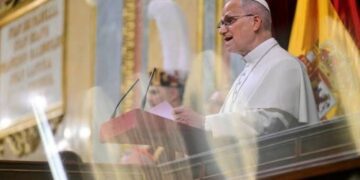











































































Pope Leo has placed the existential and societal threats posed by artificial intelligence at the centre of his papacy, issuing repeated warnings to global leaders and calling for enforceable international regulations to govern the rapidly evolving technology.
The Holy See’s proactive stance precedes recent appeals by major American tech firms at the United Nations Security Council, reflecting a institutional push that began years prior. During an address to the Pontifical Academy of Sciences, Pope Leo acknowledged the potential human benefits of artificial intelligence while cautioning that unchecked development introduces severe risks to global security and international peace.
Speaking on behalf of the Holy See’s advisory body, papal advisor Father Paolo Benanti noted that artificial intelligence possesses transformative power capable of generating unpredictable societal shifts. He emphasized that the Vatican’s engagement with technology leaders and international forums focuses on establishing safeguards before systems advance beyond effective governance.
The papal campaign builds upon Pope Leo’s foundational encyclical, in which he warned that unregulated artificial intelligence could accelerate misinformation, exacerbate global conflict, and drive autonomous warfare. Vatican officials have repeatedly drawn parallels between artificial intelligence and nuclear armaments, pointing out that while physical weapons can be cataloged and monitored, software systems operate with far less visibility and can destabilize social cohesion.
Vatican Secretary of State Cardinal Pietro Parolin reinforced the Papacy’s position during a recent address in Rome, stating that individual nations cannot effectively regulate artificial intelligence in isolation. He urged the international community to establish binding global frameworks, emphasizing that the future of humanity depends on shared oversight.
In parallel with global diplomatic efforts, the Catholic Church is engaging directly with industry executives and local ecclesiastical bodies. Following high-level meetings between Church leaders and technology executives, the United States Conference of Catholic Bishops established a dedicated task force to evaluate the ethical implementation of artificial intelligence, ensuring that technological advances remain strictly aligned with human welfare.