


















































































Global oil prices climbed by about three per cent on Monday, with Brent crude rising above $90 per barrel for the first time in more than a month, as intensifying military confrontations between the United States and Iran heightened concerns over energy supplies passing through the strategic Strait of Hormuz.
Brent crude futures advanced $2.77, or 3.14 per cent, to $90.87 per barrel by 0612 GMT, reaching their highest level since June 11. The benchmark had already recorded a weekly gain of 15.9 per cent last week, its strongest performance since April.
U.S. West Texas Intermediate (WTI) crude also extended its rally, climbing $2.35, or 2.85 per cent, to $84.84 per barrel. The U.S. benchmark touched its highest level since June 12 after posting a weekly increase of 15.5 per cent, the largest since early March.
The latest surge comes as military tensions in the Gulf continue to escalate, with the United States carrying out a ninth consecutive night of strikes against Iranian targets while regional allies, including Kuwait and Bahrain, reported fresh Iranian attacks over the weekend.
Analysts at Dutch banking group ING said the continued exchange of military strikes had intensified fears over the security of oil exports from the region.
“Brent has broken above $90 per barrel amid an unrelenting escalation in the Gulf. The continued exchange of attacks between Washington and Tehran is proving increasingly deadly, and if the conflict expands further, the region could witness a return to widespread attacks affecting energy infrastructure,” the analysts said.
The situation has also affected commercial shipping through the Strait of Hormuz, one of the world’s most critical energy corridors through which roughly 20 per cent of global oil supplies normally pass.
Iran’s Islamic Revolutionary Guard Corps (IRGC) claimed on Monday that two oil tankers attempting to navigate what it described as an unsafe southern shipping route had exploded and become disabled. The Guards alleged that the vessels had been encouraged by the U.S. military to use the passage, although the claims could not be independently verified.
Both Washington and Tehran have increasingly targeted maritime activities since the conflict intensified. The United States says it is enforcing a naval blockade on Iranian ports, while Iran maintains that it is intercepting vessels it considers to be violating its navigation rules in the Strait of Hormuz.
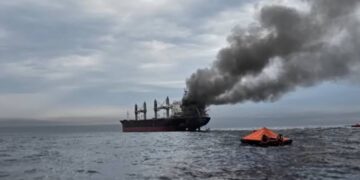
Adding to concerns, the United Kingdom Maritime Trade Operations (UKMTO) center reported that a vessel was on fire northwest of Oman’s Kumzar area early Monday, though details surrounding the incident were not immediately available.
Shipping activity through the waterway remains significantly reduced. According to data from the London Stock Exchange Group (LSEG), only four vessels transited the Strait of Hormuz on Sunday, down from eight recorded the previous day. Despite the decline in traffic, at least three oil products tankers and one Very Large Crude Carrier (VLCC) have entered the strait since Friday to load crude cargoes.
Barclays analyst Amarpreet Singh said the market is becoming increasingly focused on the longer-term implications for global oil supplies.
“The coming days and weeks will provide a clearer indication of how much oil can continue to leave the region under the renewed dual blockades,” Singh said.
He added that oil markets may still be underestimating the potential impact on global inventories.
“Unlike at the beginning of the conflict, global stockpiles are now among the tightest seen over the past five years, leaving the market more vulnerable to prolonged supply disruptions,” he said.
The sharp rise in crude prices reflects growing investor concerns that continued hostilities between the United States and Iran could further restrict energy exports from the Gulf, potentially tightening global supplies and placing additional upward pressure on fuel prices worldwide.