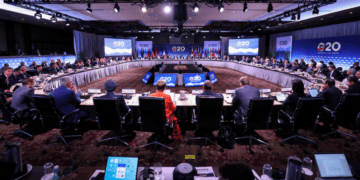


































































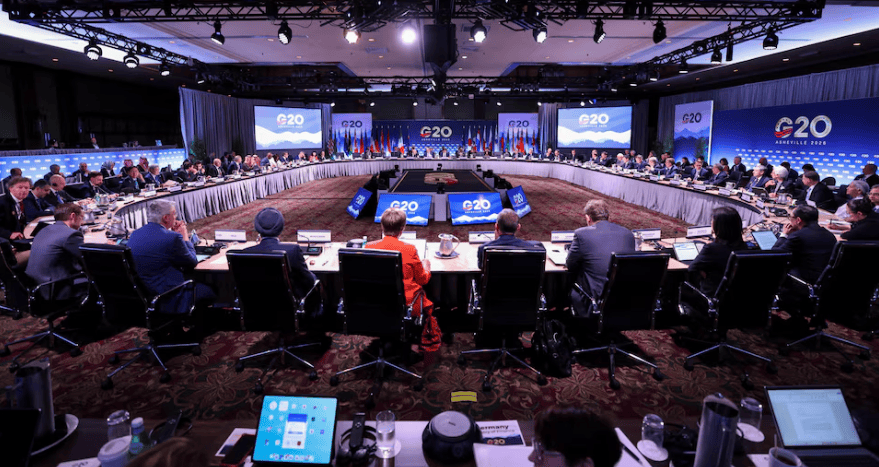
The return of Russia to the G20 finance ministers’ meeting in Asheville, North Carolina, has triggered unease among European officials, adding a diplomatic dispute to talks already focused on global growth, debt and trade tensions.
Russian Finance Minister Anton Siluanov made a surprise in-person appearance at the two-day meeting on Monday, marking the first time he has attended the forum physically since Russia’s invasion of Ukraine in 2022.
The decision to include Moscow was made by the United States, which is hosting the meeting. Several European finance ministers said they were unhappy with Russia’s presence and questioned whether Siluanov should have been treated as a normal participant while the war in Ukraine continues.
Polish Finance Minister Andrzej Domanski said European governments remained deeply distrustful of Russia.
“We do not trust Russia. They lie constantly and you need to be really, really cautious while discussing with them,” Domanski told Reuters.
He said Russia remained the aggressor in the conflict and that holding substantive discussions with its representatives would be difficult.
German Finance Minister Lars Klingbeil also criticised the decision, saying Europe’s position on further sanctions against Russia remained firm.
“I would have wanted greater clarity from the American side that he should not be received here as a normal guest,” Klingbeil said.
European officials subsequently declined to appear alongside Siluanov in the traditional G20 family photograph. The group photo was eventually taken without him.
Siluanov nevertheless held a bilateral meeting with US Treasury Secretary Scott Bessent. Russia’s finance ministry said the talks included financial cooperation within the G20 framework, while a US official said discussions focused on President Donald Trump’s Ukraine peace initiative.
A person familiar with the talks said Bessent made clear that economic relief for Russia or agreements on other matters would not be possible while the war continued.
Russia’s return represents a sharp change from the atmosphere surrounding the G20 in 2022. At a meeting that year, officials from the United States, Britain, Canada and the European Central Bank walked out when Russian representatives took part.
US puts economic growth at centre of talks
Despite the disagreement over Russia, the Trump administration is seeking to use the meeting to promote a broader economic agenda centred on stronger global growth.
Bessent told ministers that economic expansion was the most effective way to deal with the enormous debt accumulated by governments since the 2007-09 global financial crisis and the COVID-19 pandemic.
“The world is awash in debt post-GFC, post-COVID, and the only way for us to get out of this is to grow our way out of this,” Bessent said at the opening of the meeting.
Global debt reached almost $353 trillion earlier this year, intensifying concerns about financial stability and the sustainability of government borrowing.
Bessent argued that stronger growth could help countries reduce the burden created by years of high public spending and weak productivity.
The US Treasury has identified several obstacles to faster growth, including excessive regulation, inefficient tax and financial incentives, inadequate public and private investment, fragmented domestic markets and shortages in workforce skills and mobility.
The administration has also invited business leaders to participate in parts of the discussions, reflecting Washington’s emphasis on deregulation, energy production and technological innovation as drivers of economic expansion.
AI investment changes global economic outlook
Artificial intelligence is another major theme at the meeting as governments assess the economic impact of a surge in spending on AI infrastructure.
US Federal Reserve Chair Kevin Warsh, attending his first international economic policy meeting since taking office in May, said the global economy appeared to be moving away from the prolonged period of weak investment and innovation sometimes described as “secular stagnation”.
He characterized the current environment as a global investment surge, saying the boom in AI-related spending had helped reverse the so-called global savings glut that had previously left large amounts of capital searching for limited investment opportunities.
The increase in investment, however, has implications for financial markets, including government bond markets.
Treasury faces criticism over media restrictions
The G20 meeting has also generated controversy over the treatment of journalists.
The US Treasury denied media credentials to some journalists seeking to cover the summit, including teams from Bloomberg News and individual reporters from The New York Times and The Wall Street Journal.
Klingbeil said journalists should be allowed to report freely on the proceedings.
“I believe the press has a completely legitimate interest in reporting openly and freely on this G20 summit,” he said, describing the exclusion of journalists and entire editorial teams as unacceptable.
The US Treasury defended its accreditation process, saying more than 300 journalists were covering the meeting, including another reporter from The New York Times.
A Treasury spokesperson said media access carried an obligation to report factual information in accordance with established journalistic standards.
The dispute adds another layer of tension to a summit already marked by disagreements over Russia and Washington’s approach to global trade.
US seeks tougher approach to China’s trade surplus
Trade is expected to dominate the G20 agenda as the United States presses other major economies to reconsider their commercial relationships with China.
Bessent plans to urge G20 members to examine their trade arrangements with Beijing and consider measures aimed at reducing global imbalances.
Washington is particularly concerned about China’s large trade surplus, which Bessent put at about $1.2 trillion.
“The world cannot have a China with a $1.2 trillion trade surplus,” he said.
Bessent argued that China’s domestic economy remained weak and that Beijing was relying too heavily on exports to support growth.
The US position is that China should shift towards stronger domestic consumption rather than continuing to expand exports into global markets.
Economists have also argued that Washington must address its own growing fiscal deficits if global economic imbalances are to be reduced.
French Finance Minister Roland Lescure said the world’s major economic blocs all had work to do.
“We need a more balanced world,” he said. “We know that every big zone, whether China, the U.S. and Europe, has got their own homework to do.”
US debt concerns persist
Bessent also sought to play down concerns about the health of the US Treasury market and the country’s expanding debt burden.
He rejected suggestions that the US bond market was experiencing major turmoil, pointing instead to continued economic growth.
“First of all, I’m not sure where the bond market turmoil is,” Bessent said in an interview ahead of the G20 meeting. “What’s important, too, is that we are growing.”
US economic strength has been supported in part by massive investment in AI infrastructure. At the same time, that investment has increased demand for capital and contributed to higher Treasury yields.
The competing pressures illustrate the difficult economic choices facing the G20: governments want faster growth and greater investment, but they must also contend with record debt, higher borrowing costs and persistent trade imbalances.
For the United States, the Asheville meeting is therefore an opportunity to push its economic priorities on growth, deregulation, AI and trade.
For its European partners, however, Washington’s decision to restore Russia to the G20 table and restrict access for some journalists has ensured that the meeting is about more than economics.