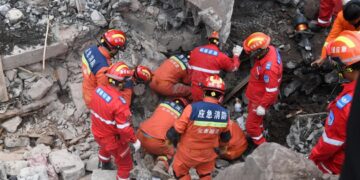












































































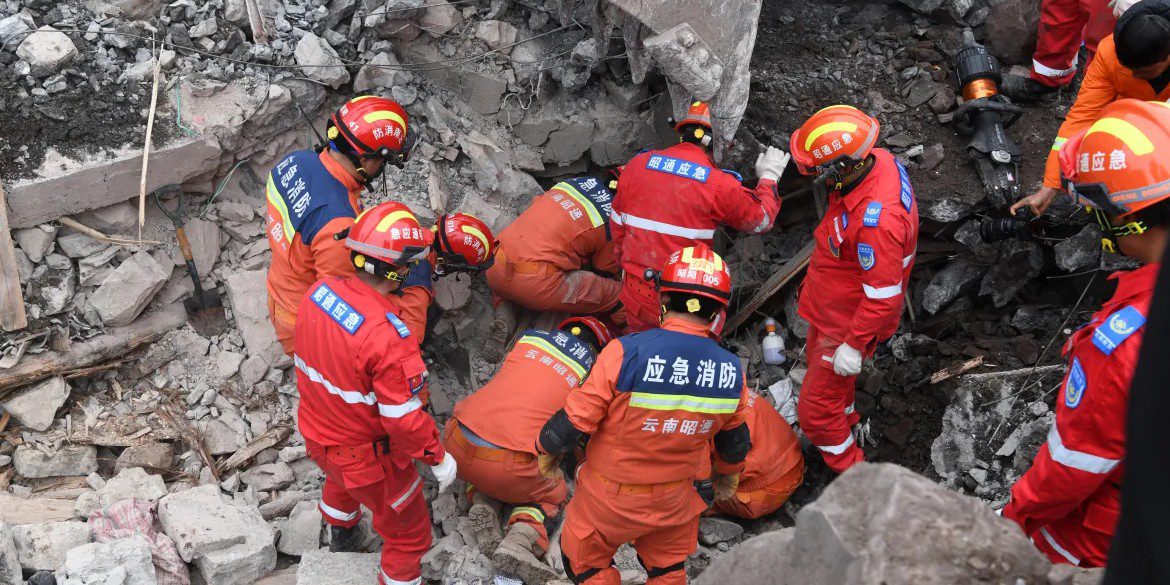
Rescue teams in Nepal and China are intensifying efforts to locate thousands of people still missing after a glacier collapse triggered a devastating torrent of ice, rock, mud and debris through Himalayan valleys.
At least 750 people have died in the disaster, according to authorities, while more than 3,000 remain unaccounted for on both sides of the Nepal-China border.
The disaster struck on Wednesday after a massive volume of material swept through mountain river systems, destroying buildings, bridges and other infrastructure and leaving communities cut off.
The Red Cross estimates that more than 90,000 people have been affected.
Chinese Foreign Minister Wang Yi described the disaster as one of the most serious cross-border emergencies in the region in recent years. Speaking to Nepal’s foreign minister by telephone on Saturday, Wang said the scale and complexity of the rescue effort had reached an unprecedented level, according to China’s state broadcaster CCTV.
Nepal’s disaster authorities said 734 people had been confirmed dead, with 2,498 still missing and 7,514 rescued. In China’s Gyirong County, 16 people had died and another 546 were missing.
Foreigners among those missing
The disaster has also left hundreds of foreign nationals unaccounted for.
Chinese authorities said 261 foreigners from 23 countries were missing in Tibet near a major border crossing linking China and Nepal.
Nepal, India and Latvia were among the countries with the largest numbers of nationals reported missing.
The rugged terrain and deteriorating weather have made the search particularly difficult. Police in Nepal said residents and rescuers had moved to higher ground after the Trishuli River rose following fresh rainfall, raising concerns about further flooding.
Rescue operations have been repeatedly suspended since Friday because of poor weather and fears that water trapped behind landslide debris could create another surge downstream.
New landslide raises fresh concerns
A temporary lake formed along the Nepal-China border after the disaster had threatened to overflow into the Lhende Khola and Trishuli rivers.
Chinese authorities said the lake had largely drained by Saturday evening, reducing the immediate threat.
However, a new danger emerged when drones detected a landslide about 2.8km downstream from the lake. The landslide formed another natural dam and created a fresh pool of water, potentially complicating efforts to reopen access routes and maintain safe rescue operations.
Authorities continue to monitor the area for signs of further movement.
Hundreds feared trapped in tunnels
In Nepal, rescuers are increasingly focusing on hydropower facilities where hundreds of people are believed to be trapped inside tunnels damaged by the floods.
Nepal has requested international technical assistance for specialized rescue operations, particularly in tunnels where conventional search methods may not be effective.
Foreign Ministry spokesperson Lok Bahadur Chhetri said Nepal also needed support with forensic identification, DNA testing and refrigerated storage for bodies.
Indian and Chinese specialists were already assisting Nepal with efforts to access damaged tunnels and support rescue teams, he said.
Mass burial of unidentified victims
As the search for survivors continues, Nepal has begun burying unidentified victims whose bodies have deteriorated after spending days in floodwaters.
In Chitwan district, bodies carried downstream from the devastated Rasuwa region have been recovered from the river system and taken for examination.
Authorities are photographing the remains, collecting DNA samples and documenting available identifying information before burial so relatives can potentially identify them later.
Police officer Anil Thapa said many of the recovered bodies were so badly damaged that visual identification was no longer possible.
More than 100 unidentified bodies were buried on Saturday, while additional graves were being prepared on Sunday for hundreds more.
The burials have added to the anguish of families who have spent days visiting hospitals, morgues and relief centres searching for missing relatives.
Disaster linked to climate change
Chinese state media has linked the catastrophe to increasing glacier instability associated with long-term global warming.
CCTV described the event as an emerging type of cryosphere disaster affecting the Tibetan Plateau.
Chinese scientists estimated that the wave of debris originating on the Nepalese side reached the Gyirong border crossing within six to seven minutes, leaving little time for people to escape.
Surveillance footage showed torrents of water, mud and debris sweeping through buildings at the border complex as people attempted to flee.
China has deployed more than 2,100 rescue personnel and committed at least 220 million yuan ($32.7m) for emergency relief, according to state media.
Equipment and supplies have also been delivered to affected areas by air, while soldiers have deployed life-detection equipment to search for survivors.
For Nepal and China, the immediate priority remains finding those still missing, while authorities face the longer-term challenge of rebuilding roads, bridges, power infrastructure and communities devastated by one of the most destructive disasters to hit the Himalayan region in recent years.