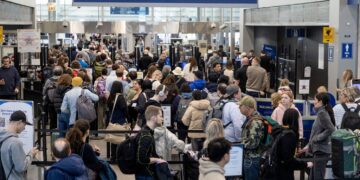










































































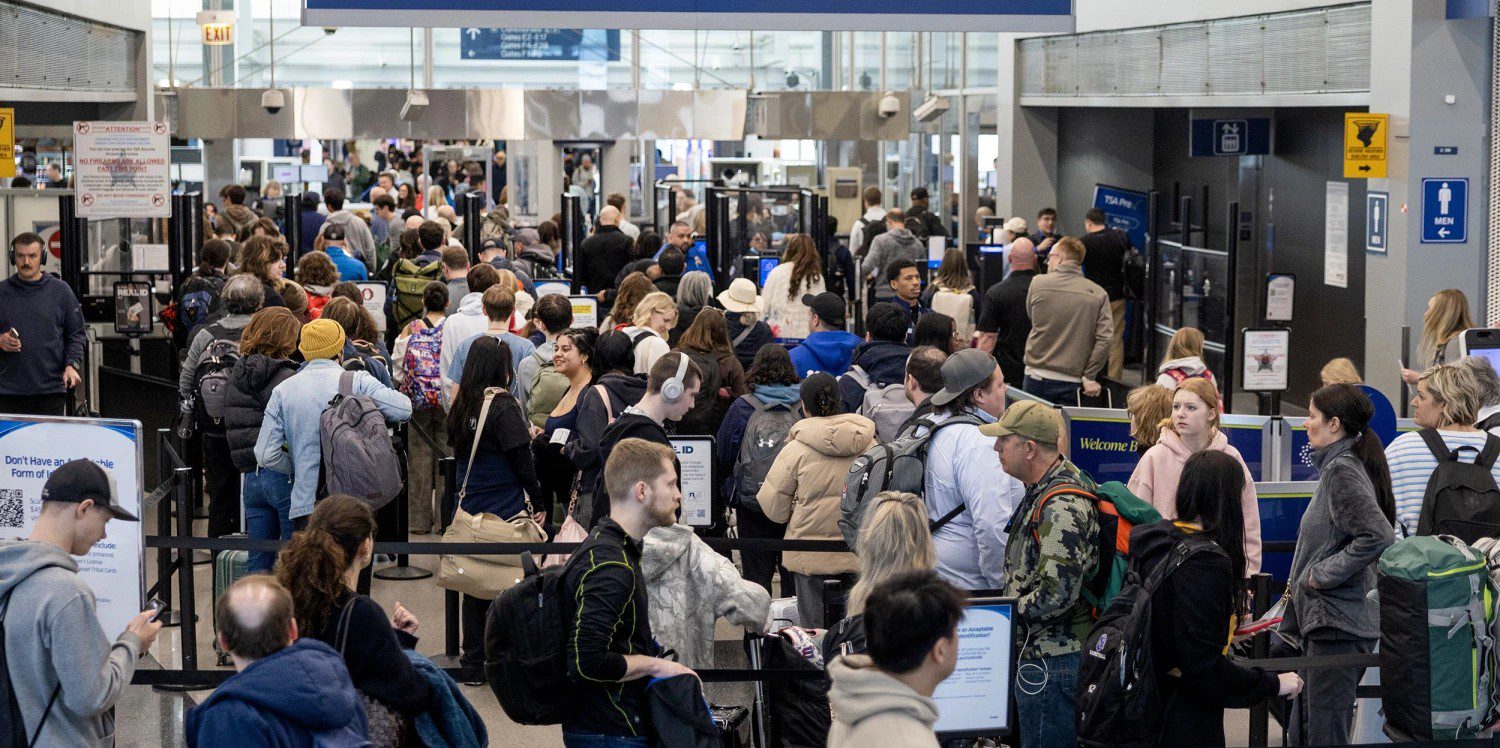
Air travel across the United States is expected to remain disrupted until late Sunday, according to the head of the Federal Aviation Administration (FAA), as airlines struggle to restore normal operations following a nationwide shutdown caused by problems with air traffic control communications.
More than 14,000 flights were cancelled or delayed on Saturday, adding to the disruption that left tens of thousands of passengers stranded after Friday’s nationwide ground stop.
FlightAware, an aviation tracking website, reported that airlines had cancelled more than 6,400 flights and delayed over 8,000 as of 9:35 p.m. Eastern Time on Saturday. This followed approximately 9,200 cancellations and 7,500 delays on Friday. A further 875 flights scheduled for Sunday had already been cancelled.
FAA Administrator Bryan Bedford said he expected airline operations to return largely to normal by late Sunday. He apologized to passengers affected by the disruption and maintained that the aviation system remained stable.
The FAA ordered a nationwide ground stop on Friday, bringing almost all departing flights to a halt for nearly five hours. It was the longest nationwide suspension of US air travel since the September 11, 2001 attacks and one of the most disruptive days for the country’s aviation industry.
The incident prompted an emergency meeting at the White House Situation Room on Friday, while federal agencies investigated whether a cyberattack was responsible.
However, Transportation Secretary Sean Duffy said on Saturday that the disruption had been traced to the installation of at least one new router by FAA contractor L3Harris at a remote facility.
Speaking at a press conference, Duffy said investigators were still trying to establish whether the problem resulted from human error during installation or a faulty device.
The Professional Aviation Safety Specialists (PASS), a union representing FAA safety employees, said the failure involved two routers that were upgraded on Friday. An official told Reuters that the equipment was believed to be located in Arkansas and Texas.
An FAA official said a safety assessment had been carried out before the work. PASS, however, said technicians represented by the union were not involved in the upgrades that preceded the shutdown.
L3Harris said it was taking the incident seriously and assisting the FAA with its investigation. Its shares fell by about four per cent in after-hours trading on Friday.
Router failure overwhelmed air traffic communication systems
Duffy said the problems began on Friday afternoon when air traffic control centres experienced instability affecting radar and communications systems.
Officials said the router malfunction generated excessive data traffic, placing additional pressure on other communication centres.
According to Duffy, the system recorded more than 1,000 connection attempts every four to five seconds. The surge affected communication between controllers and aircraft and also caused some disruption to radar operations.
The problem affected communications at 17 of the FAA’s 22 en route centres, which oversee aircraft during the cruising stage of flights.
Bedford said the agency ordered the nationwide ground stop as a precaution in case any centre lost all communication capabilities. He stressed that no facility had completely shut down and that communications had not been entirely lost.
The FAA said it was conducting further tests with L3Harris to establish whether the equipment or installation process posed any additional risks.
Several major airlines continued to cancel large numbers of flights on Saturday. Delta Air Lines, United Airlines and American Airlines each cancelled about 25 per cent of their scheduled services, while JetBlue cancelled nearly 45 per cent.
Airlines have introduced travel waivers allowing affected customers to change their bookings for later dates without paying additional fees.
Although the FAA lifted the ground stop on Friday evening, the effects continued into the weekend. Thousands of passengers remained stranded at airports as airlines worked to reposition aircraft, flight crews and other personnel needed to restore services.
Some college football teams were also caught up in the disruption, with travel delays preventing them from reaching destinations for matches scheduled for Saturday.
The latest disruption has renewed concerns about the condition of the US air traffic control network, which has faced mounting pressure from ageing equipment, communication failures and a shortage of several thousand air traffic controllers.
Duffy called on Friday for $50 billion in additional funding to modernize the system, raising his earlier request of $30 billion. Congress approved $12.5 billion for the upgrade programme last year.
House Speaker Mike Johnson said on Saturday that he supported providing additional funding for air traffic control this year.
Republicans currently control Congress, but Democrats are due to take over next year following their gains in the November 3 midterm elections.
Democratic lawmakers Rick Larsen and Andre Carson, who are expected to lead the House Transportation and Infrastructure Committee and its aviation subcommittee respectively next year, said their panels would investigate the incident.
In a joint statement issued on Saturday, they pledged to hold the administration accountable and establish what went wrong to prevent a similar breakdown.
The lawmakers also raised questions about how the funding already approved for modernisation had been used.
They said the Transportation Department had awarded contracts worth $4.3 billion since receiving the $12.5 billion allocation last year, but had spent only $1 billion.