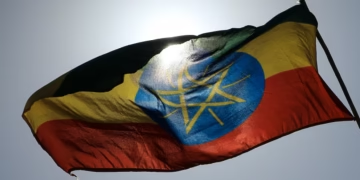












































































The Tigray People’s Liberation Front (TPLF) has withdrawn its fighters from Mekelle, the capital of Ethiopia’s northern Tigray region, paving the way for federal troops and allied forces to take control of the city after renewed fighting.
The TPLF, which had seized Mekelle and its airport on September 23, said in a statement on Saturday that its forces had pulled out of the regional capital.
The group said the decision was intended to prevent Mekelle from suffering the kind of destruction witnessed during Ethiopia’s previous war in Tigray, which ended with a peace agreement in 2022.
TPLF fighters took control of Mekelle airport during their offensive, prompting Ethiopian Airlines to suspend flights to Mekelle as well as the Tigrayan cities of Axum and Shire.
The renewed fighting has raised concerns over the future of the 2022 peace agreement, with the African Union calling on all sides to exercise restraint and avoid further escalation.
Government Forces Move Into Mekelle
Residents said federal troops and allied fighters entered parts of Mekelle after TPLF forces began withdrawing.
Internet and mobile phone disruptions have made it difficult to independently verify developments in the region, although some connectivity was restored on Sunday.
Residents who spoke to The Associated Press said federal forces had retaken the airport, although details about the military situation remained limited.
Filmon Equar Hailu, a local businessman, said he witnessed TPLF-allied fighters leaving the city in small groups over several days.
He said some fighters carrying light weapons left on foot, with the withdrawals continuing until Saturday afternoon.
Filmon also reported looting at government offices and other locations as the TPLF forces withdrew. He said some civilians took equipment from the TPLF administration office and regional police headquarters, while some shops were also looted.
Small groups of fighters from the Tigray Peace Force subsequently entered Mekelle, he said, adding that he heard celebratory gunfire overnight into Sunday.
Jalale Getachew Birru, an Ethiopia analyst with the Armed Conflict Location & Event Data project, said the federal government was likely to leave regional security arrangements largely in the hands of the Tigray Peace Force.
The group includes former members of the Tigray Defense Forces, the armed wing associated with the TPLF.
TPLF Vows to Continue Fighting
The withdrawal marks another major shift in the long-running confrontation between the TPLF and Prime Minister Abiy Ahmed’s government.
TPLF chairman Debretsion Gebremichael has openly challenged Abiy in recent months. He said on Thursday that the latest fighting represented a continuation of the previous war and that Tigrayan forces would continue fighting to defend the region.
The TPLF was once Tigray’s ruling party and was also the dominant force in the coalition that governed Ethiopia from 1991 until Abiy came to power in 2018.
The group is now one of seven opposition organizations that formed an alliance last month with the stated goal of removing Abiy from power.
The renewed conflict has brought further hardship to residents who are still recovering from the 2020-2022 war.
The suspension of flights has raised fears of renewed isolation, while residents have reported that roads linking Tigray with neighbouring Afar have also been closed to civilian traffic.
Ethiopia-Eritrea Tensions Deepen
The renewed fighting has also heightened tensions between Ethiopia and its neighbours, particularly Eritrea and Egypt.
Ethiopia has accused both countries, as well as Eritrea, of potentially supporting the TPLF-led opposition alliance. Egypt has denied backing the group, while Eritrea has accused Abiy’s government of attempting to shift blame for an internal Ethiopian conflict onto outside powers.
Relations between Ethiopia and Egypt have already been strained by the Grand Ethiopian Renaissance Dam on the Nile, which Cairo fears could affect its water supply.
Tensions between Ethiopia and Eritrea have also increased over Abiy’s calls for Ethiopia to secure sovereign access to the Red Sea, including through the Eritrean port of Assab.
Ethiopia on Thursday closed its embassy in Eritrea and ordered 10 Eritrean diplomats to leave the country, accusing them of involvement in activities that posed a threat to Ethiopian national security.
Eritrea responded by announcing that it was severing diplomatic relations with Ethiopia.
Against that backdrop, Eritrean President Isaias Afwerki travelled to Egypt on Saturday for talks with President Abdel-Fattah el-Sissi.
Eritrean Information Minister Yemane Gebremeskel said the visit, which was at el-Sissi’s invitation, would focus on strengthening relations between Eritrea and Egypt.
The developments have raised fears that renewed fighting in Tigray could extend beyond Ethiopia’s borders and further destabilize the Horn of Africa, a region already facing deep political and security tensions.