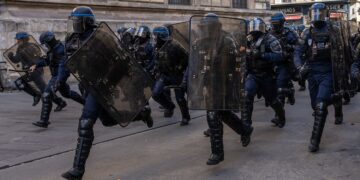





































































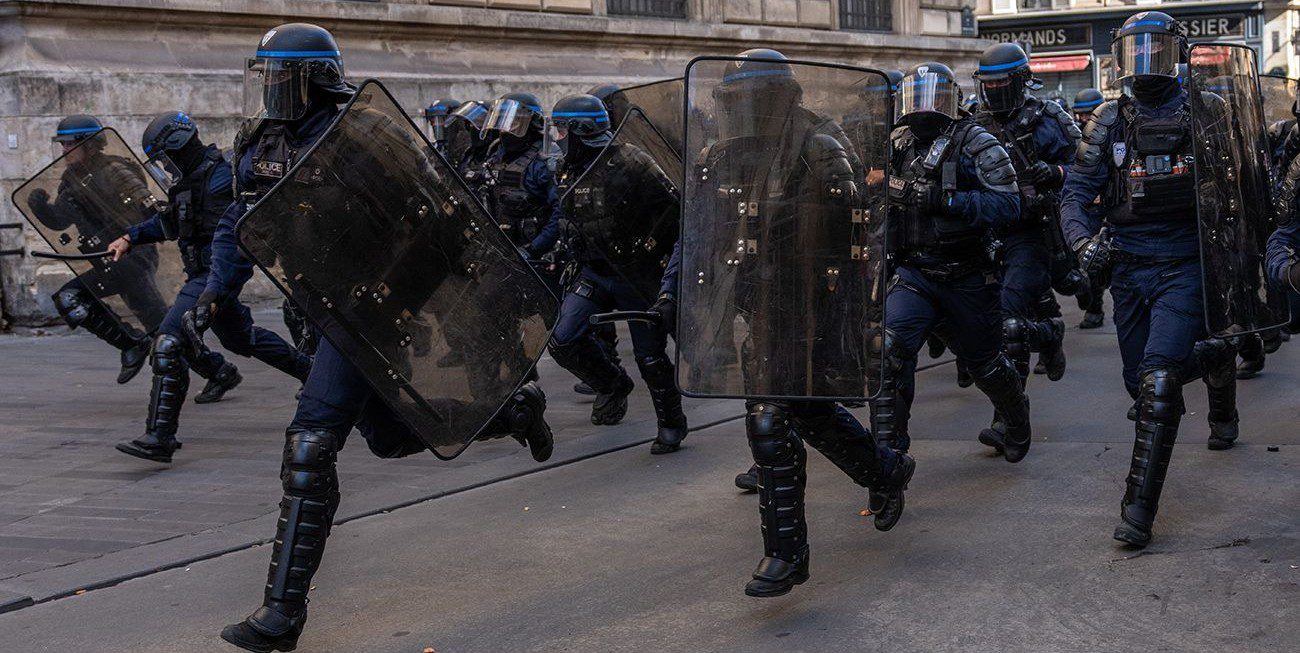
France has deployed 70,000 police officers nationwide as authorities prepare for fresh demonstrations amid fears of renewed violence, vandalism and looting, with security forces placed on high alert across Paris and restrictions imposed on protests in several cities.
Interior Minister Laurent Nunez ordered officers to respond swiftly to disturbances, warning that demonstrators could include radical groups and criminals seeking to exploit public anger over the cost of living and pressure on public services.
The security deployment is 10,000 officers larger than the force mobilized on 17-10-2026, when widespread vandalism and looting damaged businesses across the country and raised concerns about the government’s ability to maintain public order.
In Paris, soldiers from an anti-terrorism military unit patrolled the Champs-Elysees, while police vehicles were stationed around the Arc de Triomphe to protect major landmarks and commercial areas.
Addressing officers in the capital, Nunez warned that shops, public institutions and security personnel could become targets. He described the situation as potentially prolonged, citing calls for disruption from political groups and criminal elements.
Businesses and cultural sites close
Shopkeepers across Paris boarded up their premises ahead of the demonstrations, while luxury retailers increased security measures. Business associations had urged shops to close after thousands of businesses were reportedly damaged or looted during the previous weekend’s unrest.
Several major cultural attractions, including the Louvre, the Musée d’Orsay and the Paris Opera House, were also scheduled to shut for the day. More than 20 metro stations were closed as part of the security measures.
Uncertainty surrounded the main demonstration in Paris after police sought to move organizers’ proposed route away from the city centre towards the southeastern outskirts of the capital.
The Paris police prefecture said the original route presented significant risks because it passed through areas with a high concentration of businesses similar to those targeted during the unrest of 17-10-2026 and 18-10-2026.
The decision drew criticism from left-wing politicians, who accused authorities of making it difficult for organizers to rearrange their marches at short notice.
Jean-Luc Melenchon, leader of the hard-left France Unbowed party, criticized the restrictions in a post on X, arguing that the authorities were disrupting demonstrations and leaving organizers with little time to make alternative arrangements.
Protests restricted in several cities
Authorities have also limited demonstrations in several parts of France, although some restrictions have been eased.
Marseille reversed an earlier prohibition and authorized a trade union march, while protests remained restricted in central Lyon. Union rallies were also permitted in Strasbourg.
However, bans remained in place in several other cities, including Nancy, Metz, Besancon, Belfort, Rouen, Le Havre, Toulon and Limoges.
One of the first authorized demonstrations took place in Orleans, about 120 kilometers south of Paris, where protesters gathered against the far-right National Rally party, which was holding a congress in the city over the weekend.
Bally Bagayoko, mayor of Saint-Denis and a member of France Unbowed, said the march was intended to demonstrate opposition to the far right.
The demonstrations come amid heightened political and social tensions, with students, workers and trade unions participating in protests over rising living costs and strained public services. Authorities have maintained that some radical groups and young looters have used the unrest to pursue criminal activity.
Shooting adds to security concerns
Security concerns were further heightened by a shooting west of Paris on Friday. A gunman suspected of acting out of Islamophobic hatred killed one person and injured four others, including a 12-year-old girl.
The incident added to concerns about the potential for further violence as police prepared to manage demonstrations across the country.
The authorities’ expanded security operation is intended to prevent a repeat of the previous weekend’s destruction, while restrictions on demonstrations and the closure of major public attractions reflect the scale of concern over possible disorder.