

























































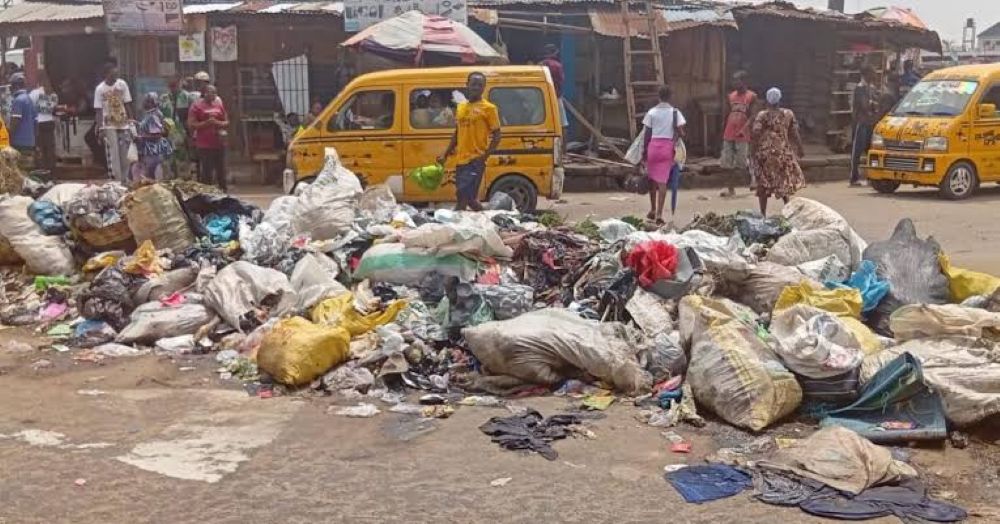
Lagos State Governor Babajide Sanwo-Olu has declared what he described as a “small state of emergency” on waste management as the government moves to address growing challenges in refuse collection and disposal across the state.
The governor announced the measure on Wednesday during an inspection of the Olusosun dumpsite in Ojota alongside his deputy, Obafemi Hamzat, and the Commissioner for Environment and Water Resources, Tokunbo Wahab.
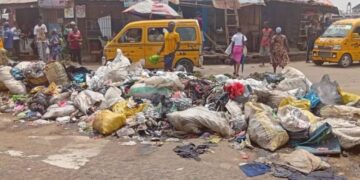
Sanwo-Olu said waste collection had come under significant pressure in recent weeks, contributing to the indiscriminate dumping of refuse in several parts of Lagos.
He said the government was declaring emergency measures to restore efficient waste collection and disposal and bring the situation under control.
According to the governor, the state had introduced monthly environmental sanitation exercises and intensified public campaigns on proper waste disposal, but the various efforts had not been sufficiently coordinated.
New waste facilities underway
As part of its medium and long-term strategy, the Lagos State Government is constructing two transfer loading stations with a combined capacity of 2,400 metric tonnes at Olusosun and Solu 3 in Alimosho.
The facilities will receive compacted waste before it is transported to material recovery centres being developed at Oke-Osho in Epe and Erikitte in Badagry.
Sanwo-Olu said the transfer stations would be capable of handling about 500 trucks daily, while the recovery facilities would support the sorting and conversion of waste into reusable materials.
He said construction work was expected to become more visible before the end of the year, with completion projected between the second quarter and the first quarter of the following year.
The governor said the government was also implementing immediate measures to expand the capacity of the Olusosun dumpsite.
The intervention is expected to raise the site’s daily truck-handling capacity from between 250 and 350 trucks to between 350 and 450.
This, he said, would involve increasing the number of tipping points from the current two or three to about four or five, allowing trucks to discharge waste more quickly.
Five disposal sites planned
Similar interventions are planned for Solu 3, Iwulepe in Ikorodu and Oke-Osho in Epe, while Erikitte in Badagry is also being developed.
Sanwo-Olu said Lagos hoped to have four active disposal sites within the next six weeks, with a fifth facility also coming on stream in Badagry.
The expansion is expected to reduce the pressure on Olusosun and improve the turnaround time for waste collection trucks.
He noted that some trucks currently spend as long as 12 hours, or in some cases an entire day, waiting to dispose of refuse at a single facility.
Distributing waste across more disposal locations, he said, would reduce delays and ease the movement of collection vehicles across Lagos roads.
Government to procure 160 compactor trucks
The governor also announced plans to purchase 160 new compactor trucks to strengthen refuse collection across the state.
The trucks are expected to improve the movement of waste from homes and roads to designated disposal facilities.
Sanwo-Olu said waste management company Zoomlion would also acquire additional trucks, while the state planned to procure landfill compactors to improve operations at disposal sites.
He described the planned transfer stations and material recovery facilities as central to Lagos’ long-term strategy for managing waste, improving disposal and converting recyclable materials into useful products.
According to him, the projects represent investments worth tens of millions of dollars.
PSP operators face review
Sanwo-Olu said the government would also review the operations of Private Sector Participants, PSPs, involved in waste collection.
The PSP association, he said, had agreed to reassess its membership and identify operators with the equipment, capacity and technical competence required to continue providing services.
The review will run alongside an independent assessment by the Lagos State Government.
Sanwo-Olu said the aim was to remove ineffective operators and create room for companies and investors with stronger operational capacity.
He said Lagos did not need hundreds of registered waste operators if a significant number of them lacked the capacity to deliver effective services.
The governor added that PSP operators had also agreed to purchase more compactor trucks.
The state government, he said, was prepared to explore financing arrangements that would reduce investment risks and prevent waste operators from falling into financial distress.
Residents urged to pay for waste services
Sanwo-Olu also appealed to Lagos residents to meet their financial obligations for waste collection.
He said it was unfair to expect waste management companies to provide services without receiving payment.
The governor said residents often demanded improved services but were reluctant to pay the operators responsible for collecting and disposing of their waste.
He assured Lagosians that the government and PSP operators would work together to improve service delivery.
The inspection of the Olusosun dumpsite formed part of renewed efforts by the Lagos State Government to address persistent challenges in waste collection, disposal and recycling across the state.