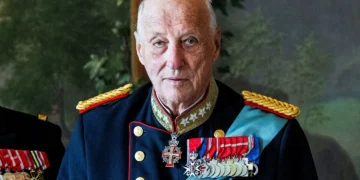













































































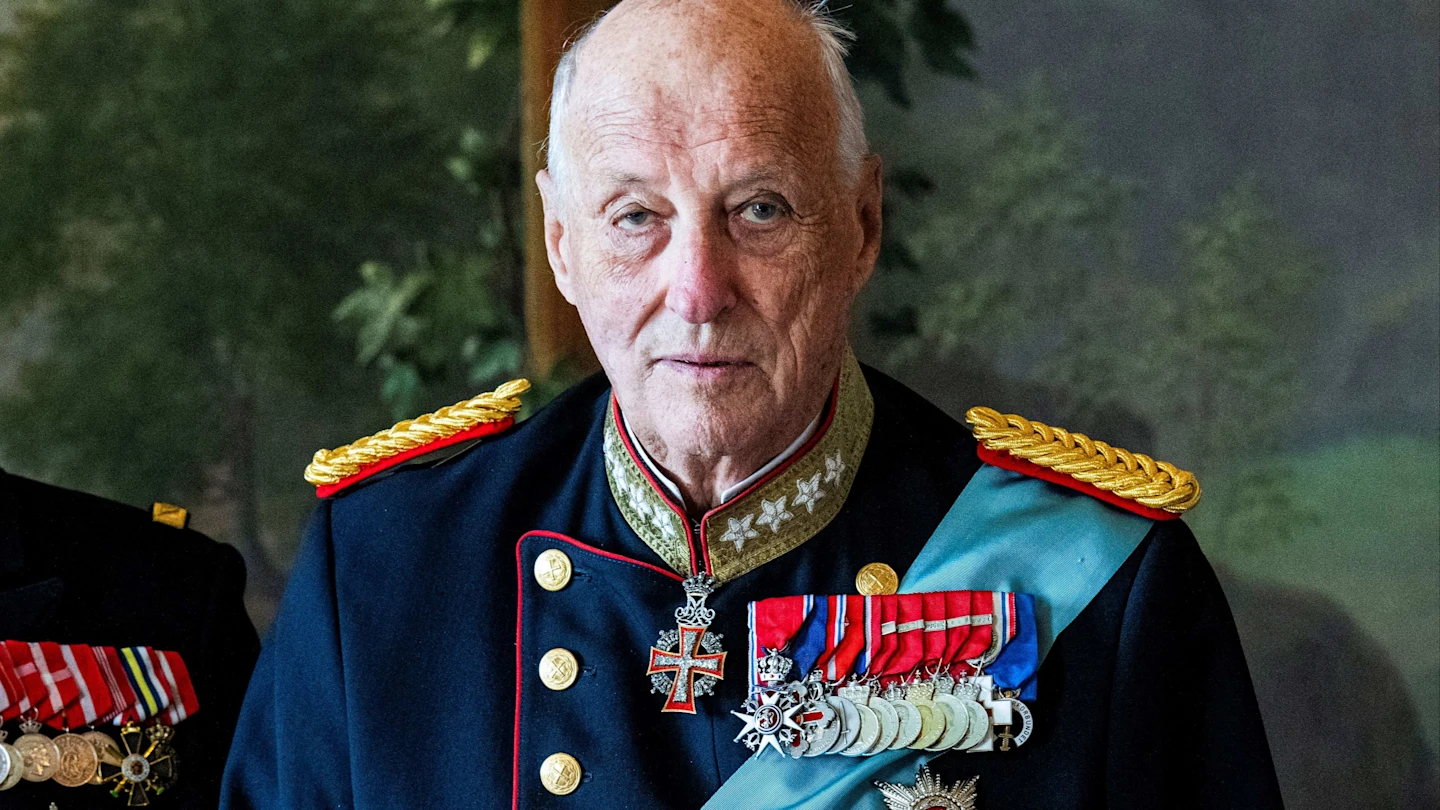
The Royal Palace said Harald died peacefully at Oslo University Hospital at 6:35 am local time on Friday, 28 August.
His death immediately triggered a period of national mourning, with flags at the Royal Palace in Oslo lowered to half-mast.
Harald had been Norway’s king since 1991, when he succeeded his father, King Olav V. He was also Europe’s oldest reigning monarch at the time of his death.
His son, 53-year-old Crown Prince Haakon, has automatically become king following his father’s death and is expected to take the name King Haakon VIII.
“It is with deep sadness that we announce that His Majesty King Harald passed away today,” the palace said.
Harald had been receiving treatment at Oslo University Hospital since August 17 after being admitted with haemolytic anaemia, a condition affecting red blood cells.
His health deteriorated during his final days, with the palace describing his condition as “extremely serious” on Thursday.
Queen Sonja and other close members of the royal family, including Crown Prince Haakon and Crown Princess Mette-Marit, were at his bedside as his condition worsened.
The king had experienced a number of health problems in recent years, including infections and the insertion of a pacemaker.
Although his health forced him to reduce his official duties, Harald consistently rejected suggestions that he might abdicate. He had previously said his oath as king was a lifelong commitment.
A monarchy under pressure
Harald’s death comes as Norway’s royal family faces a period of intense public scrutiny.
Earlier this year, the king was hospitalized during a private holiday in Tenerife with Queen Sonja after becoming ill with an infection and dehydration. Queen Sonja, also 89, was later treated in hospital for heart problems.
The family has also faced controversy surrounding Crown Princess Mette-Marit. Her past communications with convicted sex offender Jeffrey Epstein came under renewed scrutiny following the release of documents in the United States.
Her son, Marius Borg Høiby, has separately faced serious legal problems. He was sentenced in June to four years in prison for rape and other offences, although he has appealed the conviction.
Mette-Marit herself underwent a lung transplant in July while receiving treatment for a serious lung condition.
Despite the controversies, Harald maintained a strong level of public support and was widely seen as a stabilizing and unifying presence in Norwegian society.
More than 30 years as king
Born on February 21, 1937, Harald became king after his father’s death in 1991.
Over his more than 30 years on the throne, he helped shape a more modern and accessible Norwegian monarchy. His public image was often associated with openness, informality and a close connection with ordinary Norwegians.
Prime Minister Jonas Gahr Støre paid tribute to Harald, describing him as a monarch who dedicated his life to Norway and played an important role in bringing the country together during difficult periods.
The Norwegian government is expected to meet the new monarch at the Royal Palace after an extraordinary Council of State.
With Haakon now set to assume the crown, Norway begins a new chapter while mourning a king whose reign spanned more than a generation.