











































































Rescue teams are racing against time to locate nearly 1,500 people reported missing after a massive flash flood tore through parts of Nepal and China’s Tibet region, leaving widespread destruction in its wake.
The disaster struck on Wednesday after a huge landslide of rock and glacial material collapsed into the Lhende River, sending a powerful surge of mud, water and debris downstream. Roads, bridges, homes and other structures were swept away, cutting off communities and leaving thousands in need of urgent assistance.
Authorities said 826 people were missing in Nepal, including almost 500 foreign nationals. In Tibet’s Gyirong county, another 558 people were reported missing, among them 260 foreigners.
Nepali police warned that the death toll, already above 165, could rise as rescuers gain access to more affected areas and recover additional bodies.
The disaster has also left families desperately searching for relatives. Among those missing are tourists and pilgrims from several countries, including India, the United States, Australia, Britain and Canada.
Villages buried under mud
Survivors described a terrifying wall of mud and water rushing through settlements with little time to escape.
One survivor, 68-year-old Keshav Prasad Baral, said he tried to rescue his wife as the flood entered their home. He managed to reach higher ground and was later flown to safety, but his wife remains missing.
In some of the worst-hit communities, thick layers of mud now cover houses, vehicles and farmland. Bridges have been destroyed and sections of road linking Kathmandu with Lhasa have been badly damaged.
A local health worker, Tula Bahadur BK, said entire settlements along the river had disappeared. Five members of his own family were among those still missing.
Helicopters deployed for rescue
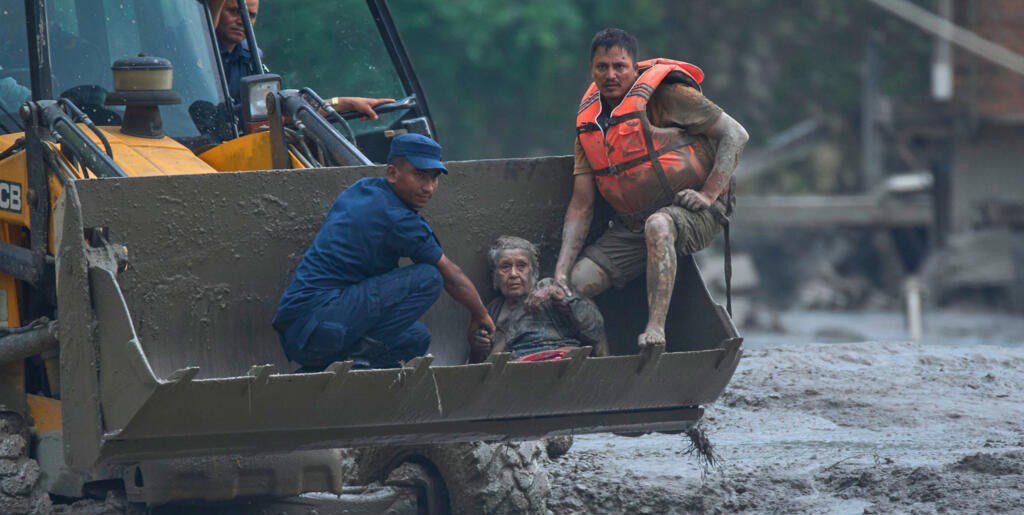
More than 5,000 soldiers and police officers have been deployed in Nepal as authorities use helicopters to reach isolated communities and deliver food, tents and other emergency supplies.
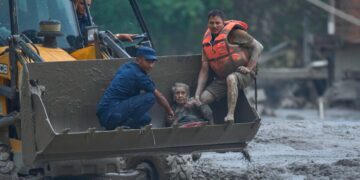
Rescuers managed to evacuate 125 people on Thursday, including 20 foreign nationals.
Neighbouring India has also supplied emergency materials, while the United States announced $500,000 in assistance and said it would send a disaster response adviser. Canada and the United Nations have also pledged support.
Nepal’s Prime Minister Balendra Shah travelled to one of the worst-affected districts to assess the situation.
Glacial collapse suspected
Initial reports suggested that an earthquake may have triggered the disaster. However, the U.S. Geological Survey later said the seismic activity was caused by the collapse of glacial rock and ice, followed by a massive debris flow.
Chinese authorities are also monitoring a lake upstream from the disaster zone that remains partially blocked. Further rainfall could cause additional flooding and make rescue operations even more dangerous.
The region has experienced similar disasters in recent years, with glacial lakes and unstable mountain slopes increasingly raising concerns about flash floods across the Himalayas.
Many of those caught in this week’s disaster were travelling to the Kailash Mansarovar pilgrimage site in Tibet, one of the most sacred destinations for Hindus and Buddhists.
With hundreds of people still unaccounted for, rescue teams continue to search through devastated communities while families wait for news of their loved ones.