
















































































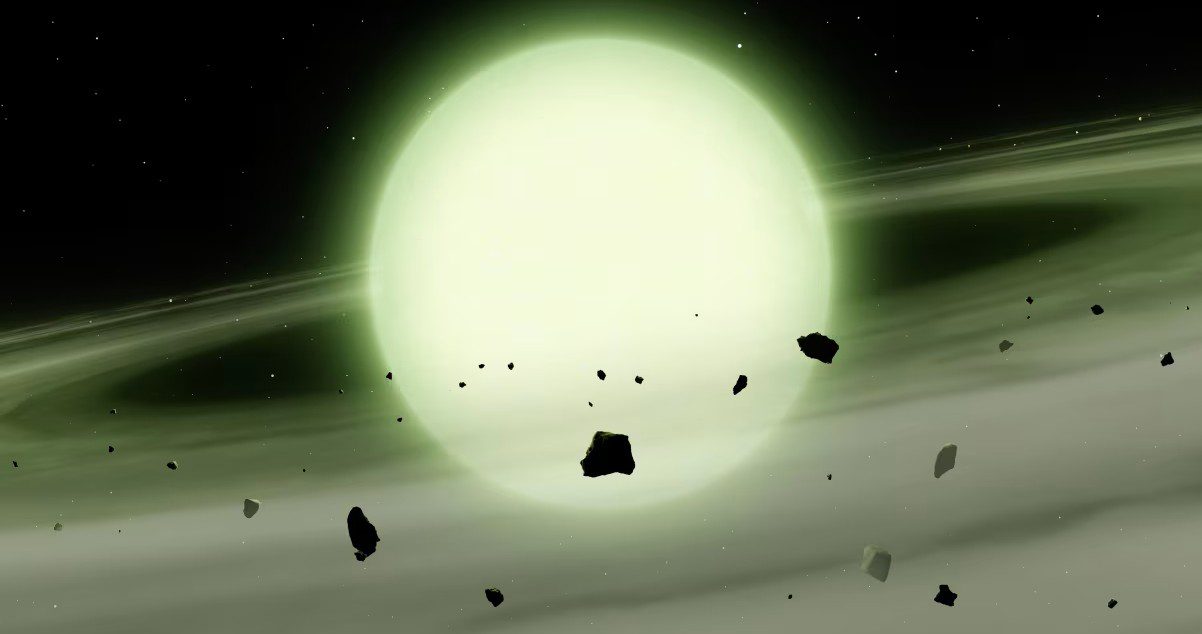
Astronomers have identified a rare white dwarf star whose light would appear green to the human eye, offering a new way to explore the chemical composition of stellar remnants and the planetary material surrounding them.
The discovery, detailed in a new study, emerged from an analysis of 151 known white dwarf stars located within 20 parsecs, or approximately 65 light-years, of Earth.
White dwarfs are the dense remnants left behind when stars similar to the Sun exhaust their nuclear fuel and reach the end of their lives. Although most stars appear orange, white or blue because of their surface temperatures, unusual atmospheric conditions can give some white dwarfs a wider variety of colours.
The study’s lead author, Mark Hollands, an astrophysicist at the University of Warwick in England, examined the stars’ light spectra to determine how they would appear to human observers.
A spectrum records the different wavelengths of light emitted by an object, producing a distinctive pattern that scientists can use to investigate its physical and chemical properties.
In most white dwarfs, the resulting colours follow familiar patterns. However, the researchers found that certain combinations of elements in the stars’ outer layers can significantly alter their light, producing unusual colours, including green and pink.
The green-appearing white dwarf contains notable amounts of calcium, sodium and lithium, according to the study.
What the colours reveal about distant planetary systems
The unusual colours are more than a visual curiosity. They may help astronomers investigate the material that has accumulated on the surfaces of white dwarfs over millions or billions of years.
Although the stars themselves are remnants of stellar evolution, some continue to collect debris from nearby objects. Asteroids or fragments of former planetary systems can venture too close to a white dwarf, where intense gravitational forces tear them apart.
The resulting dust and rocky debris can fall onto the star and mix with the material in its outer atmospheric layers.
Scientists can then examine the chemical signatures left behind to determine which elements were present in the destroyed material. Iron, magnesium and sodium, for example, can indicate the presence of rocky substances associated with planetary bodies.
By measuring the relative abundance of these elements, researchers can gain clues about the composition of planets and other objects that once existed around the star.
The process effectively allows astronomers to study planetary material that may have survived long after its original planetary system changed or disappeared.
Adam Burgasser, a professor of astronomy and astrophysics at the University of California, San Diego, who was not involved in the research, has highlighted the scientific value of using white dwarfs to investigate the chemical makeup of former planetary systems.
The evidence can help researchers reconstruct how planetary bodies formed and what materials they contained, even when the original objects no longer exist.
A pink star among the unusual discoveries
The green-appearing object was not the only white dwarf to stand out in the analysis.
The researchers also identified a star whose calculated colour would be close to salmon pink, an appearance associated with a high concentration of carbon molecules.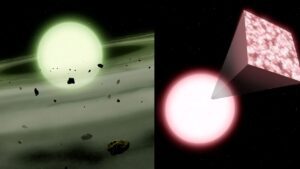 These findings demonstrate how differences in atmospheric composition can produce striking variations among objects that might otherwise appear similar.
The researchers did not observe the stars as coloured points visible to the naked eye. Instead, they calculated their likely appearance from existing spectral data, translating the wavelengths of their emitted light into colours that humans could perceive.
Agnès Kim, an astrophysicist and professor of physics at Penn State Scranton who was not involved in the study, noted the value of connecting the physics of stellar light with the way the human eye interprets colour.
The approach offers a different way of presenting complex astronomical data, allowing researchers and the public to visualize differences that are normally expressed through graphs and measurements.
The study’s colour classifications may also help scientists organize white dwarfs according to their temperatures and atmospheric properties, making it easier to investigate relationships between their appearance and chemical composition.
More discoveries may be ahead
The findings are based on existing observations and do not necessarily overturn established theories about white dwarfs. Their value lies partly in presenting a fresh way to interpret the characteristics of these stellar remnants.
Hollands plans to examine additional white dwarf spectra as new astronomical surveys begin providing more data on stars that have not yet been studied in the same detail.
Advances in observational techniques are expected to substantially expand the number of white dwarfs with available spectral measurements, potentially revealing more objects with unusual colours.
The current findings suggest that green-appearing white dwarfs may be rare, but the researchers expect a larger sample could help determine how common they really are.
Beyond their unusual appearance, these objects offer an opportunity to investigate the life cycles of stars and the fate of planetary systems. By studying the material that accumulates on white dwarfs, astronomers can recover clues about worlds that may have disappeared long before humans began observing the universe.
The discovery also provides a reminder that the universe contains phenomena that are difficult to appreciate through conventional astronomical images alone. Spectral analysis can reveal not only what distant objects are made of, but also how they might look if they were close enough for human eyes to see them.