




































































The global shift towards electric vehicles is intended to reduce pollution and slow climate change. But in the forests of Indonesia, the growing demand for battery minerals is raising difficult questions about whether the transition to cleaner transport is coming at the expense of indigenous communities and some of the world’s most important ecosystems.
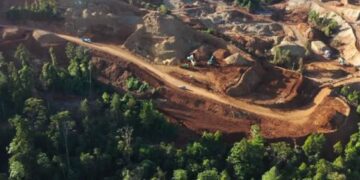
An investigation into the supply chains of major carmakers, including Volkswagen, Ford and Tesla, has linked nickel mining in Indonesia’s Sulawesi region to extensive deforestation in areas inhabited by the Indigenous Tolaki people. The findings suggest that minerals extracted from these forests may enter battery supply chains connected to leading automotive brands in Europe and the United States.
The issue exposes a contradiction at the heart of the electric vehicle industry: while electric cars produce no exhaust emissions during driving, the extraction and processing of the minerals needed to manufacture their batteries can carry significant environmental and social costs.
Sulawesi is a major centre of global nickel production and a biodiversity hotspot. Nickel is widely used in electric vehicle battery cathodes because it helps increase energy density and driving range. As demand for electric cars and other advanced technologies grows, pressure on the region’s mineral reserves has intensified.
For the Tolaki people, however, the consequences extend beyond the loss of trees. The forests form part of their cultural identity, livelihoods and relationship with the natural environment.
Wadimula, a Tolaki elder living near the Cahaya mining concession, has described the destruction of the forest as a threat to the community’s survival. The concession covers approximately 21,000 hectares.
The investigation’s findings raise concerns about how the push for cleaner transport can affect communities whose lands supply the raw materials needed for the energy transition.
From Indonesian forests to international car factories
Tracing the route of nickel from mines to finished vehicles is complicated by the number of companies involved in processing and manufacturing. The investigation used corporate disclosures, trade records and shipping data to identify links between mining operations in Sulawesi and battery supply chains serving major automotive manufacturers.
Two mining operations, Cahaya and Hengjaya, emerged as significant parts of the supply network examined.
Ore from these sites is transported to a nickel processing facility in the Morowali industrial complex on Indonesia’s eastern coast. The facility is operated by a local subsidiary of Zhejiang Huayou Cobalt, a Chinese company involved in producing materials for electric vehicle batteries.
At the plant, limonite ore is processed into mixed hydroxide precipitate, a material used in the production of battery cathodes.
Trade data cited in the investigation showed that shipments of mixed hydroxide precipitate from the Morowali facility to China were valued at $606 million in 2024 and a further $470 million in 2025.
The material was then transported to Huayou’s cathode manufacturing facilities in Quzhou, near Shanghai, and Yulin, close to China’s border with Vietnam.
Huayou’s corporate disclosures identify major battery manufacturers among its customers. The company confirmed group-level supplies to Contemporary Amperex Technology Co. Limited (CATL), the world’s largest battery maker, in response to a regulatory inquiry by the Shanghai Stock Exchange in 2024. A Huayou subsidiary, Chengdu B&M, has also acknowledged supplying large quantities of materials to CATL.
The investigation identified routes connecting Huayou’s operations and CATL’s battery manufacturing network with vehicle production facilities in Europe and the United States.
One shipment recorded in October 2024 involved 24 tonnes of cell modules valued at about $390,000 delivered to Volkswagen’s facility in Braunschweig, Germany, according to trade platform Volza.
However, the available records do not establish that a specific shipment of nickel from either Sulawesi mine ended up in a particular vehicle battery. Public disclosures do not provide the detailed sales volumes and timing needed to make that direct connection.
The findings instead identify links across a complex network of mines, refiners, battery-material manufacturers and automotive companies, raising questions about the traceability of raw materials in global supply chains.
The carmakers identified as end-users of Huayou cathode materials or recipients of CATL shipments include Volkswagen, Volvo, Ford, General Motors, Tesla, BMW, Stellantis and Hyundai. Mercedes-Benz was separately linked to Huayou.
The companies have generally said they take environmental and human rights risks seriously and expect suppliers to follow responsible sourcing standards. Several said they did not purchase nickel directly from the mines identified, while others cited monitoring and due diligence procedures.
Their responses, however, did not resolve all questions about the extent of the links or the results of environmental and social audits.
Mining takes a heavy toll on forest land
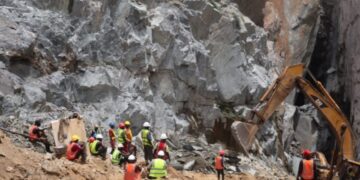
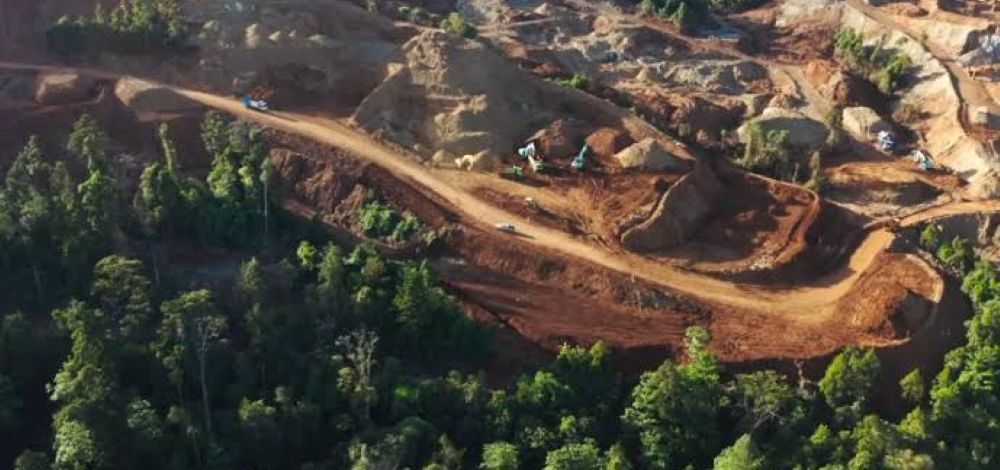
Satellite imagery and spatial analysis point to substantial forest loss within the Cahaya and Hengjaya concessions.
Research by geospatial firm The TreeMap estimated that nickel mining may account for about two-thirds of the forest loss recorded since 2001 within the Cahaya concession area, as well as more than half of the loss within Hengjaya.
A separate analysis by Indonesian environmental organization Auriga found that Sulawesi Cahaya Mineral, the operator of the Cahaya mine, contributed to the clearance of an additional 330 hectares of forest in 2024.
The company delivered approximately 11 million tonnes of limonite ore to Huayou’s smelter that year, accounting for almost all its production. Deliveries rose to nearly 12.5 million tonnes in 2025.
Local truck drivers told the investigators that the processing plant also continued to receive ore transported by road from Hengjaya.
The investigation further reported that Sulawesi Cahaya Mineral received two administrative sanctions in 2025 over the alleged illegal clearing of more than 450 hectares of forest beyond its permitted clearing area.
The company is a subsidiary of Merdeka Battery Materials, whose wider corporate group includes Huayou and CATL among its shareholders.
Both mining concessions are located in areas designated as production forest, a classification intended primarily for forestry activities rather than unrestricted industrial development. Yet Indonesia’s regulatory framework has been adjusted over time to accommodate the rapid expansion of nickel extraction.
The result is a growing conflict between mineral production and forest conservation, particularly in regions where mining overlaps with indigenous territories and sensitive ecosystems.
Indonesia has become central to the global nickel industry because of its large reserves and expanding processing capacity. The country is also a major supplier to Chinese refineries and manufacturers that produce materials for the international battery market.
As the sector expands, environmental campaigners warn that the loss of forests can undermine the climate benefits expected from electric vehicles. Trees store carbon, while their removal and the disturbance of surrounding land can release emissions and damage biodiversity.
A study published in Nature Communications found that the carbon footprint of nickel from the most damaging mining operations could be as much as 500 times higher than previously reported estimates when forest loss is taken into account.
That finding highlights the importance of assessing not only emissions from vehicles but also the environmental effects of extracting and processing the materials used to manufacture them.
The challenge facing electric vehicle manufacturers
Electric vehicles remain an important part of efforts to reduce transport emissions. Unlike petrol and diesel vehicles, they do not release exhaust gases while being driven. Their overall environmental benefits, however, depend partly on how their batteries and other components are produced.
The rapid growth of the industry has created demand for large quantities of minerals from countries where environmental protections, land rights and enforcement can be contentious.
For manufacturers, the challenge is to ensure that the transition to cleaner transport does not create new forms of environmental damage or expose local communities to exploitation.
Volkswagen said it takes potential supply-chain risks seriously but could not disclose specific supplier relationships because of contractual obligations. The company also said it could not rule out the possibility that the businesses identified in the investigation were connected to its supply chain.
Ford said it was reviewing the allegations and would determine appropriate action based on that assessment.
Mercedes-Benz said it takes reports of environmental and social harm involving raw materials, including Indonesian nickel, seriously and incorporates such risks into its due diligence process.
Renault Group acknowledged identifying a nickel mining site in Sulawesi as an indirect supplier within its battery supply chain. It said it had engaged relevant business partners to verify environmental, social and governance information relating to Sulawesi Cahaya Mineral.
Volvo Cars said it had carried out on-site audits of battery supply-chain partners during 2025, including two in Indonesia, and planned further audits in 2026 and beyond.
General Motors acknowledged that nickel mining in Indonesia presents significant environmental, human rights and community-related risks. Stellantis also recognized concerns involving deforestation, biodiversity loss and ecosystem degradation.
Hyundai said it monitors and assesses suppliers, including mineral suppliers, to check compliance with its requirements on forest protection, biodiversity and local communities.
CATL, Huayou, Sulawesi Cahaya Mineral and Tesla did not respond to requests for comment. Tsingshan, the main shareholder of Nickel Industries, which operates the Hengjaya mine, also did not respond.
The responses illustrate the difficulty of establishing accountability across supply chains involving multiple countries and layers of suppliers. A carmaker may purchase battery systems from a manufacturer without directly buying minerals from the mine where the raw material originated.
That distance can make it harder to determine whether sourcing standards are being followed and whether reported violations have resulted in meaningful corrective action.
Can the demand for minerals be reduced?
The pressure on nickel-producing regions is expected to grow. The International Energy Agency forecasts that global nickel demand could double to 5.5 million tonnes by 2040, with Indonesia and China continuing to play major roles in mining and processing.
But rising demand does not necessarily mean that the environmental costs of the energy transition must increase at the same pace.
Research has identified several ways to reduce the need for newly mined minerals, including expanding public transport, making walking and cycling safer and more practical, encouraging smaller vehicles and improving battery recycling.
A 2023 report examining lithium demand in the US transport sector estimated that stronger public transport systems and changes in travel and vehicle choices could reduce demand by 18 to 66 per cent compared with a business-as-usual scenario. Better recycling could potentially cut demand by as much as 92 per cent, the report found.
Although the research focused on lithium, its broader implications extend to the challenge of reducing pressure on mineral supply chains. More efficient use of materials, longer product lifespans and improved recycling can help limit the need for new extraction.
The expansion of large sport utility vehicles has also drawn criticism from environmental groups because bigger vehicles generally require more materials and larger batteries than smaller models. Reducing unnecessary demand for minerals could therefore complement the shift to electric power.
For Indonesia, the immediate challenge is to balance the economic benefits of nickel production against the protection of forests, biodiversity and the rights of local communities. For international manufacturers, it is to establish supply chains that can be independently scrutinized and to respond effectively when environmental damage is identified.
The investigation does not establish that every vehicle produced by the companies named contains nickel from the two mines. It does, however, expose potential connections between mining operations associated with forest loss and the global battery industry.
As electric vehicles become more common, the environmental credentials of the sector will depend not only on replacing combustion engines but also on how responsibly the minerals powering the new technology are obtained.
For the Tolaki communities living beside the mines, that distinction is immediate. The benefits of cleaner transport are global, but the loss of forests and traditional lands is felt locally, where the consequences of mineral extraction can last long after the ore has been removed.