



















































Venezuela has been plunged into one of the worst natural disasters in its modern history after two powerful earthquakes struck within seconds of each other, leaving thousands feared dead, flattening buildings, crippling infrastructure and triggering a massive international rescue effort.
The twin earthquakes, which struck on Wednesday evening, included a magnitude 7.2 tremor followed less than a minute later by a magnitude 7.5 earthquake, according to the United States Geological Survey (USGS). The epicentre was located about 160 kilometres west of Caracas, but the devastating tremors were felt across much of the country.
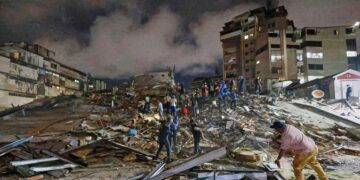
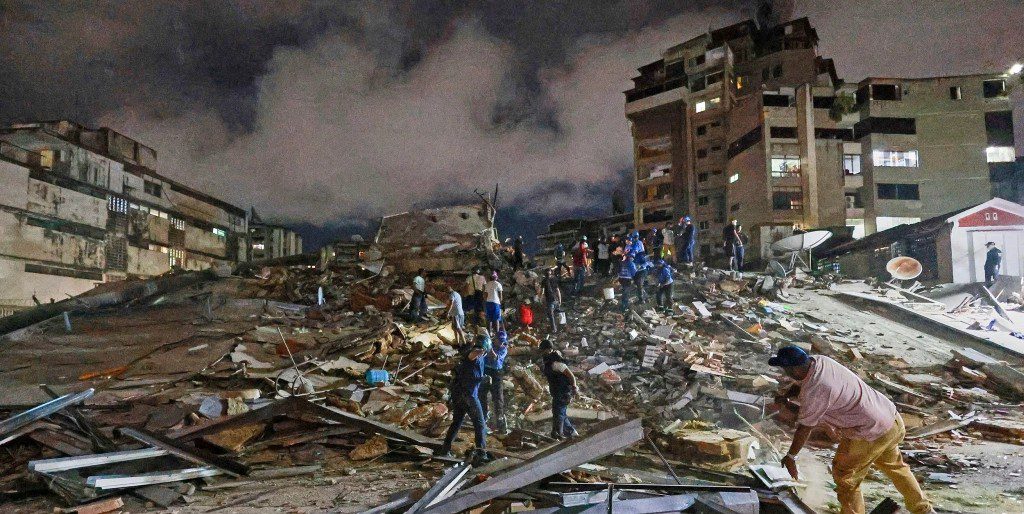
The second quake is the strongest recorded in Venezuela since 1900, reducing homes, apartment blocks and public buildings to rubble while trapping hundreds of residents beneath collapsed structures.
Authorities said rescue operations continued through the night into Thursday as emergency workers, soldiers and volunteers searched desperately for survivors.
According to Reuters, Venezuelan officials confirmed that at least 188 people have died, while 1,520 others sustained injuries. More than 200 people remain trapped beneath collapsed buildings, raising fears that the death toll could rise sharply in the coming days.
Officials also reported that over 250 buildings were either destroyed or severely damaged.
USGS predictive modelling suggested fatalities could eventually run into the thousands, with a significant probability that the final death toll could exceed 10,000.
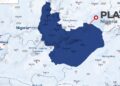
Meanwhile, an online platform established by members of Venezuela’s opposition to help reunite families had listed more than 35,000 people as unaccounted for by Thursday afternoon, although authorities have yet to verify those figures.
The worst destruction occurred in La Guaira State, neighbouring Caracas, where authorities described the situation as catastrophic.
Interim President Delcy Rodríguez declared the coastal state a disaster zone, saying emergency agencies were working alongside private companies to deploy heavy equipment needed to reach people trapped beneath collapsed buildings.
“We are mobilizing every available resource to accelerate rescue efforts,” she said.
Despite the government response, many residents complained that help had yet to reach their communities.
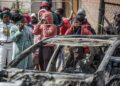
In the city of La Guaira, volunteers were seen digging through debris with their bare hands as rescue equipment remained scarce.
Among them was Yamileth Jiménez, whose 19-year-old son is believed trapped beneath the ruins of their seven-storey apartment building.
“He’s under the concrete slabs and there is no machinery to get him out,” she said. “My father died three days ago, and now this has happened. My son is all I have left.”
Across affected communities, survivors described scenes of devastation as buildings crumbled within seconds.
“When we finally got downstairs, it looked like a horror movie,” said Caracas resident Maria Alejandra.
“We had to climb over piles of rubble just to get outside. I only saw one family escape safely from the neighbouring building.”
Near the earthquake’s epicentre in Morón, in Carabobo State, homes collapsed while electricity and water supplies were cut off.
Local officials confirmed that at least eight people, including three children, were killed in the town alone.
Thousands of displaced residents spent the night outdoors amid fears of further aftershocks.
The earthquakes severely disrupted transportation and essential services.
Caracas’ main international airport, located in La Guaira, was shut down after sustaining structural damage, while roads, bridges and public buildings across several regions were affected.
Large sections of Caracas, La Guaira and nearby towns remained without electricity on Thursday, complicating rescue operations and communications.
Schools across the capital were closed for the remainder of the week, while the Caracas Stock Exchange suspended trading after authorities converted the facility into an emergency coordination centre.
Hospitals worked beyond capacity as medical personnel doubled shifts to care for the growing number of injured victims.
As shortages of food and drinking water emerged, isolated incidents of looting were reported in parts of La Guaira.
Residents who lost their homes appealed for urgent humanitarian assistance.
“We have lost everything,” said Pedro Pérez, whose upholstery business and home were destroyed.
“We have no food, no medicines. We escaped with only minor injuries, but now my family has nowhere to live.”
Governments and humanitarian organizations worldwide pledged assistance as the scale of the disaster became clearer.
President Rodríguez thanked several world leaders, including United States President Donald Trump and Russian President Vladimir Putin, for offering support.
Trump said the United States stood ready to assist Venezuela’s recovery efforts.
“We are ready, willing and able to help. America will stand with the Venezuelan people during this tragedy,” he said.
US Secretary of State Marco Rubio announced that American search-and-rescue teams were being deployed while military assets would assist operations at Caracas’ damaged airport.
The United Nations also began coordinating international emergency assistance.
UN humanitarian chief Tom Fletcher said a large-scale global response would be required, noting that millions of Venezuelans were already dependent on humanitarian aid before the disaster struck.
The UN Human Rights Mission further urged Venezuelan authorities to relax restrictions on social media platforms to improve emergency communications and help families locate missing relatives.
Despite the widespread destruction, Venezuela’s critical oil infrastructure appeared to have escaped major damage.
Officials said operations were gradually resuming at the Morón Petrochemical Complex, the country’s second-largest petrochemical facility, after safety inspections.
US energy giant Chevron, a major partner of state-owned oil company PDVSA, confirmed that all its personnel in Venezuela had been accounted for and that production activities continued uninterrupted.
British energy company Shell also reported that none of its employees had been injured.
The latest disaster ranks among Venezuela’s most destructive earthquakes since independence.
The country sits along the boundary between the Caribbean and South American tectonic plates and has experienced several deadly earthquakes, including the devastating 1812 earthquake, which claimed an estimated 30,000 lives.
For many survivors, Wednesday’s catastrophe surpassed even the deadly 1967 Caracas earthquake, which killed about 240 people.
“This earthquake was terrifying,” said Maria Romero, an 80-year-old Caracas resident.
“It was even worse than the one we experienced in 1967.”
With rescue teams continuing to search through the ruins and thousands still missing, officials warned that the full scale of the tragedy may not be known for several days.