













































































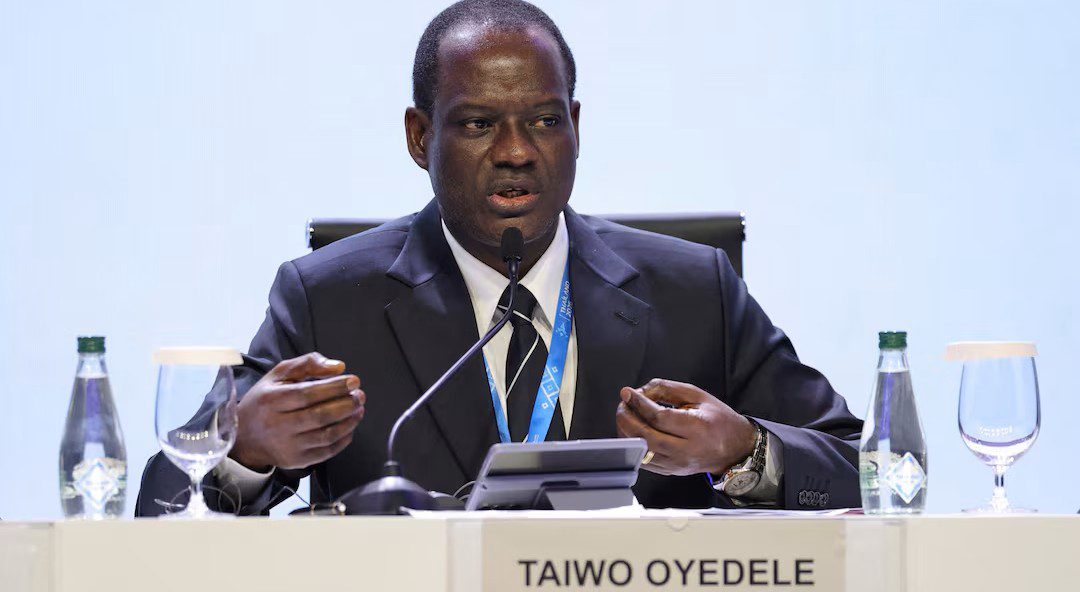
Nigeria’s Minister of Finance and Coordinating Minister of the Economy, Taiwo Oyedele, has warned that rising debt burdens and borrowing costs are undermining economic growth in developing countries, with estimates suggesting they pay about $500 billion more in debt costs than advanced economies.
Oyedele, who chairs the Group of 24 (G24), said the growing cost of servicing public debt had become a major obstacle to inclusive growth, particularly in African countries struggling with fiscal pressures.
He spoke on Tuesday at a press briefing during the annual meetings of the International Monetary Fund and World Bank in Bangkok, Thailand.
“What we have seen by members of the G24 and across particularly the developing countries such as those in Africa, is an increasing body of not just high debts, but high costs of debts,” Oyedele said.
He warned that the combination of rising debt levels and expensive borrowing was limiting governments’ ability to invest in development and create jobs.
Developing economies have faced additional pressure this year from supply disruptions linked to the ongoing Middle East conflict, rising food prices associated with a forecast “super El Niño” and higher borrowing costs.
Oyedele said these challenges were affecting the progress of emerging and developing economies towards inclusive growth and employment-generating economic transformation.
G24 Seeks Cheaper Financing for Vulnerable Countries
The G24, a bloc representing emerging and developing economies, has called on the IMF and World Bank to expand access to affordable concessional financing for countries facing severe economic pressures.
The group said such support was needed in the near term as governments sought to mobilise private investment and rein in public spending.
Iyabo Masha, director of the G24 secretariat, said heavy debt obligations were diverting resources that could otherwise be used to support economic expansion.
“Debt is something that restrains growth, because countries then do not have enough resources to finance further growth, or they are spending most of their resources just paying off the debt,” Masha said.
She added that recent improvements to the international sovereign debt framework could help countries resolve debt crises more quickly.
Masha cited Senegal as an example, saying the West African country was approaching a final agreement with its creditors.
The country was reportedly targeting an agreement in principle with official lenders and bondholders by December, following the emergence of misreported debt two years ago. Analysts have estimated the debt discrepancy at about $13 billion.
G24 Warns AI Could Widen Digital Divide
Beyond debt pressures, the G24 also raised concerns that developing countries could miss out on the economic benefits of artificial intelligence because of gaps in digital infrastructure and access to electricity.
Masha warned that countries with limited technological development risked falling further behind as AI adoption accelerated globally.
“It is a concern that (AI) will widen the digital divide,” she told Reuters on the sidelines of the briefing.
She said countries with inadequate infrastructure would struggle to benefit from the technology in the near term, while those with reliable electricity could attract data centre investments and related economic activity.
The warning comes as the IMF revised down its growth forecasts for Latin America and the Caribbean for this year and next. The fund said much of the region was gaining little from the AI boom, which has helped some economies cushion the effects of the energy shock linked to the Middle East conflict.
Masha said countries that had yet to establish the necessary foundations for AI adoption could face a prolonged wait before they began to benefit.
The G24’s concerns highlight the combined challenges facing developing economies, including rising debt-servicing costs, limited fiscal space and unequal access to emerging technologies.