










































The death toll from the devastating twin earthquakes that struck northern Venezuela has climbed to 920, while more than 50,000 people remain unaccounted for, as rescue workers from around the world intensify efforts to locate survivors trapped beneath collapsed buildings.
The powerful earthquakes, measuring 7.2 and 7.5 magnitudes, struck less than a minute apart on Wednesday evening, causing widespread destruction across the capital, Caracas, and neighbouring coastal communities. Authorities fear the number of fatalities could rise significantly as search operations continue.
The La Guaira coastal region, located near Caracas, suffered the heaviest devastation, with entire residential buildings flattened and critical infrastructure severely damaged.
Venezuela’s Interior Minister, Diosdado Cabello, announced that access to the disaster zone would be restricted from Friday night to facilitate ongoing rescue operations.
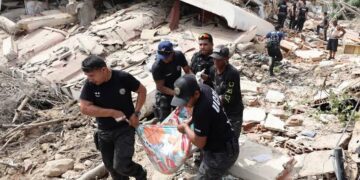
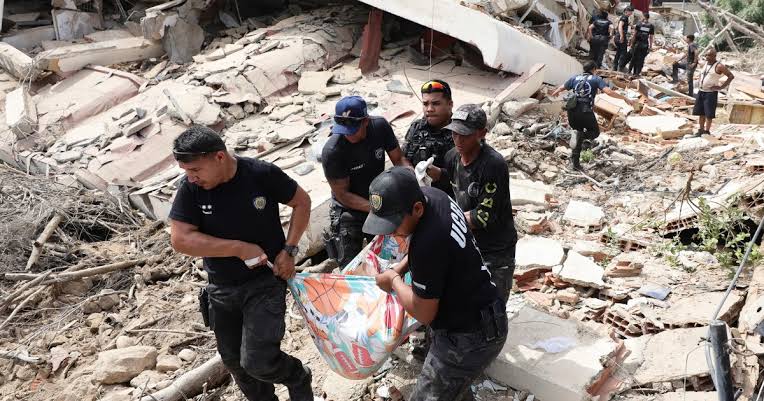
In one of the worst-hit residential complexes in La Guaira, Chilean rescue teams deployed heavy equipment to search through the remains of four high-rise apartment buildings that collapsed almost completely.
Rescue team leader Nadiomar Polanco said the scale of destruction had significantly reduced hopes of finding additional survivors.
“The collapse is almost total, and unfortunately the chances of finding people alive are very slim. Our efforts are now largely focused on recovering victims,” Polanco said.
Despite the arrival of international rescue teams, many residents continued searching for relatives with little more than their bare hands, expressing frustration over what they described as an inadequate official response during the critical first hours after the disaster.
Among them was Marjosly Salazar, who lost her 16-year-old daughter and is still searching for her five-month-old grandson and another missing relative.
“We desperately need heavy machinery to lift the concrete slabs. We have hardly seen any government rescue teams here,” she said.
Public anger was also directed at interim President Delcy Rodríguez, who faced protests while visiting one of the devastated districts in Caracas. Residents accused the government of responding too slowly to the catastrophe, with some chanting that authorities had abandoned affected communities.
Search operations continued under difficult conditions as rescue workers carefully broke through piles of concrete and twisted steel while repeatedly calling for silence in hopes of hearing voices from beneath the rubble.
The United Nations humanitarian chief, Tom Fletcher, described the operation as “an extremely complex emergency response,” warning that aftershocks and unstable buildings continued to pose serious risks to both survivors and rescue personnel.
The disaster has compounded Venezuela’s long-running humanitarian and economic crisis. Years of economic decline have weakened healthcare services, emergency response capacity and public infrastructure, leaving the country particularly vulnerable to a disaster of this scale.
International assistance has continued to expand, with the United Nations coordinating rescue missions from at least 17 countries. Search-and-rescue teams from Spain, Chile, Switzerland, Colombia, Mexico and El Salvador are already working alongside Venezuelan emergency responders.
The United States has also deployed more than 250 emergency response personnel, including specialist urban search-and-rescue units equipped with trained dogs to locate survivors beneath collapsed structures.
According to President Rodríguez, U.S. President Donald Trump and Secretary of State Marco Rubio pledged continued American support, including additional rescue personnel, specialist equipment, temporary shelters and humanitarian relief supplies for affected communities.
The United Nations and humanitarian organizations warned that the disaster could significantly worsen an already fragile humanitarian situation, noting that millions of Venezuelans were already facing food shortages, inadequate healthcare and limited access to essential public services before the earthquakes struck.
Officials also confirmed that several foreign nationals were among the victims, including citizens from Portugal, Spain, Brazil, China, Chile and Italy, while many others remain missing.
The twin earthquakes are the strongest to strike Venezuela in more than a century. The country’s northern coastline lies along the boundary between the Caribbean and South American tectonic plates, making it vulnerable to seismic activity, although major earthquakes have been relatively rare in recent decades.
As rescue operations continue, moments of silence were observed before Friday’s 2026 FIFA World Cup matches in honour of those who lost their lives in one of the deadliest natural disasters in Venezuela’s modern history.