














































































The Central Bank of Nigeria (CBN) has maintained its benchmark Monetary Policy Rate (MPR) at 26.5 per cent, opting for caution as renewed conflict in the Middle East and lingering domestic inflationary pressures continue to pose risks to the economy.
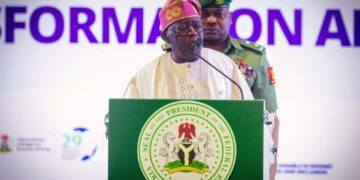
The decision was announced on Tuesday by CBN Governor Olayemi Cardoso after the 306th meeting of the Monetary Policy Committee (MPC) in Abuja, where all 11 committee members were in attendance.
The MPC voted unanimously to keep the key policy rate unchanged for the second consecutive meeting, following a 50-basis-point reduction introduced in February 2026.
Other key policy parameters retained
Alongside the decision to hold the benchmark rate, the committee also retained all major monetary policy parameters.
The Cash Reserve Ratio (CRR) remains at 45 per cent for Deposit Money Banks and 16 per cent for Merchant Banks, while the reserve requirement for non-Treasury Single Account public sector deposits stays at 75 per cent.
The committee equally maintained the existing asymmetric corridor around the Monetary Policy Rate.
Why the committee held rates
Cardoso said the MPC considered both domestic and global economic developments before deciding that maintaining the current monetary stance was the most appropriate course of action.
Although inflation has shown early signs of easing, he said heightened geopolitical uncertainty, particularly the renewed fighting in the Middle East, could reverse recent gains through higher energy prices and imported inflation.
According to him, members concluded that a cautious approach was necessary while monitoring how external developments evolve.
The governor noted that renewed hostilities in the Gulf have significant implications for global oil markets, shipping costs and inflation worldwide, factors capable of spilling over into the Nigerian economy.
Inflation eases slightly
The committee’s decision comes despite a marginal moderation in Nigeria’s inflation rate.
According to the National Bureau of Statistics (NBS), headline inflation declined slightly to 15.91 per cent in June, compared with 15.93 per cent in May, ending three consecutive months of increases.
Inflation had climbed steadily from 15.06 per cent in February to 15.38 per cent in March, 15.69 per cent in April, and 15.93 per cent in May before recording the slight decline in June.
Cardoso said the moderation reflected the impact of earlier monetary tightening measures.
Food prices remain a concern
Despite the easing in headline inflation, food prices continued to accelerate.
Food inflation rose to 17.52 per cent in June, up from 16.96 per cent in May, driven by supply disruptions in key agricultural areas and persistently high transportation costs.
Core inflation, however, slowed significantly to 15.92 per cent, compared with 16.82 per cent in May, largely due to greater exchange rate stability.
The CBN governor also pointed out that Nigeria’s 12-month average inflation rate declined for the sixth consecutive month to 17.63 per cent, down from 18.36 per cent recorded in May.
Month-on-month headline inflation equally eased from 1.75 per cent to 1.66 per cent.
Economy remains resilient
Cardoso told journalists that the Nigerian economy has continued to withstand external shocks despite growing global uncertainty.
He attributed the resilience to policy reforms implemented jointly by monetary and fiscal authorities over the past two years.
According to him, maintaining macroeconomic stability has strengthened investor confidence and created a more favourable environment for economic growth.
The governor added that closer coordination between the Federal Government and the CBN has helped reduce the domestic impact of rising geopolitical tensions.
Support for government reforms
The MPC commended recent economic reforms introduced by the Federal Government, including Executive Order 9, which members said could strengthen Nigeria’s macroeconomic fundamentals.
The committee also urged authorities to sustain efforts aimed at boosting crude oil production while accelerating reforms in the solid minerals sector to broaden government revenue sources.
Members further welcomed the successful completion of the banking sector recapitalization programme, describing it as a major milestone in strengthening the country’s financial system.
They encouraged the CBN to continue rigorous supervision of financial institutions to preserve stability.
Banking recapitalization
Cardoso disclosed that 33 out of Nigeria’s 37 banks have successfully met the new minimum capital requirements without any extension of the deadline.
He said the remaining institutions remain under close regulatory supervision and are pursuing various approved options to achieve compliance.
According to him, there is no cause for concern regarding the stability of the banking sector.
External reserves strengthen
The CBN governor said Nigeria’s gross external reserves increased to $50.47 billion at the end of May.
He explained that the improvement was driven largely by stronger crude oil-related tax receipts and increased third-party inflows.
The reserves, he noted, are sufficient to cover approximately 11 months of imports, well above the international benchmark of three months.
Growth indicators improve
Cardoso also highlighted encouraging signs from the broader economy.
Nigeria’s real Gross Domestic Product expanded by 3.89 per cent during the first quarter of 2026, supported mainly by growth in the non-oil sector.
Meanwhile, the Composite Purchasing Managers’ Index improved to 50.1 points in June, compared with 49.6 points in May, indicating a return to expansion in business activity.
CBN targets single-digit inflation
Responding to questions after the meeting, Cardoso reaffirmed the apex bank’s commitment to reducing inflation to single-digit levels.
He admitted that the renewed conflict in the Middle East had complicated that objective but maintained that recent inflation data showed the bank’s policies were beginning to yield results.
He stressed that continued collaboration between monetary and fiscal authorities would remain essential in containing inflationary pressures.
Exchange rate policy
Cardoso also addressed the International Monetary Fund’s recent assessment that the naira remains undervalued.
He said the CBN would continue supporting a transparent, market-driven foreign exchange system rather than targeting any predetermined exchange rate.
According to him, the long-term strength of the naira will depend on stronger economic fundamentals, including higher oil production, increased foreign direct investment and improved domestic productivity.
He added that Nigeria requires a competitive exchange rate capable of supporting exports and long-term economic growth.
Lending expected to recover
The governor defended the recent slowdown in bank lending to critical sectors, describing it as a temporary adjustment following the withdrawal of COVID-19 regulatory forbearance.
He explained that banks are restructuring their balance sheets after raising fresh capital and expressed confidence that lending would increase as the recapitalization process matures.
New benchmark for money markets
Cardoso also highlighted the introduction of the Nigeria Overnight Funding Average (NOFA), describing it as a major step toward improving transparency in the financial system.
Unlike previous judgment-based interbank rates, NOFA is based on actual market transactions and aligns Nigeria’s financial markets with global best practice.
He said the benchmark will play an important role in the CBN’s planned transition to a formal inflation-targeting framework.
Outlook
Looking ahead, the MPC expects economic growth to remain resilient through 2026, supported by higher crude oil output, stronger business activity and ongoing structural reforms.
Inflation is also projected to continue moderating over the medium term as exchange rate stability persists, previous monetary tightening filters through the economy and food supply improves during the harvest season.
However, Cardoso warned that a prolonged escalation of the Middle East conflict remains the biggest threat to Nigeria’s inflation outlook and broader macroeconomic stability.
He said the Monetary Policy Committee would continue to monitor domestic and international developments closely and adjust monetary policy where necessary to preserve price stability and safeguard the financial system.