









































































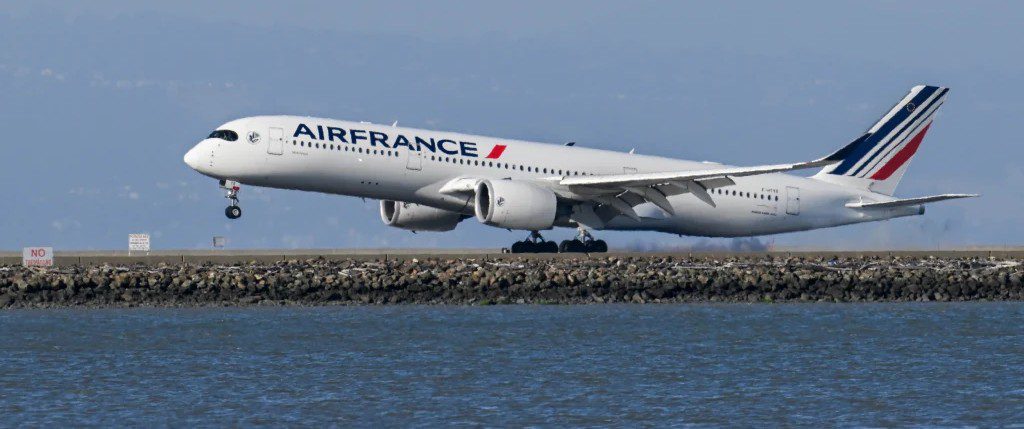
An Air France flight bound for the United States was diverted to Montreal after a passenger from the Democratic Republic of Congo boarded the aircraft despite emergency Ebola-related travel restrictions imposed by U.S. authorities.
U.S. Customs and Border Protection confirmed on Thursday that the Air France flight from Paris to Detroit was denied permission to land after officials discovered that one passenger had recently travelled from Congo, one of the countries affected by the ongoing Ebola outbreak in Central Africa.
According to a spokesperson for the agency, the traveller “should not have boarded” the aircraft because of temporary entry restrictions introduced to reduce the risk of Ebola spreading into the United States.
The aircraft, identified as Air France Flight AFR378, was redirected mid-flight and landed in Montreal, Canada, instead of Detroit Metropolitan Wayne County Airport.
In a statement issued by email, U.S. authorities said officials “took decisive action and prohibited the flight carrying that traveller from landing at Detroit Metropolitan Wayne County Airport, and instead, diverted to Montreal, Canada.”
Air France later explained that the Congolese passenger was denied entry into the U.S. because of new emergency public health rules requiring travellers arriving from high-risk countries, including Congo, Uganda and South Sudan, to enter only through Washington Dulles International Airport for enhanced health screening.
The U.S. Department of Homeland Security announced that, effective Thursday, all American citizens and lawful permanent residents who had been in any of the affected countries within the previous 21 days must pass through Washington D.C. for additional medical checks and monitoring procedures.
Canadian health authorities confirmed they were informed ahead of the diversion.
Craig Currie, spokesperson for the Public Health Agency of Canada, said American officials advised Canadian authorities that the flight was being redirected because of U.S. temporary travel restrictions linked to the Ebola outbreak.
Currie said a quarantine officer in Montreal assessed the traveller upon arrival and determined the individual showed no symptoms of Ebola infection.
“The traveller was asymptomatic,” Currie said, adding that the passenger was subsequently returned to Paris.
He also confirmed that after the health assessment was completed, the aircraft resumed its journey and continued to Detroit with the remaining passengers on board.
The incident comes amid growing international concern over a rapidly expanding Ebola outbreak centred in eastern Democratic Republic of Congo and neighbouring Uganda.
The World Health Organization recently declared the outbreak a Public Health Emergency of International Concern after health authorities reported hundreds of suspected infections linked to the rare Bundibugyo strain of the virus.
Unlike some previous Ebola outbreaks, there is currently no approved vaccine or specific treatment available for the Bundibugyo variant, raising fears among global health experts about the difficulty of containing the disease.
Health officials say the virus circulated undetected for several weeks before authorities identified the outbreak, allowing infections to spread across conflict-affected regions with weak healthcare systems.
So far, authorities have reported at least 139 suspected deaths and nearly 600 suspected cases associated with the outbreak, although experts believe the actual numbers may be significantly higher.
WHO Director-General Tedros Adhanom Ghebreyesus warned that the organization was “deeply concerned about the scale and speed of the epidemic,” noting that the outbreak may already be far larger than official figures suggest.
Health workers and humanitarian agencies operating in affected regions have also warned that shortages of medical supplies, insecurity and limited laboratory capacity are complicating response efforts.
WHO officials in Congo have cautioned that the outbreak could continue for at least two more months as authorities intensify screening, isolation, contact tracing and surveillance measures across the region.