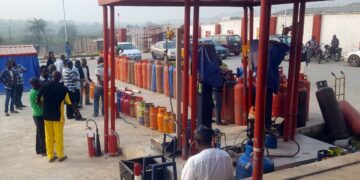













































































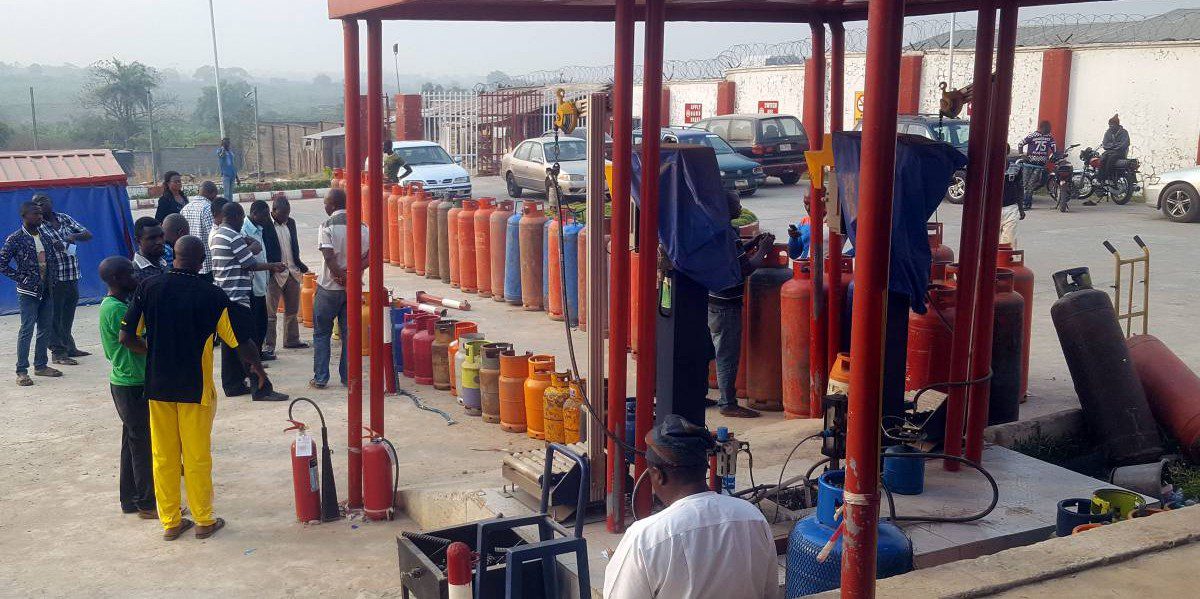
The price of Liquefied Petroleum Gas (LPG), commonly known as cooking gas, could rise sharply across Nigeria in the coming weeks as supply shortages emerge at major depots amid growing domestic demand.
Market checks on Tuesday showed that only a limited number of suppliers, including the Dangote Petroleum Refinery, Ardova Plc and Navgas, currently had significant commercial volumes of LPG available for sale in the domestic market.
Industry sources said increasing consumption in Lagos and other urban centres, driven by households and businesses shifting from kerosene and firewood to cooking gas, has intensified pressure on available stocks.
Depot pricing monitored on Tuesday showed that Dangote Refinery sold LPG at N1,060 per kilogramme, while Ardova Plc and Navgas sold at N1,065/kg and N1,085/kg respectively.
Operators warned that if supply constraints continue, retail prices could rise from the current average of about N1,300/kg to as high as N1,500/kg nationwide.
The expected increase would place additional financial pressure on households already struggling with rising food, transport and energy costs amid persistent inflation.
Nigeria has in recent years aggressively promoted LPG adoption as part of efforts to reduce dependence on firewood and charcoal, improve environmental sustainability and encourage cleaner household energy use.
However, recurring supply disruptions, foreign exchange pressures and infrastructure bottlenecks have continued to affect pricing stability in the sector.
Despite the emerging supply challenge, fresh regulatory data showed that domestic gas consumption in Nigeria continued to expand in early 2026.
According to figures released by the Nigerian Midstream and Downstream Petroleum Regulatory Authority and the Nigerian Upstream Petroleum Regulatory Commission, domestic gas utilization rose to 55,903.72 million standard cubic feet in March 2026, up from 52,300.45 million standard cubic feet recorded in February.
The increase coincided with higher national gas production and reflects the Federal Government’s push to deepen domestic gas use for electricity generation, manufacturing and commercial activities.
Analysts say the growth in domestic gas consumption highlights rising energy demand across the country, especially as businesses and households seek alternatives to unstable electricity supply and expensive diesel.
Nigeria continues to face chronic power shortages despite its vast natural gas reserves, with many industries relying heavily on self-generated energy to sustain operations.
Energy experts warn that sustained LPG shortages could slow the country’s transition toward cleaner cooking energy and reverse gains made in reducing dependence on traditional biomass fuels.