




































































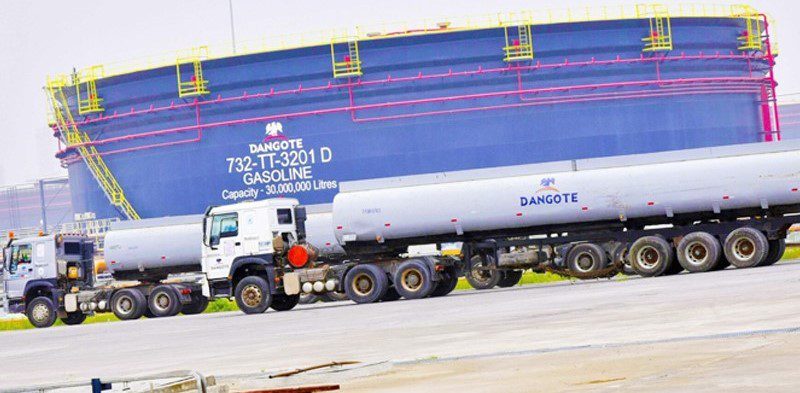
Aliko Dangote, President and Chief Executive of Dangote Group, has confirmed that Abu Dhabi National Oil Company, ADNOC, alongside other strategic investors and governments, has expressed interest in acquiring stakes in the Dangote Petroleum Refinery.
Dangote, however, declined to provide details of the potential transactions, saying existing non-disclosure agreements prevented him from identifying the parties or discussing the terms of their investments.
He spoke with journalists in Lagos on Monday after an event linked to the refinery’s planned public share offering.
Responding to questions about reports that ADNOC was seeking an investment in the refinery, Dangote said interest in the facility extended beyond the Abu Dhabi-based energy company.
“I don’t want to, you know, there is what you call an NDA, non-disclosure agreement. So, we have agreements with other people; it’s not only ADNOC, other people too. They are very, very interested,” he said.
He added that some governments had already invested in the refinery and that others were increasing their commitments.
“There are other governments too; they have invested and they are also investing more money,” Dangote said.
Strong demand for refinery shares
The billionaire businessman said the level of investor interest in the refinery had exceeded the company’s expectations.
He recalled that during an earlier private share offering, Dangote Refinery had initially sought to raise about $1bn but received commitments significantly above that target.
According to him, investors paid about $3.7bn into the company’s accounts for the offering, representing demand several times higher than the amount initially targeted.
Dangote said the company eventually accepted about $2.5bn and returned roughly $1.2bn to investors.
“The investment really, like what I said, it is actually shocking to us how people are very, very interested in investing in this refinery,” he said.
He expressed confidence that demand for the forthcoming share offer could be equally strong.
“So, even this one, I’m sure if we are to open for two days and close, the number of shares we want to sell will be all sold out,” he stated.
Refinery projections not based on Middle East crisis
Dangote also rejected suggestions that the refinery’s investment plans or financial projections were driven by the ongoing geopolitical crisis in the Middle East.
He said preparations for the share offering began long before the latest disruptions in global energy markets and that the refinery’s business calculations were based on normal operating conditions.
“Our own basis of calculation is based on normal days. When I say normal days, before the Middle Eastern crisis, what money can we make when we refine oil?” he said.
According to him, the company evaluated the refinery’s earnings potential under ordinary market conditions before deciding to invite additional investors.
Dangote said temporary disruptions arising from conflicts in the Middle East or the Russia-Ukraine war could not form the basis of a long-term investment strategy.
“Middle Eastern crisis, the crisis of Ukraine-Russia, it’s not going to go on forever; it will stop one day,” he said.
“You cannot base your business based on that. We don’t base our business based on crisis. Whatever that we have over and above, that is icing on the cake.”
He described the refinery as a long-term project designed to operate for generations.
“This is a lifetime investment. This refinery is not about 10 years, 20, 30, or 50 years,” he said, adding that the facility was expected to remain operational for decades.
IPO not primarily for fundraising
Dangote also clarified that the planned public offering was not primarily intended to raise money for the refinery.
He said the business had strong cash flow and had already secured substantial financing through bonds and private placements.
Instead, he said the decision to widen ownership was aimed at giving more Africans an opportunity to participate in the refinery’s growth.
“We are not really about raising funds. We have a very good free cash flow in the company, and we have raised quite a lot of money,” he said.
“We’ve done bonds, we’ve done private placement, and the cash generation in the refinery business today is very good.”
Dangote said the group was targeting as many as 10 million shareholders from across Africa and other parts of the world.
According to him, investors with different financial capacities would be able to participate in the offering.
“It doesn’t matter. If you can afford 10 shares, you buy 10. If you can afford one million, you can buy one million. But we want to get as many Africans as possible,” he said.
He argued that the company could have offered a much larger stake if its primary objective had been to raise fresh capital.
“If we wanted to raise money, we know how to raise,” he said.
Building wealth and expanding African ownership
Dangote said opening the refinery to more investors was also part of a broader effort to spread wealth and create a lasting legacy.
He said ordinary Africans, including salary earners, should have opportunities to invest in businesses capable of generating long-term returns.
“Major part of our own job is not about really even making money; it’s about legacy,” he said.
“It’s about trying to say, how do we actually make sure that we send down the prosperity?”
Dangote said he hoped long-term investments in the group’s businesses would create wealth for shareholders, similar to the gains enjoyed by early investors in major global companies.
He cited companies such as Amazon as examples of businesses whose early investors saw the value of their holdings rise significantly over time.
The Dangote Group chief said the refinery was only one part of a wider strategy to create major African industrial corporations and broaden participation in their ownership.
He pointed to the group’s fertilizer business and other industrial projects, saying the company wanted more Africans to benefit from the value created by large-scale investments.
“We are creating big corporations where we don’t want to be the only people enjoying. We want to spread this enjoyment to the rest of Africans,” he said.
Dangote also urged African entrepreneurs to participate in the continent’s industrial development by investing in local processing and manufacturing.
He said Africa continued to export large volumes of raw materials for processing abroad, a trend he argued should change as the continent seeks to strengthen its industrial base.
“We want to process; we want to industrialize Africa,” he said.
“By industrializing Africa, it must be done by we, the Africans, not by any other party.”