





































































Iran’s Supreme Leader has reportedly ordered that the country’s stockpile of highly enriched uranium must remain inside Iran, marking a major hardening of Tehran’s position in ongoing negotiations with the United States and further complicating efforts to end the Iran-Israel conflict.
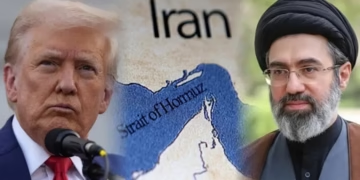
According to senior Iranian sources, Mojtaba Khamenei issued a directive rejecting any transfer of Iran’s near-weapons-grade uranium outside the country, despite pressure from Washington and Israel.
The move directly challenges one of the key demands pushed by Donald Trump during ongoing diplomatic discussions aimed at preventing renewed military escalation.
Iranian officials say the leadership believes removing the uranium stockpile would leave the country vulnerable to future attacks by the United States or Israel.
“The Supreme Leader’s directive, and the consensus within the establishment, is that the stockpile of enriched uranium should not leave the country,” one senior Iranian source said.
The directive is expected to deepen tensions with Israel, whose Prime Minister Benjamin Netanyahu has repeatedly insisted that any peace arrangement must include the removal of Iran’s enriched uranium reserves, an end to support for proxy militias and the dismantling of Tehran’s ballistic missile capabilities.
Israeli officials have also indicated that Trump privately assured Israel that Iran’s enriched uranium would eventually be transferred abroad under any final agreement.
Although a fragile ceasefire remains in place after months of fighting between Iran, Israel and allied groups across the region, negotiations remain stalled over Tehran’s nuclear programme and regional military posture.
Iranian officials reportedly fear the pause in fighting could merely be a tactical attempt by Washington to create a false sense of security before launching new strikes.
Iran’s parliamentary speaker and senior negotiator Mohammad Baqer Qalibaf warned that recent American actions suggested preparations for renewed attacks were continuing behind the scenes.
Meanwhile, Trump warned that the United States remained prepared to resume military action if Tehran failed to reach an acceptable agreement.
The negotiations are also being complicated by Iran’s tightening control over the Strait of Hormuz and continued disruption to Gulf shipping routes.
Tehran has strengthened maritime monitoring and security controls across the strategic waterway while indirect diplomatic contacts continue through intermediaries including Pakistan and Gulf states.
The conflict has already driven volatility in global oil markets and heightened concerns about wider economic fallout.
Despite the hardening stance, Iranian officials hinted there may still be room for compromise through technical arrangements involving international supervision.
One source suggested that instead of exporting the uranium stockpile, Iran could agree to dilute portions of the material under oversight from the International Atomic Energy Agency.
The IAEA estimates Iran possessed more than 440 kilograms of uranium enriched to 60 percent before recent attacks on its nuclear facilities, though the exact amount remaining is unclear.
Iran continues to insist its nuclear programme is intended for peaceful civilian and medical purposes, while Israel maintains long-standing ambiguity over its own suspected nuclear arsenal.
Analysts say the dispute over Iran’s enriched uranium stockpile remains one of the biggest obstacles preventing a broader diplomatic settlement and reducing the risk of renewed regional war.