


















































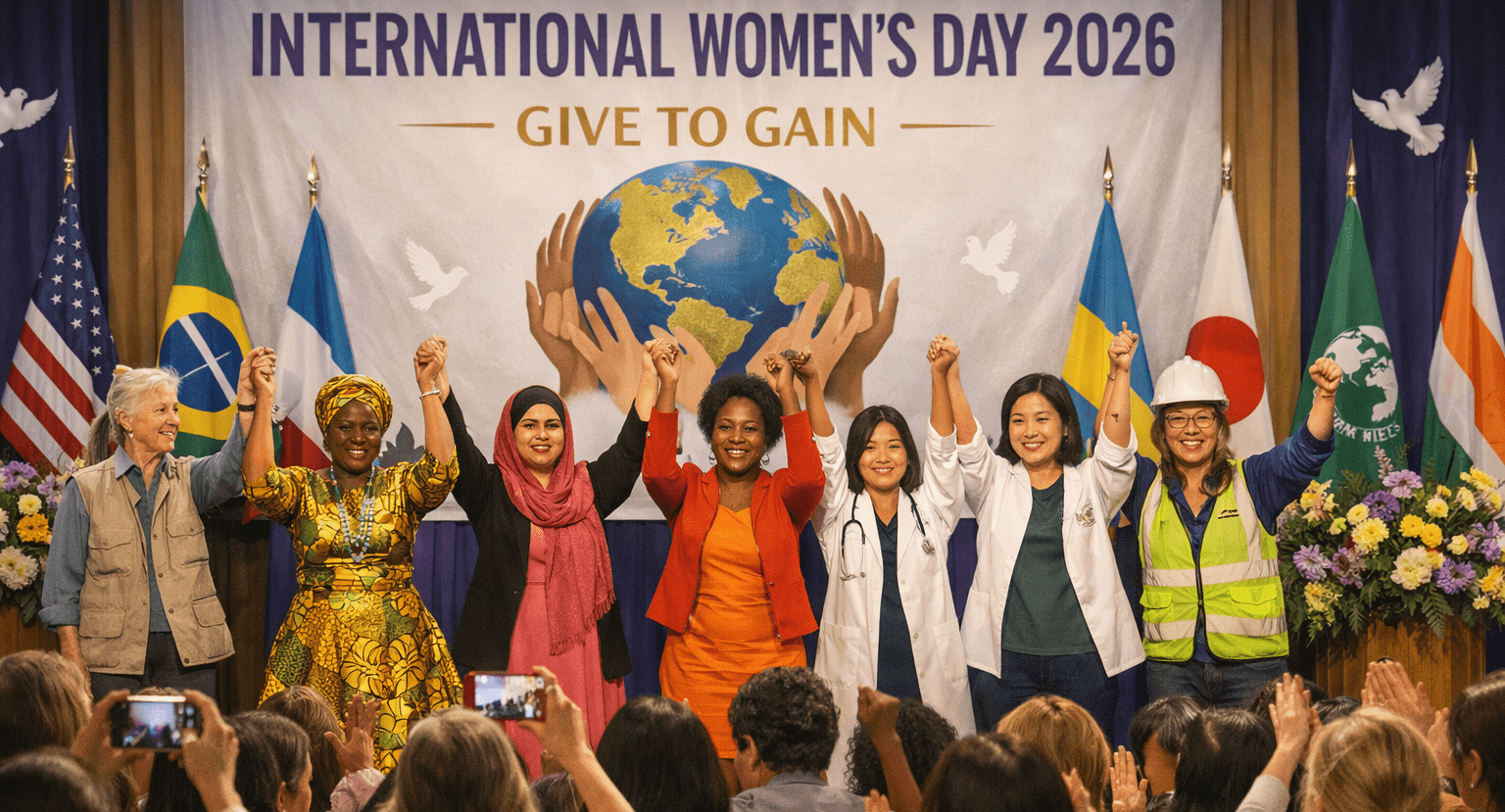
As the world marks International Women’s Day 2026, the familiar chorus of celebration is met with a much-needed dissonance. While governments and institutions reflect on a century of struggle, one is forced to confront a sobering data point: gender equality is not just “unfinished”, it is being outpaced by the very systems meant to support it.
This year’s theme, “Give To Gain,” demands more than just inclusive rhetoric; it calls for a radical redistribution of progress. It is a reminder that the “Gains” of the elite few are hollow if the “Gaps” for women in underserved geographies and lower-income brackets remain a chasm. True progress is not a trickle-down effect; it is an infrastructure that ensures protections and opportunities are accessible across every sphere, for every woman.
We must stop hiding behind the word “persistent.” Historic advances in education and political leadership are undeniable, but they are being sabotaged by structural failures. Whether it is the stagnant gender pay gap, the digital divide, or the systemic lack of safety, these are not just “slow-downs”, they are intentional barriers. 2026, should no longer be about asking for a seat at the table; but auditing the table itself.
A Century of Progress Across Fields
It must be said that the “Gains” we scrutinize today were built on the backs of radical defiance. The modern observance of International Women’s Day did not begin in a boardroom; it began in the streets of the early 1900s, where labour activists in Europe and North America demanded the basic dignity of a vote and a fair wage. By the time the United Nations recognized the day in 1975, the momentum had shifted from seeking permission to seizing power.
Over the decades, women have not just “participated” in global sectors, they have fundamentally re-engineered them.
In science and medicine, women have made transformative contributions. Hungarian-American scientist Katalin Karikó helped pioneer the mRNA technology behind vaccines that were vital in fighting COVID-19, while countless female doctors and researchers have played leading roles in public health innovations.
In activism, figures such as Malala Yousafzai have championed girls’ education worldwide, while environmental activist Greta Thunberg has mobilized millions in the global climate movement.
Women have also shaped modern engineering and technology. Trailblazers like Fei-Fei Li have contributed significantly to the development of artificial intelligence and computer vision, fields expected to define the next era of global technological progress.
In global literature, there is a long, thoroughly impressive list of women writers who have profoundly influenced the space across genre, fields of human endeavour, social thought and political discourse. To name but a few.-
American poet and civil rights activist Maya Angelou used works like I Know Why the Caged Bird Sings to explore themes of identity, race and resilience, inspiring generations around the world. Other literary pioneers include Nigerian novelist Chimamanda Ngozi Adichie, whose works such as Half of a Yellow Sun and Americanah examine feminism, migration and African identity.
Zimbabwean author Tsitsi Dangarembga broke new ground with Nervous Conditions, widely regarded as a landmark African feminist novel. British author J.K. Rowling reshaped modern publishing with the global success of the Harry Potter series, while Canadian literary icon Margaret Atwood explored gender, power and authoritarianism in works like The Handmaid’s Tale.
In Africa, Nobel laureate Nadine Gordimer used fiction to confront apartheid-era injustices in South Africa. Meanwhile, American novelist Toni Morrison became the first Black woman to win the Nobel Prize in Literature, with powerful works that examined race, memory and the legacy of slavery.
Together, these writers have reshaped global storytelling while giving voice to women’s experiences and social struggles.
Take a look at transformative roles of women in less spotlighted areas like global wildlife conservation and animal rights advocacy: The incredible works of primatologists known collectively as the “Trimates”, Dr Jane Goodall, Dian Fossey and Birutė Galdikas, revolutionized the scientific understanding and protection of great apes.
Goodall’s pioneering research on chimpanzees reshaped modern primatology and inspired generations of conservationists. Fossey’s work protecting mountain gorillas in Rwanda brought global attention to the threats of poaching and habitat destruction, while Galdikas dedicated decades to studying and protecting orangutans in Indonesia.
Beyond scientific research, other women have led influential global campaigns against animal cruelty. Ingrid Newkirk, co-founder of People for the Ethical Treatment of Animals (PETA), has been one of the most visible voices advocating for animal welfare and ethical treatment of animals worldwide. Jill Robinson founded Animals Asia Foundation and led decades-long efforts to end the practice of bear bile farming in Asia. In Thailand, Lek Chailert has become internationally recognized for rescuing abused elephants and establishing sanctuaries dedicated to their protection. Together, these women have helped reshape conservation science, promote habitat protection and lead global efforts to rescue animals and end cruelty.
In law and justice, women such as Ruth Bader Ginsburg left a lasting legacy by advancing gender equality jurisprudence in the United States Supreme Court and inspiring legal reforms globally.
Politics has also witnessed landmark achievements. Ellen Johnson Sirleaf became Africa’s first elected female president in Liberia, while Angela Merkel served as Germany’s chancellor for 16 years, shaping European politics and economic policy. Today, more than two dozen countries are led by women, a number that continues to grow gradually.
In business, women are increasingly leading global corporations. Ngozi Okonjo-Iweala, the first woman and first African to head the World Trade Organization, and executives such as Mary Barra, the CEO of General Motors, reflect the expanding influence of women in global economic leadership.
Sports and entertainment have similarly seen women achieve historic breakthroughs. Athletes like Serena Williams revolutionized tennis and became a global icon for women in sports, while performers such as Beyoncé have used their platforms to promote women’s empowerment and social justice.
These achievements reflect how women have reshaped societies across multiple disciplines.
The Economic Audit: Gains vs. The 20% Tax
If the last century was about the right to work, 2026 must be about the right to be paid. While women’s participation in the global workforce has expanded dramatically over the past 50 years, the financial architecture remains skewed. We have entered the office, but the “Equal Pay” sign at the door remains a hollow promise.
The numbers don’t lie, but they do indict. The International Labour Organization (ILO) estimates that women globally still earn approximately 20% less than their male counterparts. This isn’t just a “disparity”, it is a systemic tax on female labor.
Despite the high-profile success of female CEOs, the World Economic Forum confirms that women still hold less than one-third of top corporate leadership positions worldwide. We are over-represented in the workforce but under-represented in the rooms where the checks are signed.
This gap is fueled by more than just bias; it is driven by structural neglect. Occupational segregation and the disproportionate burden of unpaid caregiving act as a drag on female economic mobility. Women are essentially subsidizing the global economy with billions of hours of free labor, only to be penalized for it in their professional paychecks.
Beyond wages, there is the issue of capital. For the female entrepreneurs, the gap is not just in the paycheck, it is in the lack of access to the seed funding and credit needed to scale.
In 2026, awareness of the pay gap is no longer enough, pay transparency as a default and treating the gender pay gap as a corporate liability rather than a persistent challenge is critical.
Violence Remains a Major Global Challenge
If the economic gap is a tax, then Gender-Based Violence (GBV) is a structural blockade. In our 2026 reality check, we must confront the most visceral failure of global policy: the fact that safety remains a luxury, not a right.
The data is as stagnant as it is heartbreaking. The World Health Organization (WHO) continues to report that one in three women worldwide will experience physical or sexual violence in their lifetime. This is not just a statistic; it is a global emergency that transcends borders, bank accounts, and social standing.
Movements like #MeToo and its regional counterparts have done the heavy lifting of dismantling the “silence culture.” They successfully exposed the rot of systemic harassment in workplaces and institutions, forcing a wave of legislative reforms across dozens of nations. We are finally naming the problem, but naming it is not the same as neutralizing it.
While the “Global North” has seen a surge in workplace protections, activists rightly point out that in the developing world, the law is often a paper tiger. Legal protections exist on the books, but enforcement is hamstrung by underfunded police forces, patriarchal judicial systems, and a lack of safe houses. In 2026, a law that is not enforced is simply an empty promise.
We must also audit the new frontlines. As our lives move online, Cyber-GBV, from doxxing to AI-generated non-consensual imagery, has become a potent tool for silencing women’s voices. This digital violence is the gaps of the modern era, requiring a new type of technological and legal intervention.
Education and Technology Gaps
Education has long been heralded as the ‘great equalizer,’ yet in 2026, the classroom is becoming a site of divergent realities. While we celebrate the gains of a global increase in female literacy, the gaps in specialized, high-growth fields are creating a new kind of intellectual and economic apartheid.
The crisis of access remains a foundational failure. UNESCO reports that over 120 million girls globally are still out of school. This is not a choice; it is a forced exclusion driven by the brutal intersection of poverty, conflict, and the archaic social norms of early marriage. For these 120 million, the progress of the last century is a myth.
Even where the classroom doors are open, the path to the future is often blocked. Women remain chronically underrepresented in the sectors that will define the next fifty years: Artificial Intelligence, Robotics, and Cybersecurity. These are not just jobs; they are the command centers of the global economy.
When women are absent from the development of AI, the algorithms themselves inherit the biases of their creators. We are not just missing out on wages; we are being written out of the logic of the future. Without a seat at the coding table, women become the subjects of technology rather than its architects.
Closing this gap requires more than encouraging girls to code. It requires an aggressive investment in the digital infrastructure of the Global South, the very mission that drives the “Give To Gain” philosophy. We must treat tech education as a basic human right.
Because the disparity in ‘future-proof’ skills is the most dangerous gap we face today.
Africa’s Mixed Story of Progress
When we turn our reality check toward Africa, the story is one of spectacular gains clashing with systemic, deep-seated gaps. The continent is currently the world’s most vibrant laboratory for female leadership and entrepreneurship, yet it remains haunted by the most basic failures of human infrastructure.
Africa is no longer just ‘following’ global trends; in many ways, it is setting them. For instance, Rwanda remains the global gold standard for political representation, with women consistently holding over 60% of parliamentary seats. This is not a ‘gradual shift’, it is a masterclass in how aggressive, intentional quotas and constitutional reforms can decapitate a patriarchal political structure overnight.
Beyond Rwanda, countries like Senegal, South Africa, and Namibia are proving that when women occupy the seats of power, the legislative agenda shifts toward health, education, and social protection. Representation is not just a win for women; it is a win for the entire governance of the state.
African women are the most entrepreneurial in the world. From the bustling markets of Lagos to the tech hubs of Nairobi, women-led SMEs (Small and Medium Enterprises) are the true engine of the continent’s economy.
These are more than subsistence businesses. African women are innovating in agritech, fintech, and renewable energy, creating jobs and solving local problems with global-scale solutions.
Here is the ‘reality check’: despite their outsized impact, women-led businesses in Africa still face a $42 billion financing gap. We are the most productive entrepreneurs on earth, yet we are the least funded. This is where the “Give To Gain” philosophy must be operationalized by dismantling the biased risk-assessment models that prevent African women from accessing the capital they deserve.
More so, contrast between political representation and economic/health outcomes is the most critical gap we face.
We cannot also talk about progress while the most basic right, the right to survive childbirth, remains a gamble.
Despite significant drops in the last decade, sub-Saharan Africa still accounts for a disproportionate percentage of global maternal deaths. Poverty, lack of rural healthcare infrastructure, and cultural restrictions on reproductive autonomy are the gaps that no parliamentary quota can fix on its own.
In 2026, audit shows that economic power and political power must be leveraged to fix physical power, the right of every African woman to have control over her health and her life.
The Road to True Equality
Again, the data from a 2026 reality check is clear, but the timeline remains unacceptable. The World Economic Forum estimates that at our current pace, it will take more than 100 years to close the global gender gap. In a world where we can innovate AI in a matter of months and restructure global oilfields in a weekend, waiting a century for human parity is not a trend, it is a choice.
Achieving true equality requires more than the performative honouring of women once a year. It requires a hard-coded commitment to the infrastructure of power:-
We need stronger, enforceable policies on equal pay and pay transparency that treat wage theft as the corporate crime it is.
We must expand access to childcare systems and recognize unpaid domestic labour as a core pillar of the global GDP.
Laws protecting women from violence and discrimination must move from the statute books to the streets, backed by the funding and political will to protect every woman, regardless of geography.
As the world observes International Women’s Day 2026 under the banner “Give to Gain,” the message from the frontlines is unambiguous: The achievements of women have already transformed societies, but societies have not yet transformed to accommodate women.
We should not wait 100 years. We must build the tools, the platforms, and the narratives to force the timeline. The gains are evident, but the gaps are where our work begins.
About the Author
Morayo Nwabufo operates at the high-stakes intersection of digital media and fintech, she is dedicated to engineering the economic resilience of women across the Global South. Her work focuses on technological innovation and engendering global narratives that define female empowerment in the 21st century.