







































































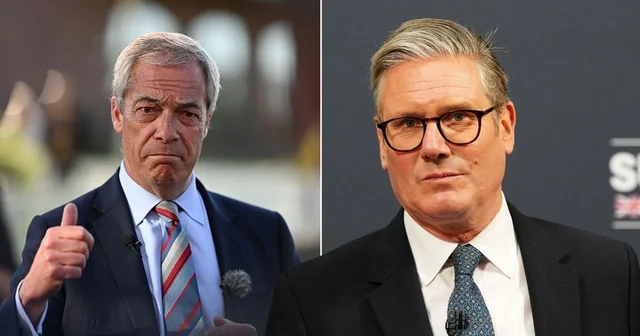
The escalating rhetoric from Reform UK leader Nigel Farage, who openly spoke of a “reverse takeover” of the governing Conservative Party, has provided the opposition Labour Party with a potent political weapon, which they have immediately deployed to dismantle the Tories’ remaining electoral credibility.
Labour’s official response yesterday condemned the relationship between the two right-wing factions as an “unholy alliance,” arguing that the rhetoric proves the Conservatives and Reform UK are “ideologically identical” and merely competing to lead the same hard-right bloc.
The opposition was quick to capitalize on the turmoil caused by Farage’s statements, which confirmed that his ultimate goal is not just to win seats but to infiltrate and undermine the Conservative Party from within.
Labour’s Shadow Cabinet members immediately seized the narrative, framing the Tories as no longer a distinct governing party but one desperate to merge with Farage’s populist movement. A Labour Party spokesperson stated:
“Nigel Farage’s ambitions expose what voters already know: the Conservatives have drifted so far to the extreme right that they are now ideologically indistinguishable from Reform UK. This isn’t a competition; it’s an unholy alliance fighting over the same broken voters.”
Labour’s strategy is to use the “unholy alliance” accusation to appeal directly to traditionally moderate or centrist Conservative voters who may be alienated by Farage’s brand of politics. By linking the Conservatives to Farage, Labour aims to push these swing voters towards their own banner.
Labour’s attack also highlights the fragmentation of the right-wing vote. Although the two parties are technically competing, Labour argues that both are pulling support from the same pool, making it easier for Labour to win key marginal constituencies with less than 40% of the vote.
The leadership of the Conservative Party, still reeling from a series of by-election defeats, has struggled to mount a coherent defence against the “unholy alliance” narrative.
Prime Minister Rishi Sunak has avoided direct confrontation with Farage, focusing instead on attacking Labour’s economic policies. This silence is interpreted by analysts as a tacit admission that the party is afraid of further driving its grassroots supporters into Reform UK’s arms.
The Conservative establishment fears that Farage’s threat is real. Many senior Tory MPs privately admit that their party is becoming politically and ideologically beholden to the populist agenda championed by Reform UK, making Labour’s “ideologically identical” claim difficult to dismiss.
From an international political perspective, Labour’s successful framing of the issue is a masterclass in political simplification.
By reducing the complex dynamic of the UK’s right-wing to an “unholy alliance,” Labour has given voters a clear, singular narrative: a vote for either Conservative or Reform is a vote for the same extreme agenda that has delivered over a decade of failed governance.
This strategic clarity is crucial as the UK heads toward a general election, positioning the Labour Party as the only unified, coherent alternative to a right-wing bloc consumed by internal fighting and ideological homogeneity.