









































































For thousands of years, the Garden of Eden has occupied a unique place in religious imagination, a lost paradise described in the Bible as the cradle of humanity, watered by rivers that nourished a perfect world. Often treated as symbolic or mythical, the Eden story has long resisted geographical certainty.
Now, renewed analysis of satellite imagery is reviving debate among geologists, archaeologists and biblical scholars, suggesting that parts of the Genesis account may reflect real landscapes that once existed in the ancient Middle East.
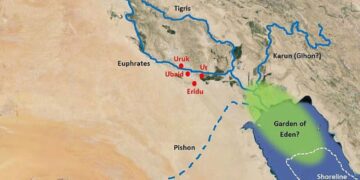
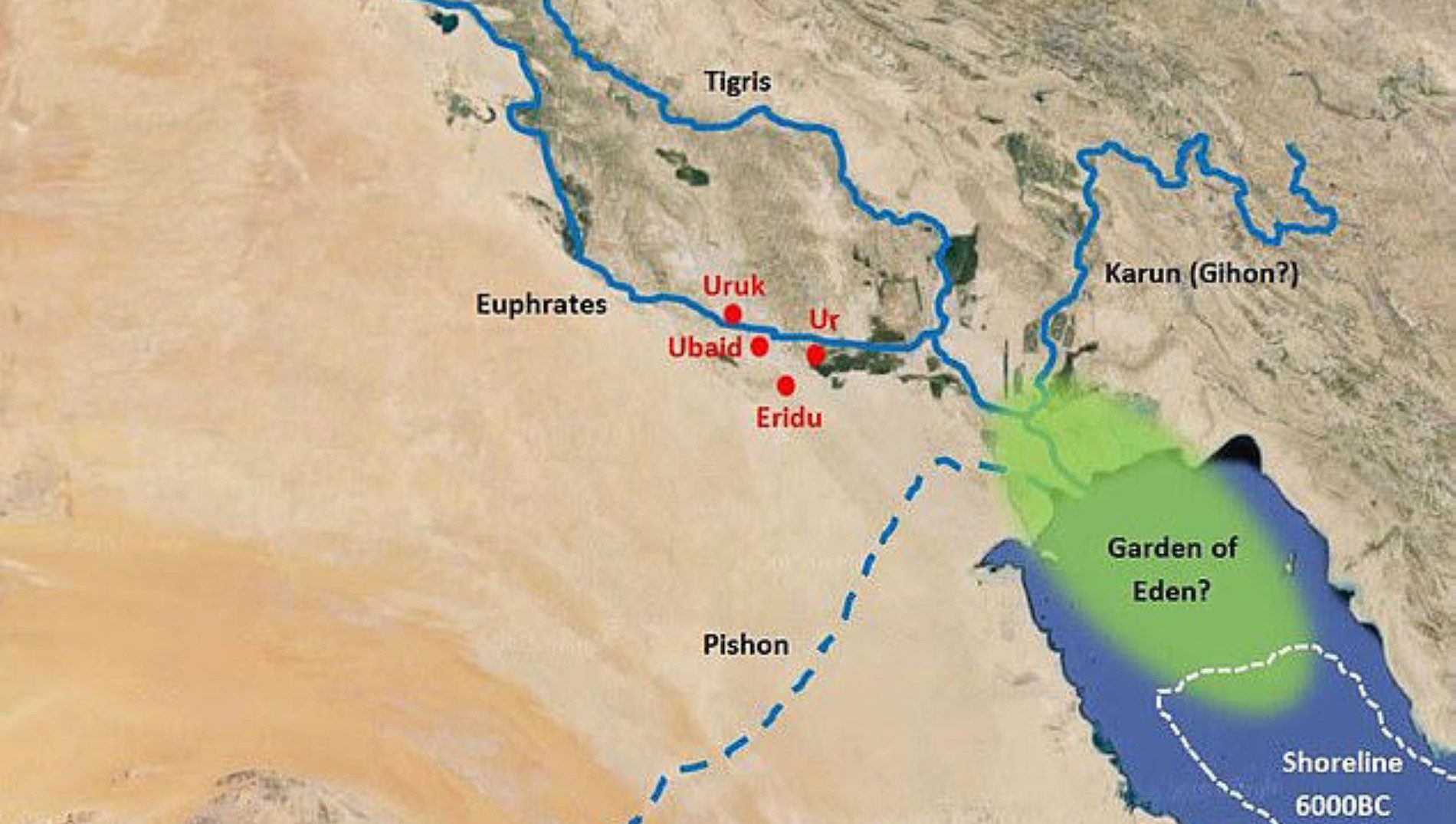
Using orbital radar data, researchers have identified vast, fossilized river systems buried beneath the sands of the Arabian Peninsula and the Persian Gulf, waterways that may correspond to two of the Bible’s most mysterious rivers: the Pishon and the Gihon.
A vanished river in Arabia
At the centre of the discussion is Wadi al-Batin, a massive dry river channel stretching from Saudi Arabia’s western highlands near Medina northeastward toward Kuwait and the northern Persian Gulf. Though today it is an arid corridor of sand and gravel, satellite imagery reveals that it was once a powerful river system several kilometres wide.
The Book of Genesis describes Eden as being watered by a single river that split into four branches: the Pishon, Gihon, Tigris and Euphrates. While the Tigris and Euphrates still flow through modern-day Iraq, the identities of the other two rivers have remained uncertain for centuries.
Some scholars believe Wadi al-Batin closely matches the biblical description of the Pishon, which Genesis says “winds through the whole land of Havilah,” a region associated with gold, bdellium and onyx stone. Satellite scans show an ancient delta near the Persian Gulf, along with dunes and depressions that mark the river’s former course and scale.
Radar data indicates that the river was active during a wetter climatic period thousands of years ago, before gradually drying out between roughly 2000 and 3500 BC as Arabia became increasingly arid.
The Gihon and the Zagros Mountains
Attention has also turned eastward to Iran’s Karun River, which flows through the Zagros Mountains before emptying into the Persian Gulf. The Karun’s looping, twisting path has led some researchers to identify it with the Gihon, described in Genesis using the Hebrew verb sabab, meaning “to encircle” or “to wind around.”
Historically, the Karun flowed through territories linked by some scholars to the land of Cush mentioned in the Bible, though this identification remains contested.
If Wadi al-Batin and the Karun once joined the Tigris and Euphrates near the Persian Gulf, the four rivers could have converged in a fertile lowland region that supported early human settlement, trade and agriculture.
Science behind the images
Much of the river mapping is based on radar images captured by NASA’s Space Shuttle Endeavour in the early 1990s. Boston University geologist Farouk El-Baz was among the scientists who analyzed the data, using radar to peer beneath desert sands.
“These images allow us to reconstruct landscapes that disappeared thousands of years ago,” El-Baz said. “They show river systems that shaped early human life and may have influenced ancient stories passed down through generations.”
Biblical archaeologist James A. Sauer, who also examined the data, has said Wadi al-Batin’s size and direction make it the strongest candidate yet for the Pishon, though he cautions against claiming definitive proof of Eden itself.
Archaeologist Juris Zarins has likewise argued that satellite evidence supports the idea that the Eden narrative preserves a memory of real geography, even if its theological elements remain symbolic.
Environmental data backs the broader picture: Arabia was far greener after the last Ice Age, with higher rainfall and flowing rivers, before climate change and rising sea levels transformed the region and submerged parts of the ancient Gulf basin.
Disagreement and alternative theories
Not all scholars are convinced. Some argue that the biblical land of Cush refers to regions in Africa rather than the Middle East, linking the Gihon to the Nile instead of the Karun. Others emphasize that Genesis blends spiritual allegory with historical memory, making precise mapping inherently speculative.
Still, the satellite discoveries have reignited interest in the geography behind biblical texts, especially as ancient river paths align with archaeological evidence of early farming communities and trade routes across the Fertile Crescent.
An African Eden?
The debate has also extended beyond the Middle East. In a 2025 study that has not been peer-reviewed, Mahmood Jawaid, a Texas-based chemical engineer, proposed that the Garden of Eden may have been located in Bahir Dar, in northwestern Ethiopia near Lake Tana, the source of the Blue Nile.
Drawing on both the Bible and the Quran, Jawaid argued that the Blue Nile could correspond to the Gihon and that Lake Tana’s outflows may once have divided into multiple waterways resembling the four rivers described in Genesis.
His theory also connects Eden to human evolution, suggesting that Adam may have emerged from early hominin populations in East Africa before being “placed” in the Ethiopian highlands, a lush region about 6,000 feet above sea level.
Jawaid links this idea to the Quranic term habata, meaning “to descend,” proposing that Adam and Eve later moved from the highlands into the Rift Valley. He argues that the region’s fertile environment, abundant wildlife and flowing rivers fit both biblical and Quranic descriptions of an earthly garden.
Myth, memory and landscape
While scholars remain divided, advances in satellite imaging have given new momentum to the study of ancient landscapes hidden beneath deserts and seas. What emerges is a picture of a world far greener than today’s Middle East, one that could have inspired enduring stories about humanity’s beginnings.
Whether Eden was a literal place or a symbolic ideal, researchers increasingly agree that the Genesis account may be rooted in memories of real rivers, real climates and real environments that shaped early civilization.
As technology continues to uncover the planet’s buried past, the line between myth and geography may grow thinner, even for humanity’s oldest stories.