






































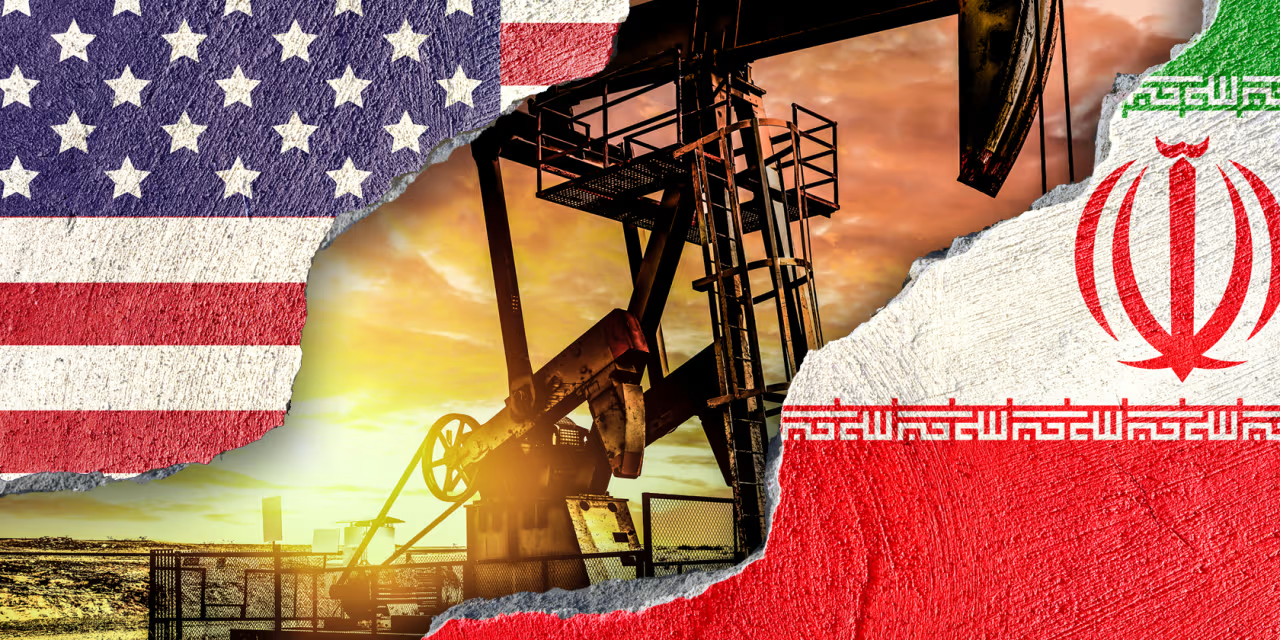





























Oil prices rose on Friday, January 9, 2026, as a fresh wave of geopolitical risk in the Middle East and a high-stakes “Energy Summit” at the White House prompted traders to reassess the global supply balance.
Following a mid-week slump, Brent Crude reclaimed the $62 mark, while WTI pushed back toward $58.2 The market is currently caught in a tug-of-war between the immediate threat of production disruptions in Iran and the long-term prospect of a U.S.-led “oil bonanza” in Venezuela.
The “Iran Risk” has returned to the forefront of energy trading as nationwide protests over economic hardship show no signs of abating.
Reports from NetBlocks confirmed a near-total internet shutdown in Iran today, a move usually preceding a heavy security crackdown.
As the world’s seventh-largest producer, any disruption to Iran’s output (roughly 3.2 million bpd) would be far more impactful than the current Venezuelan situation.
President Trump issued a stern warning on social media today, stating the U.S. would hit the Iranian government “hard” if protesters are killed, raising fears of renewed military friction in the Persian Gulf.
In Washington, Energy Secretary Chris Wright is hosting a summit today with executives from Chevron, ExxonMobil, ConocoPhillips, and global traders Vitol and Trafigura.
Furthermore, President Trump has proposed a massive $100 billion investment to rebuild Venezuela’s dilapidated oil infrastructure, claiming U.S. firms can restore the nation to its former glory as a top-tier producer.
The administration is moving to market up to 50 million barrels of crude currently sitting in storage (worth approx. $2.8 billion) to U.S. Gulf Coast refiners.
Market analysts at Energy Aspects have however, cautioned that while the news is “exciting,” tripling Venezuela’s output would take years and billions in capital, meaning the “supply glut” from South America may be further off than the President suggests.
Beyond the headlines, a technical shift is supporting prices this week. Annual commodity index rebalancing is seeing significant cash flows rotate back into energy futures.11 This “passive” buying is providing a floor for prices even as Goldman Sachs reports that its clients remain “the most bearish on oil in 10 years” due to the overall 2026 supply surplus.
“If Venezuela is a bear cub, Iran is a grizzly bear in the bushes. Traders are more afraid of what could go wrong in the Strait of Hormuz today than what could go right in the Orinoco Belt in 2028.” – Commodity Strategist, Westpac Banking Corp.