





































































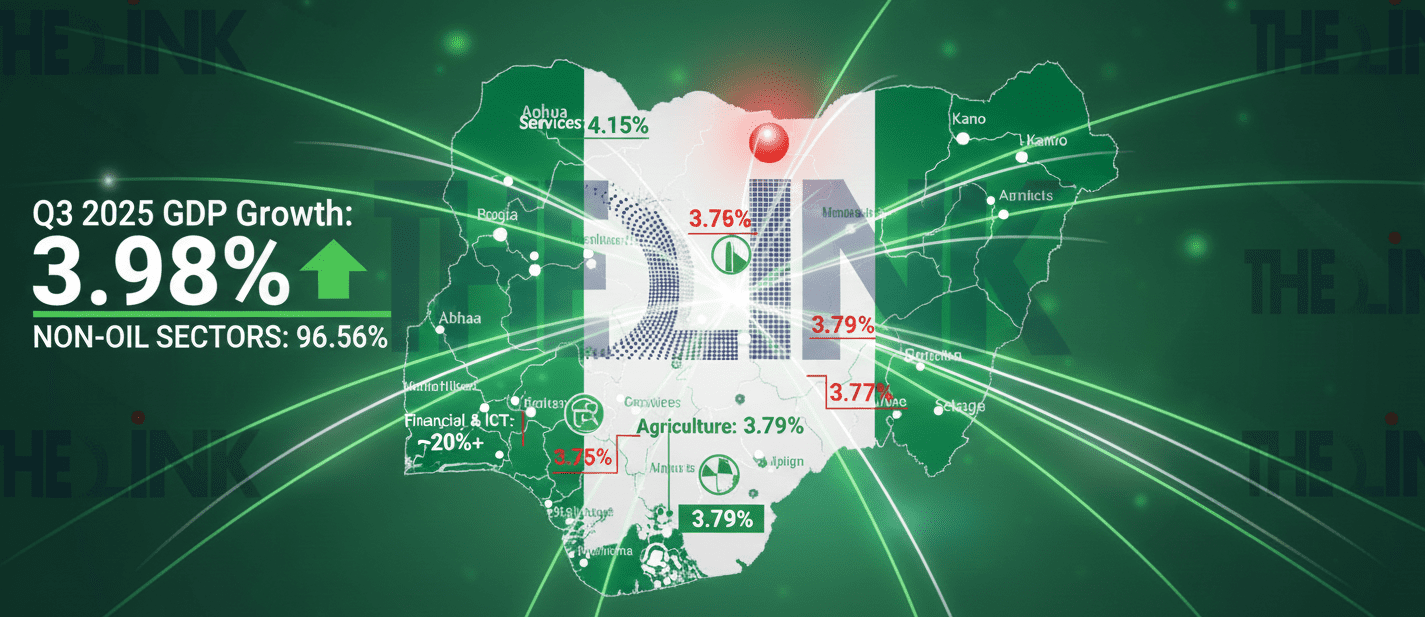
The National Bureau of Statistics (NBS) released its Gross Domestic Product (GDP) report for the third quarter (Q3) of 2025, confirming that the Nigerian economy grew by 3.98% in real terms on a year-on-year basis.
While the figure is a slight slowdown from the 4.23% recorded in the preceding quarter (Q2 2025), it represents a marginal improvement from the 3.86% recorded in Q3 2024. The data suggests the Nigerian economy is maintaining moderate expansion despite persistent challenges like elevated inflation and security concerns.
The Q3 2025 growth was overwhelmingly powered by the Non-Oil Sector, which contributed a commanding 96.56% to the total real GDP. The sector’s growth rate was 3.91%, outperforming the 3.79% recorded a year earlier. The top-performing sectors that anchored the economy were:
| Sector | Q3 2025 Real Growth Rate (YoY) | GDP Contribution |
| Services | 4.15% | 53.02% |
| Agriculture (Crop Production) | 3.79% (up from 2.55% in Q3 2024) | 31.21% |
| Financial & Insurance (Financial Institutions) | 19.63% (Sharpest growth rate) | 2.65% |
| Information & Communication (ICT) | 5.78% | 9.10% |
| Industry | 3.77% (Up from 2.78% in Q3 2024) | 13.36% |
The Oil Sector recorded a real growth rate of 5.84% year-on-year, primarily due to an increase in average daily crude oil production to $1.64$ million barrels per day (mbpd), up from $1.47$ mbpd in Q3 2024.
However, its contribution to the overall real GDP remains small at 3.44%, emphasizing the structural shift away from oil dependency as the main engine of growth.
The Link News Analysis: The Macro-Micro Disconnect
The $3.98\%$ GDP growth rate, while positive on a macro scale, immediately fuels the recurring debate over the “Macro-Micro Disconnect.” The Link News analysis highlights two critical interpretations of the data:
Policy Validation (Macro): The sustained growth, particularly in the non-oil sector, is being hailed by some economists as evidence that recent major reforms, such as the foreign exchange market unification and the push for agricultural and industrial diversification, are beginning to stabilize the economy. Sectors like Financial Services (growing at $19.63\%$) and ICT (growing at $5.78\%$) are flourishing, suggesting capital is finding profitable avenues outside of traditional oil reliance.
Household Reality (Micro): The gains recorded at the aggregate level are not yet filtering down to the average Nigerian household and Small and Medium Enterprises (SMEs). Economists point to the fact that inflation remains stubbornly high, driven by high input costs, energy prices, and logistics bottlenecks. The growth figures confirm that while economic activity is increasing, the benefits are being eroded by soaring living costs and weakened consumer purchasing power.
For this positive GDP trend to translate into genuine improvement in welfare, the government must prioritize strengthening the link between the macro-economy and the micro-economy by focusing urgently on security in farming communities to sustain agricultural output, and stabilizing the Naira to tame import-driven inflation.