


































































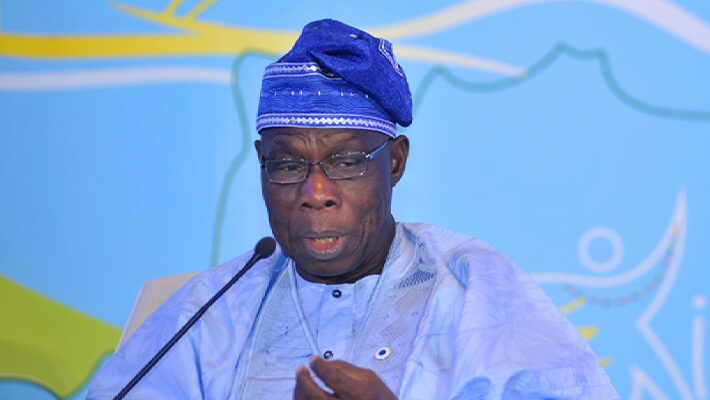
Former President Olusegun Obasanjo has issued a scathing and highly critical assessment of the Federal Government’s approach to the worsening insecurity crisis, particularly its handling of mass abductions, demanding an immediate cessation of all negotiations and apologies to criminal elements.
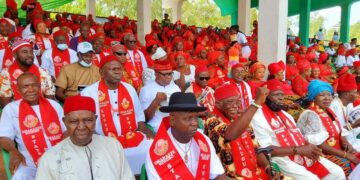
Speaking on Friday at the Plateau State Unity Christmas Carol and Praise Festival in Jos, the former Head of State declared that the nation is being “killed” by relentless violence and warned that the government’s failure to protect its citizens may justify seeking international intervention.
Obasanjo lambasted the tactic of negotiating with terrorists and kidnappers, asserting that such practices only embolden the criminal groups, providing them with resources and recognition that fuel the continuity of the trade.
“Why are we apologizing? Why are we negotiating?” he queried, referencing recent incidents, including the release of abducted worshippers in Kwara State following negotiations. “Before I left the government, I knew we had the capacity to pick up anybody in Nigeria who commits crime anywhere… Now we have capacity. With drones, you can take them out. Why are we not doing that?”
He insisted that the continuous loss of life is a national disgrace. “We are being killed. We are Nigerians, no matter the religion or where you come from, we are being killed,” he stressed.
The former President advocated for a decisive, technology-driven, and hard-line approach to routing criminal gangs from their hideouts, rather than engaging in dialogue.
He described the insecurity trend, which he noted has steadily declined “from bad to worse” since the Chibok girls’ abduction, as evidence that Nigeria’s security architecture is overstretched and failing.
Obasanjo went further to issue a stern warning regarding the limits of state capacity:
“The first responsibility of any government is the protection and security of its citizens, but our government seems incapable of protecting us. If our government cannot do it, we have a right to call on the international community to do for us what our government cannot do for us. We should have no apology for that.”
He also cautioned against framing the violence along ethnic or religious lines, stating that this rationalization is dangerous and distracting from the core issue of state failure.
The Former President’s statement comes amidst a fresh wave of high-profile mass abductions across Niger, Kwara, and Kaduna States, reinforcing the perception of a security crisis spiraling out of control.
He tasked the government at all levels to face its constitutional responsibility head-on, urging political leaders and security agencies to adopt concrete, measurable strategies to restore safety and public confidence, insisting that the killings must stop.
Indeed, former President Obasanjo’s commentary represents a significant escalation in criticism from Nigeria’s elder statesmen. However, while his call for a hard-line approach is strategically sound, as negotiating funds the criminal economy, the reality on the ground presents a painful dilemma for the current administration from the life-safety trade-off and technological capacity vs. deployment standpoint.
The primary rationale for negotiations, however morally questionable, is the immediate preservation of human life, particularly after the government failed to prevent the abductions in the first place. When hundreds of schoolchildren are involved, the political pressure to save them outweighs the long-term deterrence objective. Thus, Obasanjo’s “no apologies” stance implies a willingness to risk the lives of captives to enforce a policy, a choice no government makes lightly.
Just as his insistence that Nigeria has the technological capacity (drones, surveillance) to “take them out” is accurate, the operational reality of deploying these assets which requires actionable, real-time intelligence, the political will to authorize deadly force, and the readiness to manage collateral damage, is often hampered by bureaucratic inertia and a deeply compromised local intelligence network. The problem is not the tool, but the system that controls the tool.
Furthermore, the suggestion that Nigeria might seek international intervention is a dramatic and weighty pronouncement. While it underscores the severity of the crisis, it also treads dangerously close to conceding the state’s sovereign control over its territory, a concept Nigerian leaders are historically loath to accept.
Obasanjo’s call is a forceful demand for accountability and a rejection of crisis management in favour of decisive action. The challenge for the government now is to find a way to secure its citizens without paying ransom, effectively demonstrating that the state is more determined and better equipped than the terror groups.