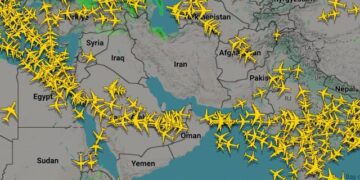





































































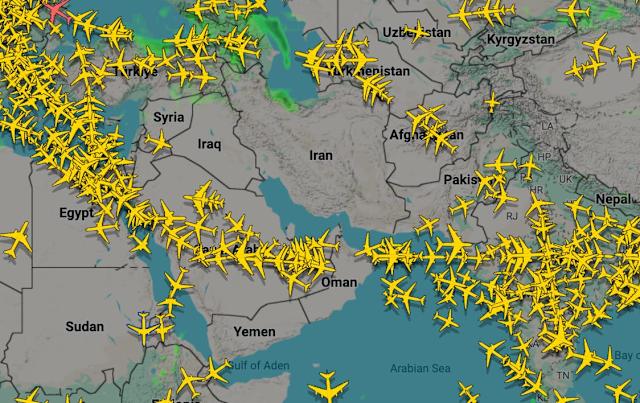
Air travel across the Middle East was thrown into chaos after joint strikes on Iran by the United States and Israel triggered widespread airspace closures, forcing the cancellation of thousands of flights and stranding travellers across multiple continents.
According to flight tracker Flightradar24, more than 3,400 flights were cancelled on Sunday across seven major airports in the region.
Airports in Dubai and Abu Dhabi in the United Arab Emirates, Doha in Qatar, and Manama in Bahrain were among the key hubs affected. These airports serve as critical transit points linking Europe, Africa and the West to Asia.
Emirates suspended all flights to and from Dubai until at least Sunday afternoon, while Qatar Airways announced that Doha’s airport would remain closed until at least Monday morning.
Israeli airspace also remained shut, with El Al saying it was preparing a recovery plan to bring stranded Israelis home once operations resume.
Countries including Israel, Qatar, Syria, Iran, Iraq, Kuwait and Bahrain closed their airspace on Saturday, leading to widespread diversions. The United Arab Emirates announced a “temporary and partial closure” of its airspace, resulting in little to no flight activity over the country for several hours.
The three major carriers operating through Dubai, Abu Dhabi and Doha, Emirates, Qatar Airways and Etihad, typically handle about 90,000 passengers daily across those hubs, according to aviation analytics firm Cirium.
Airlines have since begun rerouting flights southward over Saudi Arabia to avoid conflict zones, adding hours to journey times and increasing fuel consumption. Industry analysts warn that prolonged disruption could push up ticket prices.
Officials at Dubai International Airport said four people were injured following incidents linked to retaliatory strikes attributed to Iran. Zayed International Airport in Abu Dhabi reported one fatality and seven injuries in what authorities described as a drone strike.
Strikes were also reported at Kuwait International Airport.
Although Iran did not publicly claim responsibility for the retaliatory attacks, Gulf governments attributed missile and drone launches to Tehran, saying they extended beyond previously declared military targets.
Aviation experts say parts of the region’s airspace could reopen in phases if military authorities clarify operational zones and missile risks diminish.
Mike McCormick, a former senior air traffic control official with the U.S. Federal Aviation Administration and now a professor at Embry-Riddle Aeronautical University, said authorities may gradually reopen safer corridors once risk assessments are updated.
However, the duration of the disruption remains unclear. For comparison, a previous round of Israeli-U.S. strikes on Iran in mid-2025 led to nearly two weeks of regional aviation disruption.
The impact has extended far beyond the Middle East. In Indonesia, more than 1,600 tourists were stranded at Bali’s I Gusti Ngurah Rai International Airport after flights to the region were cancelled or delayed.
Airlines have urged passengers to check flight statuses online before heading to airports. Several carriers have issued waivers allowing travelers to rebook without additional fees.
Industry analyst Henry Harteveldt of Atmosphere Research Group said passengers should prepare for extended delays.
“There’s no way to sugarcoat this,” he said. “If you haven’t left home yet, chances are you won’t be traveling through these destinations for several days, if not longer.”
As military exchanges continue, aviation authorities, airlines and passengers face an uncertain outlook, with regional stability and safety assessments expected to determine when normal operations can resume.
SOURCE: AP News