











































































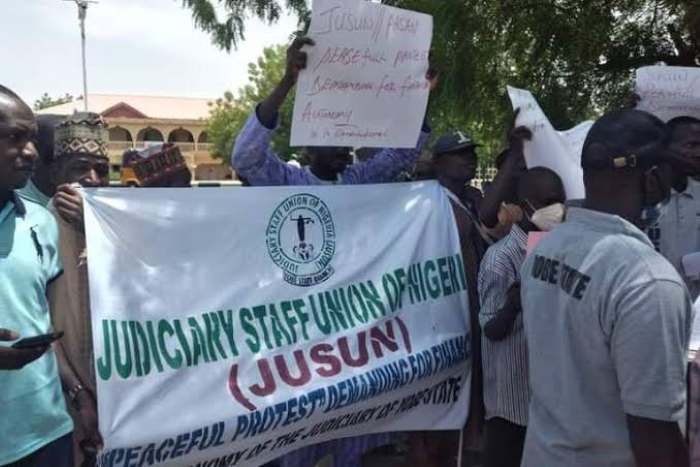
The Judiciary Staff Union of Nigeria (JUSUN) has suspended its planned nationwide strike for two weeks, following a deadlock in negotiations with government authorities, including the Department of State Services (DSS). The union announced its decision late Sunday, citing goodwill and respect for ongoing dialogue but warning that industrial action could resume if no progress is made.
The planned strike, initially scheduled to begin on Monday, was expected to paralyze courts and judicial institutions across the country. JUSUN had demanded immediate action on a series of grievances, including alleged government interference in judicial autonomy, non-implementation of financial independence for the judiciary, and what it described as worsening working conditions.
At the core of the standoff is JUSUN’s long-standing push for full financial and administrative autonomy for the judiciary, mandated by the constitution but inconsistently implemented at both federal and state levels. Despite previous court judgments and executive orders supporting autonomy, the union says many state governments continue to withhold funds or interfere in judicial operations.
“Our patience is not infinite,” said JUSUN National President, Comrade Marwan Mustapha Adamu. “We have shelved the strike, not because our demands have been met, but to give room for one last round of negotiations. If nothing changes in two weeks, we’ll have no choice but to act.”
According to sources close to the negotiations, discussions with the DSS and representatives of the Federal Government stalled over assurances of compliance and timelines for implementation. JUSUN had also raised concerns over perceived surveillance and intimidation of union members in some states.
The DSS reportedly appealed for calm and requested additional time for internal coordination among government agencies. In response, JUSUN opted for what it described as a “strategic pause,” giving authorities a two-week window to deliver tangible commitments.
Even though the strike was suspended, news of its possibility had already begun to affect judicial activities. Several state high courts reduced their hearing schedules in anticipation of shutdowns, and legal practitioners warned that any disruption could further clog Nigeria’s already backlogged court system.
“The judiciary is barely functional as it is,” said Abuja-based lawyer Kemi Olatunji. “A prolonged strike would cripple access to justice and delay critical cases, from human rights trials to commercial disputes.”
The Ministry of Justice has yet to issue a formal response to JUSUN’s demands. However, insiders say efforts are underway to establish a working group that includes the Office of the Attorney General, the Revenue Mobilization Allocation and Fiscal Commission (RMAFC), and the National Judicial Council (NJC) to chart a roadmap for resolving the union’s concerns.
Analysts warn that the government must not underestimate the stakes. “The judiciary is not just another government department—it’s the spine of democracy,” said policy analyst Ibrahim Dikko. “Ignoring JUSUN’s demands is not only risky from a governance standpoint; it sends the wrong message about the rule of law.”
By pausing its strike, JUSUN has offered the government a window to act—one that will close fast. With trust fraying and tensions simmering, the coming days may prove decisive not just for the judiciary but for broader public confidence in Nigeria’s democratic institutions.
Judicial Autonomy in Nigeria: What the Law Says
What is Judicial Autonomy?
Judicial autonomy refers to the independence of the judiciary from interference by the executive or legislative arms of government. It ensures that courts can operate, make rulings, and manage their own finances without external pressure or manipulation.
Legal Foundations of Judicial Autonomy in Nigeria:
- 1999 Constitution (as amended)
- Section 121(3) mandates that all money standing to the credit of the judiciary in the consolidated revenue fund must be paid directly to the heads of courts.
- This applies to both federal and state judiciaries.
- Executive Order 10 (2020)
- Issued by former President Muhammadu Buhari to enforce financial autonomy for state judiciaries and legislatures.
- It directed state governors to include judiciary allocations as a first-line charge in their budgets.
- The order was controversial and later suspended due to legal and political resistance from state governments.
- National Judicial Council (NJC)
- Constitutionally empowered to regulate the appointment, promotion, and discipline of judicial officers.
- However, funding for court operations at the state level is often still filtered through governors, creating room for interference
Timeline: Key Moments in JUSUN’s Fight for Judicial Autonomy
- 2014
JUSUN stages a nationwide strike demanding compliance with constitutional provisions on financial independence. - 2019
Federal High Court rules in favour of full financial autonomy for state judiciaries. - May 2020
Executive Order 10 is signed, sparking hope for implementation—later met with legal pushback from governors. - April–June 2021
JUSUN embarks on a 64-day strike, shutting down courts nationwide. Strike ends after an MoU is signed with governors and the Federal Government. - June 2025
JUSUN announces a fresh strike threat over stalled reforms and delayed implementation, ultimately giving authorities a two-week reprieve.