













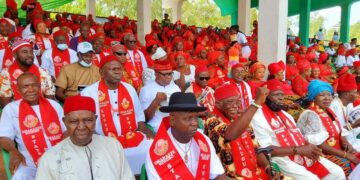












































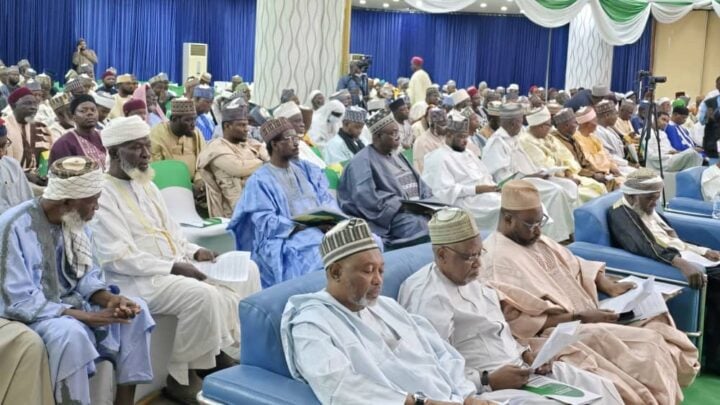
The Supreme Council for Shariah in Nigeria (SCSN) has pushed back against reported calls by some U.S. lawmakers to end the practice of Sharia law in Nigeria, describing such proposals as misinformed and an infringement on the country’s sovereignty.
In a statement issued Wednesday, the council said Sharia law forms an integral part of the religious and legal identity of Muslims in Nigeria and cannot be abandoned due to what it termed “external pressure, misinformation, or political intimidation.”
SCSN Secretary General, Nafiu Ahmad, said Sharia represents more than a legal framework, describing it as a comprehensive moral and spiritual guide for Muslim communities.
“No power or authority can arrogantly make Muslims relinquish its practice in response to external pressure, misinformation, or political intimidation,” the council stated.
Sharia operates alongside statutory and customary law in Nigeria’s plural legal system. It is practiced primarily in 12 northern states, where it was formally adopted in 1999 as a body of civil and criminal law applicable to Muslims.
The council emphasized that Sharia practice in Nigeria is protected under the country’s constitution, which guarantees freedom of religion and allows individuals to regulate personal and family matters according to their faith.
Nigeria’s legal structure accommodates multiple systems, reflecting its diverse religious and cultural composition. While Sharia courts handle matters involving Muslims who voluntarily submit to their jurisdiction, conventional courts continue to operate nationwide.
The SCSN also dismissed assertions that Nigeria is witnessing a “Christian genocide,” arguing that such claims oversimplify and misrepresent the country’s complex security challenges.
According to the council, insecurity in Nigeria stems from terrorism, banditry, organized crime and governance weaknesses, affecting both Muslims and Christians.
“The government appears either indifferent or incapable of resolving the security problem which has claimed the lives of Muslims and Christians alike,” the statement said, adding that framing the violence strictly as religious persecution is “inaccurate and unhelpful.”
The council concluded that Nigeria’s multi-religious society and plural legal framework should be respected by the international community.
It maintained that external interference in domestic religious or legal matters would be counterproductive and could deepen tensions in an already fragile security environment.
The statement underscores ongoing sensitivities surrounding religion, governance and international engagement in Africa’s most populous nation.