



















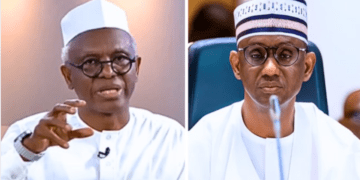


































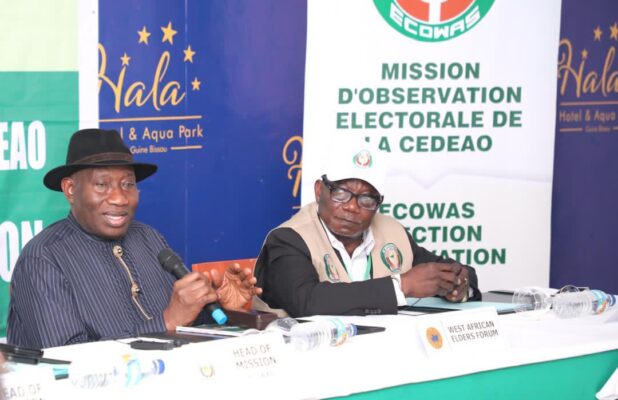
Former Nigerian President Goodluck Ebele Jonathan, who was recently evacuated from Guinea-Bissau after the military announced a takeover, has cast serious doubt on the authenticity of the coup, alleging that the political turmoil was orchestrated by the ousted President, Umaro Sissoco Embaló, to avoid a possible election defeat.
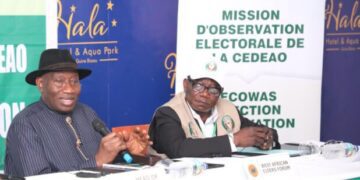
Dr Jonathan, who led the West African Elders Forum (WAEF) Election Observation Mission to monitor the presidential and legislative elections held last Sunday, November 23, 2025, described the event as “maybe a ceremonial coup,” insisting it did not follow the pattern of classic military takeovers in the region.
Speaking in an interview shortly after his safe return to Nigeria, Jonathan highlighted the anomalies in how the military action unfolded on Wednesday, November 26, 2025, just one day before the official election results were due to be announced.
Dr. Jonathan noted that President Embaló was the first to announce the coup, telling international media that he had been arrested, before the military made any public declaration of a takeover.
“The military doesn’t take over governments, and the sitting president that they overthrew would be allowed to be addressing press conferences and announcing that he has been arrested. Who is fooling whom?” Jonathan queried, expressing deep skepticism over Embaló’s ability to use his phone to address global media while supposedly detained.
The former President’s analysis supports claims made by the Guinea-Bissau opposition, led by presidential challenger Fernando Dias, who publicly alleged that Embaló had “fabricated the coup d’état” to disrupt the election results, which both he and Embaló claimed to have won.
While Jonathan played down the severity of the event, the African Union (AU) and the Economic Community of West African States (ECOWAS) took immediate, stern action. The regional bodies issued a joint statement deploring the military’s action as a “blatant attempt to disrupt the democratic process” and subsequently suspended Guinea-Bissau from their decision-making bodies.
However, Dr. Jonathan, despite co-signing the joint condemnation, maintained his focus on the election results. He called on ECOWAS and the AU to compel the timely announcement of the actual results, stressing that the military should not be allowed to interfere with the democratic outcome.
“They have the results because AU and ECOWAS officials were in all the regions when the results were collated… They must tally all those results and announce them. Let the world know who won that election,” he insisted.
Dr. Jonathan’s insight, drawn from his position as both a former regional leader and an election observer on the ground, transforms the Guinea-Bissau crisis from a simple coup d’état into a highly suspicious and complex power struggle.
The “staged coup” theory is highly plausible within the context of Guinea-Bissau’s volatile political history. The timing, just as a fiercely contested election result was due, suggests the primary motive was political self-preservation. Facing a potential loss, the incumbent or his close military allies may have executed the action to trigger an institutional reset, allowing them to remain in power or organize a transition favorable to them.
The military officers who announced the takeover cited a plan involving “national politicians” and a “well-known drug lord” to manipulate election results. This is a common narrative camouflage. Guinea-Bissau is a major cocaine transit hub, and political crises are frequently used by entrenched military and political factions to seize control of the state apparatus, which facilitates the lucrative drug trade.
Jonathan’s challenge to ECOWAS to publish the election results is the most critical demand. By prioritizing the transparency of the election outcome over merely condemning the military action, Dr. Jonathan correctly identifies the key to defusing the crisis: removing the political uncertainty that the military exploited. Until the legitimate winner is known, the “ceremonial coup” will remain an effective tool for maintaining the status quo.