








































































France has returned a sacred talking drum taken during the colonial era to Côte d’Ivoire, marking one of the most significant cultural restitutions to a former French colony in recent years.
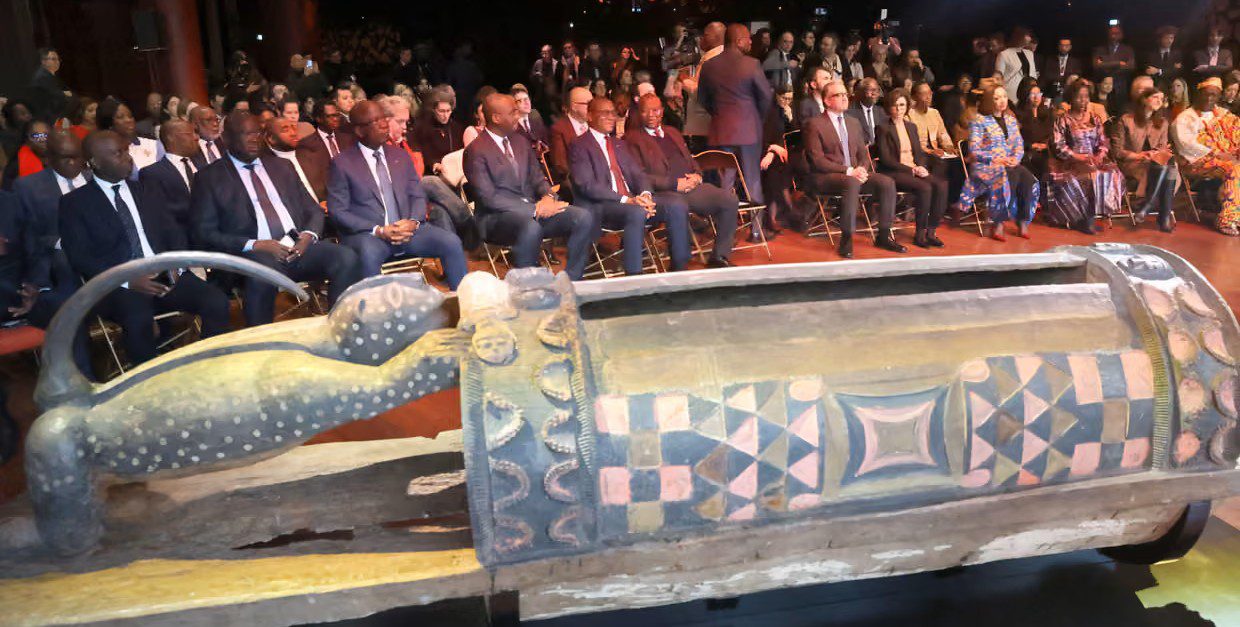
The historic Djidji Ayôkwé, a massive talking drum confiscated by French colonial authorities in 1916, arrived Friday morning at Port Bouët Airport in Abidjan, where it was formally received by Ivorian officials and cultural leaders.
The artefact had been held for decades at the Musée du Quai Branly, Jacques Chirac in Paris before its transfer earlier this month to Ivorian authorities.
Community leaders described the drum’s return as a deeply symbolic moment of cultural restoration.
“After a long stay away from this land, it is returning to its own people and it is an honour for us and a relief to welcome it,” said Aboussou Guy Mobio, chief of the Adjamé-Bingerville community. “This is the missing piece of the puzzle that is returning today.”
The Djidji Ayôkwé holds immense historical and cultural significance for the Ebrié people of southern Côte d’Ivoire, after whom the Ebrié Lagoon in Abidjan is named.
Talking drums are hourglass-shaped instruments capable of mimicking the rhythm and tone of human speech. The Djidji Ayôkwé is particularly striking, measuring about four metres in length and weighing approximately 430 kilograms.
Before and during colonial rule, the drum served as a powerful communication tool, transmitting messages across villages over long distances. It was used to announce ceremonies, deaths and celebrations, and in times of crisis, to warn communities of approaching danger.
In 1916, French colonial authorities seized the drum after local communities used it during resistance to forced labour imposed by the colonial administration.
The instrument was then transported to France, where it remained for more than a century.
The drum’s return follows years of advocacy and diplomatic negotiations.
French President Emmanuel Macron pledged in 2021 to return the artefact as part of a broader effort to address the legacy of colonial-era cultural looting.
However, the process required formal approval from the French parliament before the restitution could be finalized.
Speaking during the ceremony, Côte d’Ivoire’s Minister of Culture and Francophonie, Françoise Remarck, described the moment as an act of historical justice.
“I feel deep emotion. We are indeed experiencing a moment of justice and remembrance,” she said, thanking both Macron and President Alassane Ouattara for supporting the process.
Addressing the artefact directly during her speech, Remarck said: “Djidji Ayôkwé, today your return is a message for our youth who have chosen to reclaim their history.”
As the drum arrived in Abidjan, a cultural troupe welcomed it with the traditional tchaman dance, marking the moment with music and celebration.
The instrument will eventually be displayed at the Musée des Civilisations de Côte d’Ivoire in Abidjan’s Plateau administrative district.
To support the museum’s preparation for the artefact’s exhibition, the UNESCO has provided $100,000 for research and training through its Abidjan office.
Cultural advocates say the restitution could pave the way for the return of other African artefacts held in European museums.
Sylvie Memel Kassi, founder of the TAPA Foundation for Arts and Culture and a former director of the national museum, said discussions are already underway about additional items.
“We are studying eight other objects,” she said, referring to ongoing cooperation between Ivorian and French authorities.
For many Ivorians, the return of the Djidji Ayôkwé is more than a cultural gesture, it represents the restoration of a powerful symbol of identity, resistance and ancestral connection.