








































































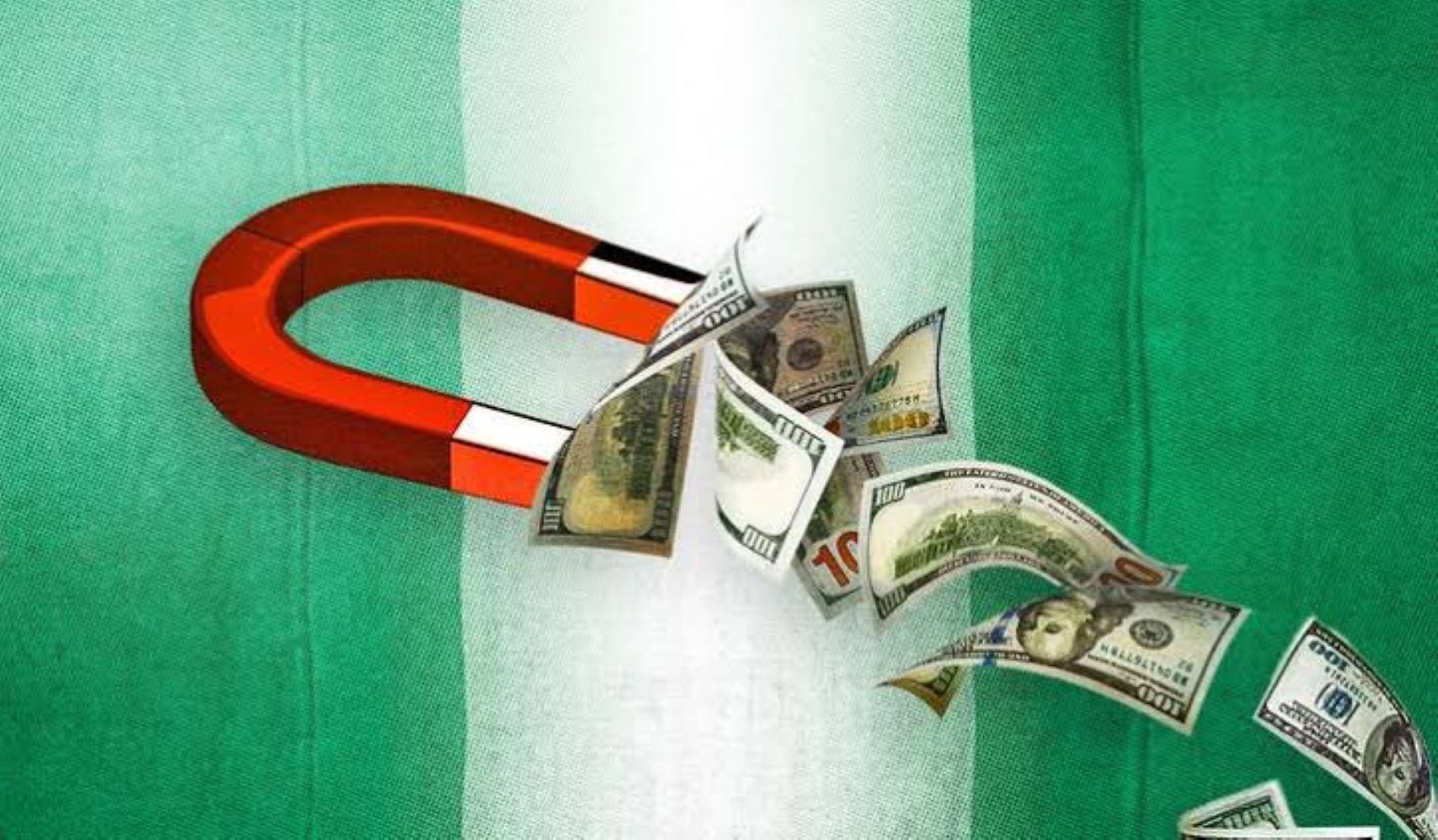
Capital inflows into Nigeria rose significantly in 2025, signaling renewed foreign investor interest in the country’s economy amid ongoing foreign exchange reforms and a more liberalized financial market.
According to the 2025 Capital Importation Report released by the National Bureau of Statistics, total capital importation increased by 88.5 percent year-on-year to $23.21 billion in 2025, up from $12.31 billion recorded in 2024.
Quarterly data showed some fluctuations during the year. Capital inflows stood at $5.64 billion in Q1 2025, declined by 9.2 percent to $5.12 billion in Q2, then rose by 17.4 percent to $6.01 billion in Q3, and increased again by 7.15 percent to $6.44 billion in Q4. The Q4 2025 figure also represented a 26.61 percent increase compared to $5.09 billion recorded in Q4 2024.
Portfolio investment remained the dominant driver of capital importation, accounting for $5.49 billion or 85.14 percent of total inflows in Q4 2025. This was followed by Other Investment, which contributed $599.65 million (9.31 percent), and Foreign Direct Investment (FDI), which accounted for $357.80 million (5.55 percent), indicating that most of the inflows were short-term financial investments rather than long-term business investments.
Sectoral analysis showed that the Banking sector received the largest share of capital inflows at $3.85 billion (59.75 percent), followed by the Financing sector with $1.94 billion (30.15 percent), while the Production/Manufacturing sector received $308.93 million (4.79 percent).
By country of origin, the United Kingdom emerged as the largest source of capital inflows, contributing $3.73 billion (57.94 percent). The United States followed with $837.91 million (13 percent), while South Africa accounted for $516.96 million (8.02 percent), highlighting Nigeria’s continued financial ties with major global economies.
By recipient bank, Stanbic IBTC Bank Plc led with $2.23 billion (34.58 percent), followed by Standard Chartered Bank Nigeria Ltd with $1.85 billion (28.75 percent), and Citibank Nigeria Ltd with $840.72 million (13.05 percent).
The NBS report indicates sustained foreign investor interest in Nigeria’s capital markets, largely driven by foreign exchange market liberalization, improved investor sentiment, and attractive yields in Nigeria’s financial markets.
Economic analysts say the data suggests growing confidence in Nigeria’s ongoing economic reforms, though they also note that the heavy dominance of portfolio investment means Nigeria remains vulnerable to sudden capital flow reversals if global financial conditions change.