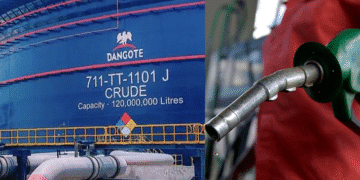










































































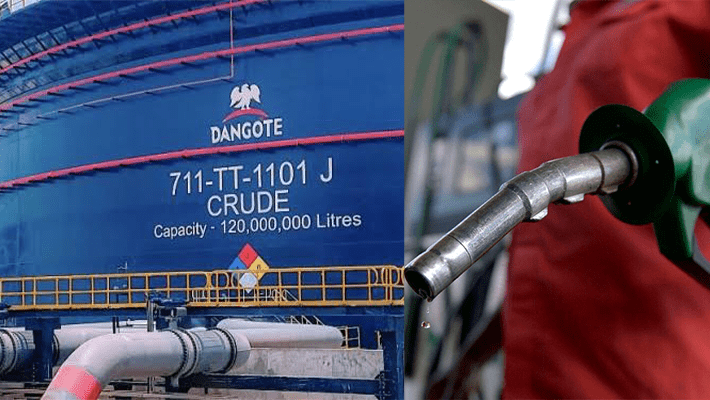
In a dramatic intervention set to fundamentally alter Nigeria’s downstream petroleum sector, the Dangote Petroleum Refinery has formally committed to supplying 1.5 billion litres of Premium Motor Spirit (PMS) or 50 million litres daily, to the Nigerian market for December 2025 and January 2026, starting today, 01 December.
The move, announced in a letter to the Nigerian Midstream and Downstream Petroleum Regulatory Authority (NMDPRA), signifies the refinery’s readiness to take on the majority of the nation’s domestic fuel requirements, potentially neutralizing the perennial fear of fuel scarcity, especially during the crucial festive season.
The commitment of 50 million litres per day is roughly equivalent to Nigeria’s current average daily consumption rate. This volume is set to increase further to 1.7 billion litres per month (approximately 57 million litres daily) from February 2026 onwards, effectively making the refinery capable of meeting nearly 100% of the country’s domestic demand.
Signaling a proactive move toward transparency, the refinery’s Chief Executive Officer, David Bird, formally invited the NMDPRA to “host officials onsite at our refinery starting December 1, to validate and publicly confirm our daily supply volumes.” The refinery has also pledged to publish its production and stock figures across various media channels.
“In line with our commitment to national wellbeing, and consistent with our track record of ensuring a holiday season free of fuel scarcity, the Dangote Petroleum Refinery will supply 1.5 billion litres of PMS to the Nigerian market this month,” said Aliko Dangote, President and Chief Executive of Dangote Industries Limited.
The company also used the communication to request the NMDPRA’s support in ensuring unhindered clearance of crude oil, feedstocks, and blending components, as well as smooth vessel lifting of finished products, citing that delays in these processes impact operations and add unnecessary costs to consumers.
This commitment from the Dangote Refinery is not merely an operational update; it represents a genuine turning point for Nigeria’s macro-economy and the long-term stability of the Naira.
TheLink News notes certain areas for impact consideration such as prior to the refinery’s operation, Nigeria spent over 40% of its total foreign exchange earnings on importing refined petroleum products. By replacing these massive imports with domestic supply, the $20 billion spent annually on fuel imports will largely be preserved, offering immense relief to the country’s beleaguered foreign exchange reserves. This is the single most powerful factor capable of stabilizing and strengthening the Naira in the coming months.
More so, the commitment of 50 million litres daily directly counters recent skepticism from some market players who claimed local supply could not meet demand. The invitation to NMDPRA for immediate, transparent verification is a smart move to preempt sabotage and build market confidence.
The success of this pledge is the ultimate test for the government’s economic patriotism. The refinery explicitly asked the NMDPRA to “allow the ‘Nigeria First’ policy to work.” This implies a demand for bureaucratic cooperation, competitive pricing policies, and the removal of systemic bottlenecks that historically favoured fuel importers over local refiners. The government must now ensure all regulatory and logistical hurdles are cleared to allow this domestic capacity to fully revitalize the economy.
The Dangote Refinery has laid the foundation for Nigeria to become a net exporter of refined products, shifting the country from a consumer state to an industrial powerhouse in the energy sector.