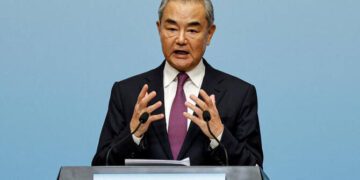






































































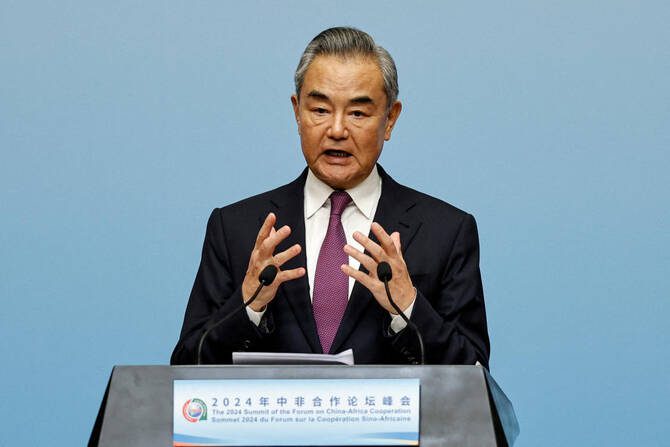
Continuing a 36-year-old diplomatic tradition, China’s Foreign Minister Wang Yi landed in Africa today, Wednesday, 07 January 2026, for a high-stakes New Year tour. This year’s mission is laser-focused on securing “strategic trade access” across the continent’s eastern and southern corridors at a time of heightened global instability and direct competition with Western infrastructure projects.
The six-day tour, running until January 12, includes critical stops in Ethiopia, Somalia, Tanzania, and Lesotho.
Wang Yi’s itinerary highlights Beijing’s intent to safeguard its maritime and land-based supply chains amid shifting geopolitical alliances.
In the most significant stop, Wang Yi became the first Chinese foreign minister to visit Mogadishu, Somalia since the 1980s. The visit follows Israel’s recent recognition of the breakaway Republic of Somaliland in December 2025. By backing Somalia’s territorial integrity, Beijing is securing its influence over the Gulf of Aden, the gateway to the Red Sea and a vital corridor for Chinese exports heading to Europe via the Suez Canal.
Furthermore, Beijing is doubling down on the refurbishment of the Tazara Railway, which links the minerals-rich Copperbelt of Zambia to the Indian Ocean. This move is a direct response to the U.S. and EU-backed Lobito Corridor, which aims to ship those same minerals through Atlantic ports.
In Addis Ababa, Wang Yi is attending the launch of the China-Africa Year of People-to-People Exchanges. With Ethiopia’s economy projected to grow by 7.2% this year, China is transitioning from “building roads” to “building factories,” aiming to process raw materials locally.
The tour’s conclusion in Lesotho is a pointed diplomatic maneuver. Last year, the small kingdom was hit by sweeping U.S. tariffs, some as high as 50%, imposed by the Trump administration.
Wang Yi is expected to contrast this with Beijing’s recent offer of tariff-free access for the world’s poorest nations. By positioning China as a “defender of free trade,” Wang is attempting to pull southern African nations closer to the Chinese economic orbit as a hedge against U.S. trade pressure.
The visit to Somalia also reinforces a core tenet of Chinese domestic policy. By supporting Mogadishu against the independence of Somaliland, Beijing is mirroring its own stance against “Taiwan independence” secessionists (whom the mainland officially named and sanctioned just yesterday, 06 January).