










































































China has showcased a large electric aircraft capable of carrying up to 10 passengers, offering a glimpse into what future flying taxi services could look like as the global race to develop urban air mobility intensifies.
The aircraft, known as the Matrix, was developed by Chinese aviation startup AutoFlight and demonstrated at a flight test facility in Kunshan, a city located about 60 kilometres west of Shanghai.
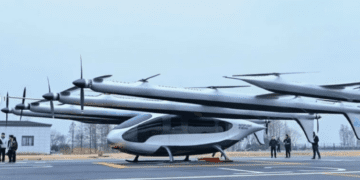
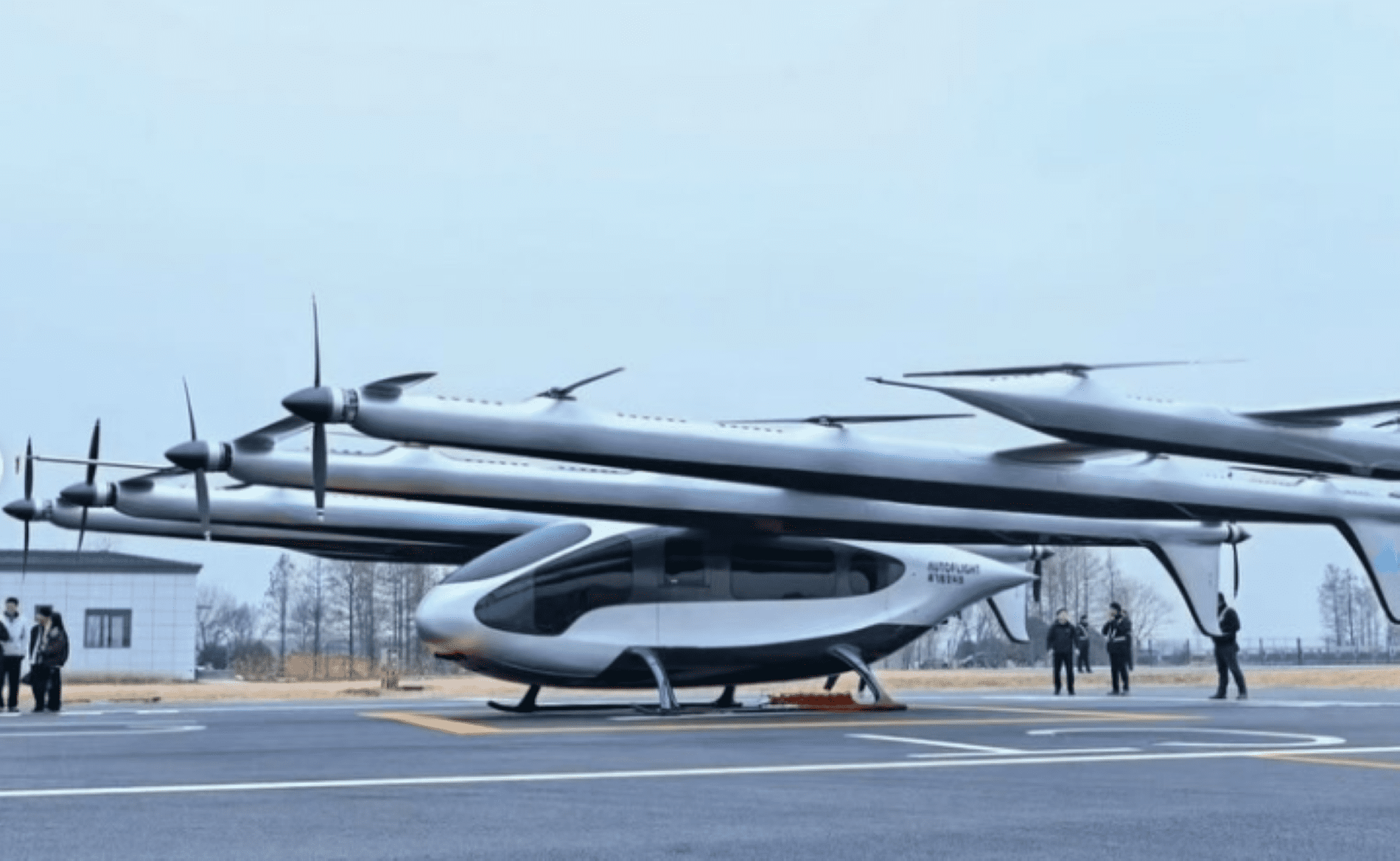
Designed as an electric vertical takeoff and landing (eVTOL) vehicle, the Matrix resembles a massive drone and is currently considered one of the largest electric aircraft prototypes developed in China.
The Matrix weighs around five tonnes and can carry up to 10 passengers, making it significantly larger than many eVTOL prototypes currently under development worldwide.
The aircraft features a 20-metre wingspan, measures 17.1 metres in length, and stands 3.3 metres tall. Powered by multiple electric propellers, it can fly for approximately one hour on a single charge.
During a recent demonstration flight observed by journalists, the aircraft slowly lifted off from a test heliport after a series of safety checks. It flew two laps around the facility before landing smoothly roughly ten minutes later.
Observers noted that while the aircraft was noisy, it produced less sound than a conventional helicopter.
Despite the successful demonstration, company executives acknowledge that fully operational flying taxi services remain some years away.
Steven Yang, senior vice president at AutoFlight, said the company hopes to obtain a type certificate from aviation regulators by 2027, which would confirm that the aircraft meets required safety standards.
However, additional regulatory approvals would still be needed before operators can begin carrying passengers commercially.
“We really believe it will happen,” Yang said. “But it’s not only AutoFlight’s job — the whole ecosystem has to develop.”
China is emerging as a major player in the global eVTOL industry, with multiple companies racing to develop electric aircraft capable of short urban flights.
One of them, EHang based in Guangdong province, has already received certification from Chinese authorities to offer commercial passenger services, although regular operations have yet to begin.
The sector is part of China’s broader push to develop what policymakers call the “low-altitude economy,” which includes drones, autonomous aerial vehicles and other new aviation technologies.
Experts say the technology itself is advancing rapidly, but large-scale deployment will depend on building an entire ecosystem around it.
Gary Ng, a senior economist at Natixis Corporate and Investment Banking, noted that safety certification, air traffic management, infrastructure and logistics all need to mature before flying taxis become common.
“All of this ecosystem surrounding the technology itself is still underdeveloped,” Ng said, adding that it could take at least three more years before the industry reaches a more commercially viable stage.
While passenger air taxis remain experimental, China has already begun integrating drones into everyday services. In cities like Shenzhen, drones are increasingly used for deliveries, including transporting food orders.
Developers hope that larger eVTOL aircraft like the Matrix could eventually transform urban transportation, reducing traffic congestion by shifting short-distance travel into the air.
For now, however, the vision of electric flying taxis shuttling passengers across cities remains on the horizon, a promising technology still waiting for regulation, infrastructure and real-world scale to catch up.