










































































Four astronauts have safely returned to Earth after completing a landmark mission that took humans farther into space than at any time in more than 50 years.
The crew aboard Artemis II splashed down in the Pacific Ocean off the coast of Southern California on Friday, bringing to a close a nearly 10-day journey that marks a major step in humanity’s return to the moon.
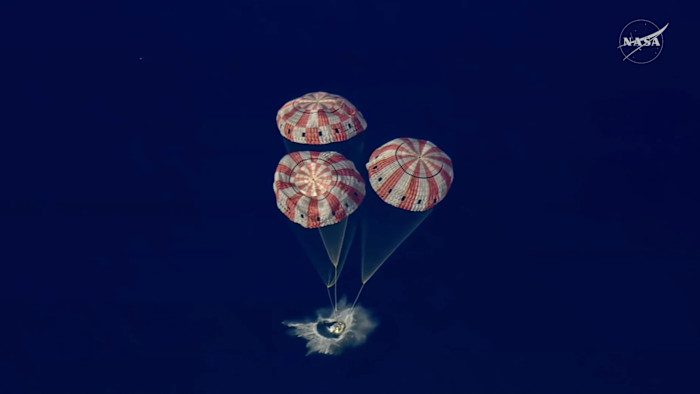
Their spacecraft, the Orion capsule named Integrity, re-entered Earth’s atmosphere at high speed before deploying parachutes and landing gently in calm waters shortly after 5:07 p.m. Pacific Time.
The mission carried astronauts more than 252,000 miles from Earth, making it the farthest distance humans have traveled in space. Over the course of the mission, the crew covered nearly 700,000 miles, completing two Earth orbits and a close flyby of the moon at about 4,000 miles above its surface.
It is the first crewed mission to reach the moon’s vicinity since the Apollo program ended in the 1970s.
NASA confirmed a successful landing, describing it as a “perfect” splashdown.
Mission commander Reid Wiseman reported shortly after landing that all four crew members were safe and in good condition.
The team included U.S. astronauts Victor Glover and Christina Koch, alongside Canadian astronaut Jeremy Hansen.
Recovery teams from NASA and the U.S. Navy secured the capsule and retrieved the astronauts within two hours of splashdown.
ALSO READ: Ex-South Korean leader Yoon sentenced to life imprisonment for insurrection
A critical test for future missions
The return to Earth was considered the most dangerous phase of the mission, as the spacecraft re-entered the atmosphere at about 32 times the speed of sound.
During re-entry, the capsule endured temperatures of roughly 5,000 degrees Fahrenheit, protected by its heat shield. A brief communications blackout also occurred, as expected, due to ionized gases surrounding the spacecraft.
The mission served as a crucial test of the Orion spacecraft, developed by Lockheed Martin, particularly its ability to safely carry astronauts back from deep space.
Path to moon landing
Artemis II is part of NASA’s broader Artemis programme, which aims to return humans to the lunar surface for the first time in decades.
If future missions proceed as planned, astronauts are expected to land on the moon again by 2028.
For now, the successful return of the Artemis II crew marks a major milestone, proving that human spaceflight beyond low-Earth orbit is once again within reach—and setting the stage for the next chapter in lunar exploration.