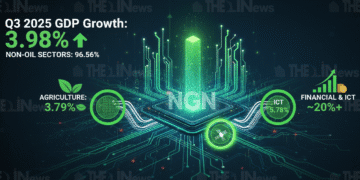







































































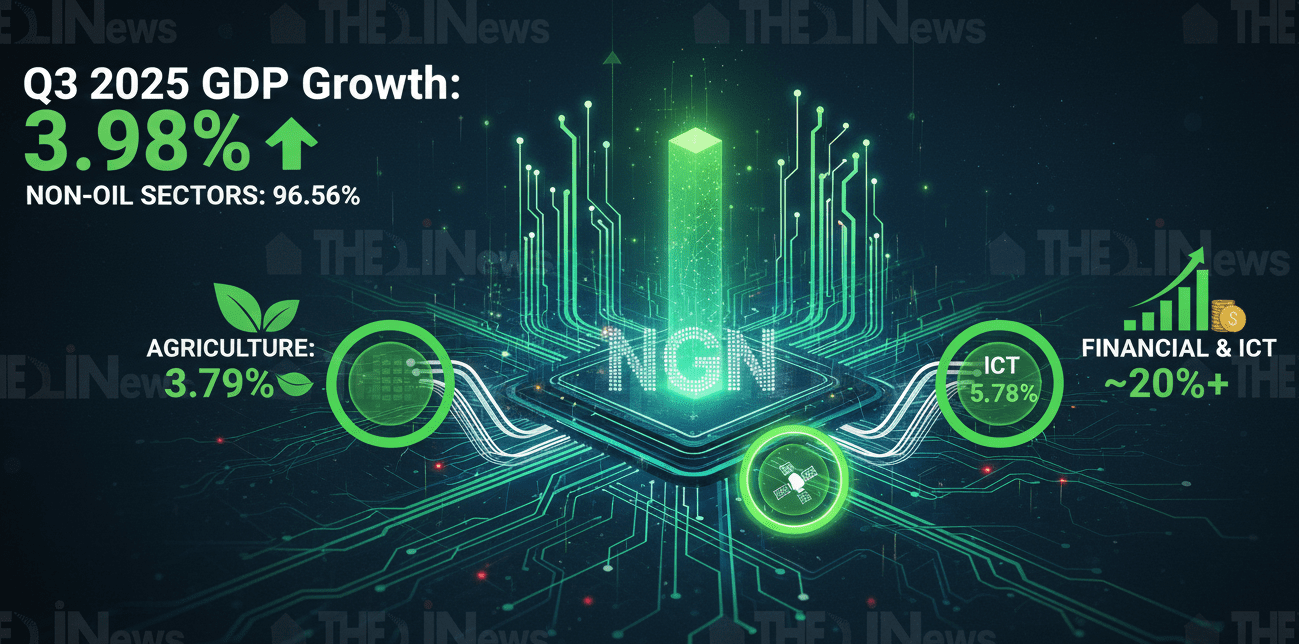
The latest data from the National Bureau of Statistics (NBS) for Q3 2025 has unequivocally confirmed that Nigeria’s economic trajectory is now driven by its non-oil sectors, with Agriculture, Information and Communication Technology (ICT), and Financial Services emerging as the core engines of national growth.
The non-oil sector contributed a commanding 96.56% to the total real GDP, validating the ongoing efforts toward economic diversification away from its historical reliance on crude oil.
The three leading sectors start with the financial and insurance services (The High-Octane Driver), particularly the financial institutions sub-sector, which demonstrated explosive growth, reflecting policy stability and high activity in the banking sector. With Real Growth Rate (YoY) at 19.63% (the fastest-growing sector in the quarter), its key drivers being regulatory activity like the Central Bank of Nigeria’s (CBN) stability and capital adequacy requirements that spurred activity, leading to increased interest income; the FX revaluation gains with banks benefiting significantly from the Naira’s unification and subsequent revaluation effects; and digital transactions that foster continued rapid adoption of digital payment platforms and financial technology drove transaction volumes.
The second sector is Information and Communication Technology (ICT) (The Digital Backbone) which remains a reliable pillar of the economy, consolidating its role as the country’s digital backbone. With Real Growth Rate (YoY) pegged at 5.78%; and GDP contribution indicating a 9.10% (One of the largest contributors after Services and Agriculture) position. Key drivers of growth was principally driven by the telecommunications sub-sector, fueled by sustained investment in broadband infrastructure, 5G network expansion, and the increasing demand for data and digital services across the country.
The third is the agricultural sector particularly in crop production as the foundation of livelihoods. More so, despite the continuous pressure from insecurity, the sector showed remarkable resilience, contributing the largest share of production next to the services sector. Real Growth Rate (YoY) showed 3.79% (a significant rebound from 2.55% in Q3 2024) while GDP contribution is 31.21% with strong growth linked to the government’s diversification efforts, favorable weather patterns during the period, and a sustained focus on increasing crop yield to combat food inflation. The growth here is critical as it directly impacts food prices and the livelihood of the majority of the population.
The Q3 2025 figures offer compelling evidence that the structure of Nigeria’s economy is successfully shifting. The stellar performance of the high-value sectors (Financial Services and ICT) and the foundation sector (Agriculture) provides a more robust and diverse base than one dependent solely on oil revenues.
However, the challenge now is to sustain this growth and ensure it is inclusive. The high growth in financial services must translate into accessible, low-interest funding for the manufacturing and agricultural value chains to boost production and employment.
Furthermore, despite GDP growth, high inflation remains the biggest tax on the poor. The gains of economic activity are currently being eroded by rising costs, particularly food prices. Stabilizing the currency and ensuring food security by tackling insecurity in farming belts are essential for the average Nigerian to feel the benefit of this $3.98\%$ expansion.
The data confirms the economic potential lies outside the oil sector; the political will must now be focused on resolving the security and structural bottlenecks that prevent this non-oil growth from translating into widespread prosperity.